UBUCIKO
UBUHLE NEMPILO
UBUCIKO BEZANDLA
AMASIKO NOMLANDO
EZOKUZIJABULISA
IMVELO
UKUDLA NEZIPHUZO
REVERSE ENGINEERING
IZAYENSI
EZEMIDLALO
UBUCHWEPHESHE
IZINTO EZIGQOKWAYO
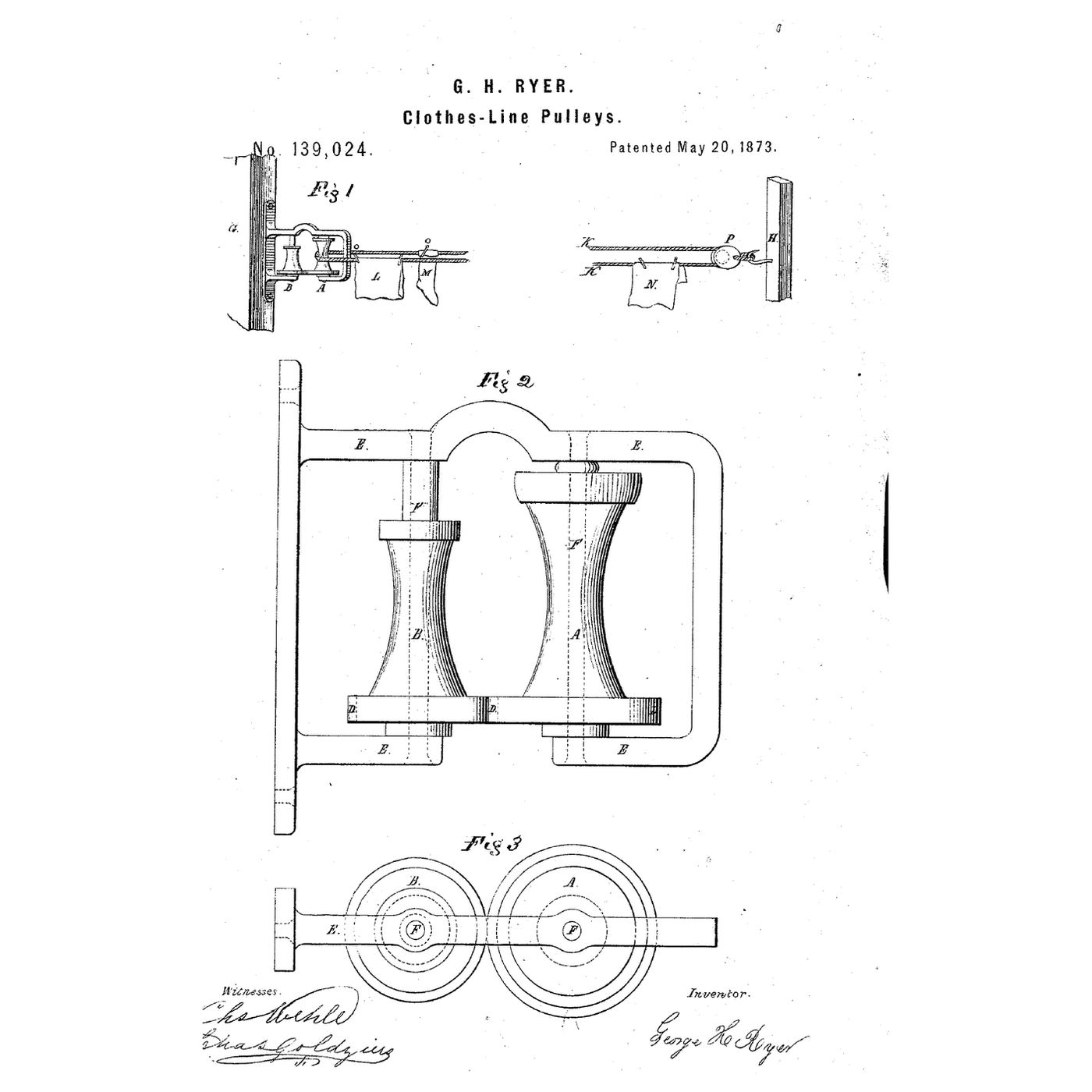


The Two-Pulley Clothesline: Let the Washing Pass the End
A clothesline on two pulleys lets washing be hung from one spot and sent out along the line. As usually rigged, only one of its two runs can carry washing.
George H. Ryer of New York received US 139,024, dated 20 May 1873 (filed 24 October 1872), for clothes-line pulleys arranged so that "two blocks or pulleys are used, allowing the clothes to pass between them, and thus allowing the whole rope or line to be used for hanging clothes on, instead of the present method, whereby only one-half of the line can be used".
This rung computes how hard a loaded line pulls on its ends, then rigs a line, loads it and measures sag and pull.
Oqalayo
About 1 hour
Imiyalelo
1
1
Sag, pull and length
Sag, pull and length
Ilayisha incwadi ye-Jupyter…
2
2
Pulleys, from the beginning
Pulleys, from the beginning
The embedded blueprint builds a block and tackle; here pulleys only turn the line, and the tension is set by the load and the sag.
3
3
Read US 139,024
Read US 139,024
"The invention consists in an arrangement whereby on one end of the line two blocks or pulleys are used, allowing the clothes to pass between them, and thus allowing the whole rope or line to be used for hanging clothes on, instead of the present method, whereby only one-half of the line can be used for that purpose."
"A is the large pulley over which the clothes-line or rope passes. B is the small pulley, revolving in an opposite direction from the large pulley; the lower circle of the two pulleys touch, and are covered by two India-rubber bands or rings, D D, which permit the clothes to pass through without injury to them."
"The reason for two pulleys is to prevent the clothes-line from coming off."
4
4
Hanging a loop line, as a program
Hanging a loop line, as a program
Indawo Yokusebenza Ye-Blockly
Loading Blockly workspace...
5
5
Load a line and measure it
Load a line and measure it
Tie a clothesline between two firm points about 3 m apart, with a force meter in the line at one end. Peg equal weights (filled water bottles work) at equal spacing along it.
Measure the sag at the middle with the ruler and read the pull on the force meter. Tighten the line to halve the sag and read again. Put your span, weight per metre and sag into the notebook's formula and compare with the force meter.
Izinto zokwakha zalesi sinyathelo:
 Intambo yokwaneka1 ucezu
Amathuluzi adingekayo:
 Isondo lentambo yokwaneka
 Ipuli
Ipuli Isilinganiso Samandla (Isikali Sensimbi Esontekile)
 Isisindo
 Irula
Irula Isethi yezingcingo zezingubo - ukhuni
6
6
A line that sags, slips or snags
A line that sags, slips or snags
Clothesline troubleshooting.
Flow
Loading...
7
7
History and honest limits
History and honest limits
**George H. Ryer** of New York filed US 139,024 on 24 October 1872; it is dated 20 May 1873.
**Honest limits.** The tension formula assumes an evenly loaded line with a small sag; bunched washing pulls harder. The span, load and sags are examples. Your force-meter readings are the measurement.
Izinto
1- 1 ucezuIsibambeli
Ama-blueprint ahlobene
Lama-blueprint abelana ngolwazi — amasu, izinto noma izimiso

CC0 Isizinda Somphakathi
Le blueprint ikhishwe ngaphansi kwe-CC0. Ukhululekile ukukopisha, ukuguqula, ukusabalalisa, nokusebenzisa ngaphandle kwemvume.
Sekela uMenzi ngokuthenga imikhiqizo nge-Blueprint yabo IKhomishane Yomenzi kumiswe ngabathengisi, noma dala inguqulo entsha yale Blueprint bese uyifaka njengoxhumaniso ku-Blueprint yakho ukuze wabelane ngemali engenayo.