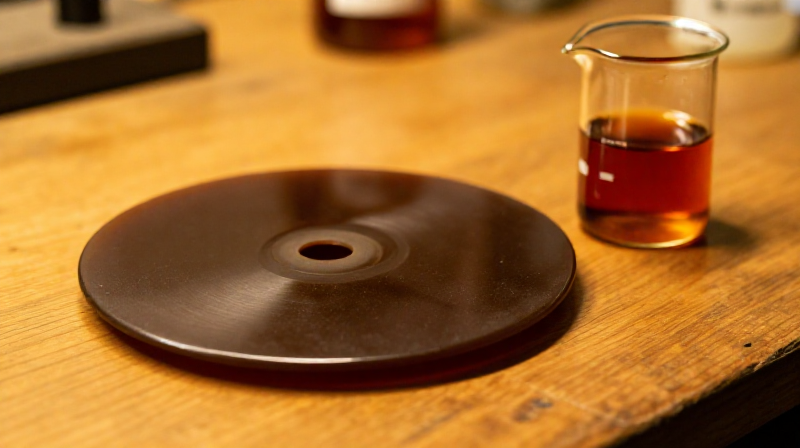


Making Bakelite — The First Fully Synthetic Plastic That Launched the Age of Polymers
Celluloid, the first plastic (1869), was made from modified natural cellulose — a semi-synthetic material. The next leap came in 1907, when Leo Baekeland, a Belgian-born chemist working in Yonkers, New York, created the first entirely synthetic plastic: a material whose polymer chains were built from scratch from simple chemical feedstocks, with no natural polymer as a starting point.
Baekeland reacted phenol (C₆H₅OH) with formaldehyde (HCHO) under heat and pressure in a steam-heated autoclave he called the 'Bakelizer'. The reaction is a condensation polymerisation: each phenol molecule has three reactive positions on its aromatic ring (ortho and para to the hydroxyl group) where formaldehyde can form methylene bridges (-CH₂-) linking adjacent phenol rings together. Unlike celluloid, which is a thermoplastic (can be remelted), the phenol-formaldehyde network is a thermoset — once the cross-linking is complete, the material cannot be melted, dissolved, or reshaped. It is permanently, irreversibly hard.
Bakelite's properties were extraordinary: electrically insulating, heat-resistant, chemically stable, dimensionally stable, and mouldable into complex shapes before curing. It became the material of the electrical age — every telephone, radio, distributor cap, plug, and switch from 1910 to 1950 was made of Bakelite or a phenolic resin. It was also the first material to prove that chemists could design new materials with properties unavailable in nature.
This lab-scale demonstration follows Baekeland's core chemistry: reacting phenol with formaldehyde using an acid catalyst to produce a phenol-formaldehyde resin (novolac), then curing it with heat and a hardener (hexamethylenetetramine) to produce the cross-linked thermoset.
SAFETY WARNING: Phenol is a severe skin poison — it causes painless white burns that can be fatal if a large area is exposed. Formaldehyde is a known carcinogen, toxic by inhalation, and a severe eye irritant. This experiment MUST be performed in a fume hood with full protective equipment. Never handle phenol with bare hands — it penetrates nitrile gloves over time, so double-glove and change gloves every 15 minutes.
Instructions
Prepare maximum protective equipment
Prepare maximum protective equipment
This synthesis uses two acutely toxic chemicals and MUST be performed in a functioning fume hood. Wear a full-face respirator with organic vapour cartridges, chemical splash goggles, a lab coat, and double-layer nitrile gloves (change the outer pair every 15 minutes when handling phenol). Phenol penetrates skin rapidly and painlessly — it destroys tissue beneath the surface before pain is felt. If phenol contacts skin, flush immediately with water for 15 minutes, then apply polyethylene glycol (PEG 400) if available. Formaldehyde is a suspected carcinogen — never inhale the vapour.
Tools needed:
 P100/FFP3 Respirator with Acid Gas Cartridge
 Chemical Splash Goggles
 Nitrile Rubber Gloves (Thick)
 Lab Coat
Weigh and dissolve the phenol
Weigh and dissolve the phenol
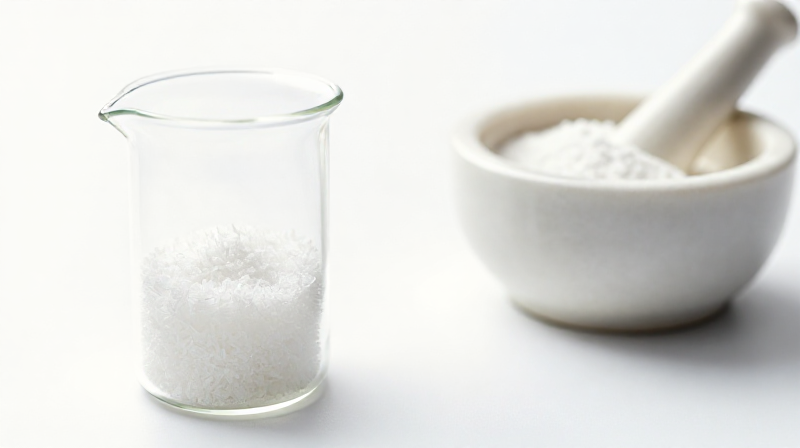
Weigh 10 g of phenol (C₆H₅OH) — a white crystalline solid with a sharp, medicinal odour (the smell of old-fashioned disinfectant). Phenol melts at 41 °C, so it may be partly liquid in warm weather. Place in a 250 ml borosilicate beaker. Phenol was first isolated from coal tar by Friedlieb Runge in 1834 and was used as 'carbolic acid' antiseptic by Joseph Lister in the 1860s. It is the simplest aromatic alcohol — the hydroxyl group activates the benzene ring, making the ortho and para positions reactive toward electrophilic substitution by formaldehyde.
Materials for this step:
 Phenol (Crystalline)10 g
Tools needed:
 Digital Precision Scale
 Glass Beaker (Borosilicate, 500ml)
Add formaldehyde solution
Add formaldehyde solution
Measure 15 ml of formalin — a 37% aqueous solution of formaldehyde (HCHO, methanal). Add to the phenol in the beaker. Formaldehyde is the simplest aldehyde — a single carbon with a double-bonded oxygen and a hydrogen. It is intensely reactive because the carbonyl is unhindered. In the Bakelite reaction, each formaldehyde molecule bridges two phenol rings by forming a methylene (-CH₂-) link. The molar ratio is approximately 1:1.5 (phenol:formaldehyde), providing a slight excess of formaldehyde to ensure complete cross-linking.
Materials for this step:
 Formaldehyde Solution (37% Formalin)15 ml
Tools needed:
 Graduated Cylinder (10ml)
Add acid catalyst and heat gently
Add acid catalyst and heat gently
Add 1 ml of concentrated hydrochloric acid (HCl) as an acid catalyst. Stir the mixture with a glass rod. Place the beaker in a water bath heated to 70–80 °C. The acid catalyses the reaction by protonating the formaldehyde, making it a stronger electrophile. The hydroxymethylation reaction begins: formaldehyde attacks the activated ortho and para positions of the phenol ring, forming hydroxymethyl (-CH₂OH) intermediates. Under acidic conditions, these intermediates condense with other phenol molecules, releasing water and forming methylene bridges.
Materials for this step:
Tools needed:
 Glass Stirring Rod (25cm)
 Thermometer (Lab)
React for 60 minutes to form the novolac resin
React for 60 minutes to form the novolac resin
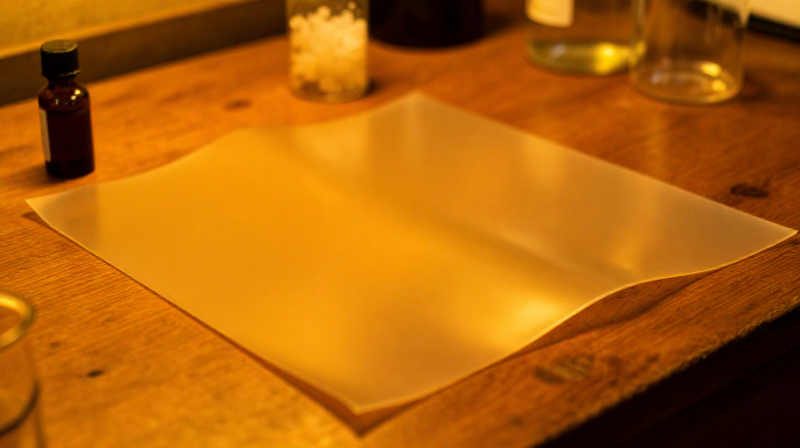
Maintain the water bath at 70–80 °C and stir occasionally for 60 minutes. The mixture gradually thickens and turns from clear to amber to dark brown as the phenol-formaldehyde oligomers grow longer. Eventually, two layers separate: an upper aqueous layer and a lower viscous, amber resin layer — this is the novolac (from Latin 'nova lacca', new lacquer). Novolac is a thermoplastic prepolymer — the chains are linear or branched but not yet cross-linked. At this stage, the resin can still be dissolved in alcohol or acetone and melted by gentle heating.
Separate and wash the novolac resin
Separate and wash the novolac resin
Carefully pour off the upper aqueous layer (containing water, excess formaldehyde, and HCl). Add 50 ml of warm water to the resin and stir to wash out residual acid and formaldehyde. Pour off the wash water. Repeat twice more. The washed novolac is a sticky, amber, translucent mass with a characteristic phenolic smell. In Baekeland's original process, this resin was produced in bulk and sold to moulding companies who added the curing agent and shaped the final product.
Materials for this step:
 Distilled Water (1 Liter)150 ml
Add hexamethylenetetramine as cross-linking agent
Add hexamethylenetetramine as cross-linking agent
Weigh 1.5 g of hexamethylenetetramine (hexamine, (CH₂)₆N₄) and mix thoroughly into the warm novolac resin. Hexamine decomposes when heated, releasing formaldehyde directly into the resin — this provides the additional formaldehyde needed to form the final cross-links without the water that liquid formalin would introduce. The released formaldehyde bridges the remaining unreacted positions on the phenol rings, converting the linear novolac into a fully cross-linked, three-dimensional network. This is the step that transforms a mouldable thermoplastic into an irreversible thermoset.
Materials for this step:
 Hexamethylenetetramine (Hexamine)1.5 g
Mould the resin mixture
Mould the resin mixture
Press the resin-hexamine mixture into a small metal or silicone mould — a muffin tin, a small baking mould, or a purpose-made compression mould. Press firmly to eliminate air pockets. The mixture is still workable at this stage — warm it gently if it has become too stiff to mould. This is the last moment the material can be shaped — once curing begins, the shape is permanent. Baekeland's genius was recognising that this mouldability before curing, combined with the hardness after curing, made phenol-formaldehyde ideal for mass production of complex shapes.
Tools needed:
 Evaporating Dish (Porcelain)
Cure in an oven at 150–170 °C
Cure in an oven at 150–170 °C
Place the mould in an electric oven preheated to 150–170 °C. Cure for 2–3 hours. During curing, the hexamine decomposes and the final cross-linking reactions proceed: every phenol ring becomes linked to two or three neighbours through methylene bridges, building an infinite three-dimensional network. The material darkens to deep brown or black, hardens progressively, and shrinks slightly. A faint formaldehyde odour is released — ensure adequate ventilation. The curing temperature and time determine the final hardness: higher temperature and longer time produce a harder, more completely cross-linked product.
Demould and examine the finished Bakelite
Demould and examine the finished Bakelite
Allow the oven to cool, then remove the moulded piece. The finished Bakelite is a hard, dark brown or black material with a smooth, glossy surface where it contacted the mould. It is dense and heavy in the hand. Tap it — it produces a sharp, resonant click (the characteristic 'Bakelite sound'). It cannot be scratched with a fingernail. It does not soften when heated — hold it near a hot surface and it remains rigid. It does not dissolve in any common solvent. This is a thermoset: the cross-links are permanent, and the material's shape is fixed forever.
Test the properties of Bakelite
Test the properties of Bakelite
Test electrical insulation: touch a multimeter across the sample — resistance is effectively infinite. This property made Bakelite the standard material for electrical components for half a century. Test heat resistance: place the sample on a hot plate at 200 °C — it remains rigid with no softening, distortion, or melting. Test chemical resistance: place a chip in concentrated hydrochloric acid — no visible reaction. Compare with celluloid (which is thermoplastic and dissolves in acetone) to demonstrate the fundamental difference between thermoplastic and thermoset polymers.
Store the finished Bakelite sample
Store the finished Bakelite sample
Label the sample: BAKELITE (PHENOL-FORMALDEHYDE THERMOSET). Unlike celluloid, Bakelite is chemically stable and can be stored indefinitely — museum Bakelite from the 1910s remains in perfect condition. Leo Baekeland's 1907 patent (US Patent 942,699) for 'Bakelite' was the first fully synthetic plastic — a material created entirely from simple chemicals with no natural polymer precursor. It proved that chemists could engineer materials with properties impossible in nature: hard as stone, light as wood, an insulator like glass, mouldable like clay, and permanent as metal. Every modern thermoset — epoxies, polyurethanes, silicones — descends from Baekeland's phenol-formaldehyde chemistry.
Tools needed:
 Glass Storage Jar with Lid
Materials
5- Placeholder
- Placeholder
- Placeholder
- Placeholder
Tools Required
11- Placeholder
- Placeholder
- Placeholder
- Placeholder
- Placeholder
- Placeholder
- Placeholder
- Placeholder
- Placeholder
- Placeholder
Connected Blueprint Materials
Related Blueprints
These blueprints share knowledge with this one — techniques, materials, or principles that connect them in the learning graph.
Related blueprints
Other builds that share materials, tools, or techniques with this one.
CC0 Public Domain
This blueprint is released under CC0. You are free to copy, modify, distribute, and use this work for any purpose, without asking permission.
Support the Maker by purchasing products through their Blueprint where they earn a Maker Commission set by Vendors, or create a new iteration of this Blueprint and include it as a connection in your own Blueprint to share revenue.