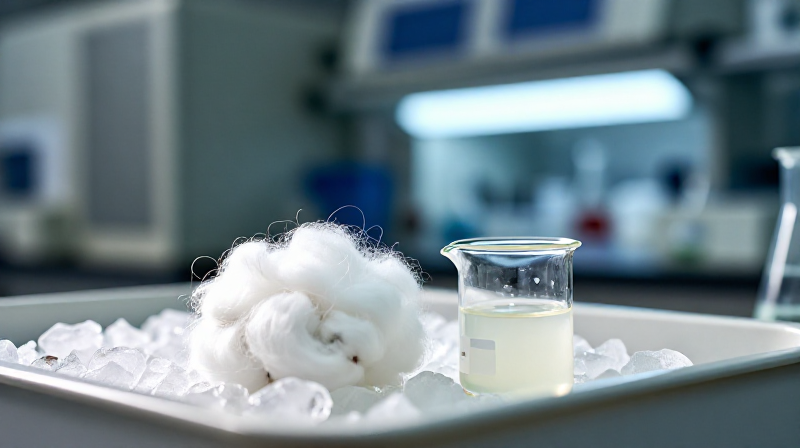


Making Nitrocellulose (Guncotton) — The Nitration That Launched Smokeless Powder and Plastics
In 1846, Christian Friedrich Schönbein, a professor in Basel, accidentally spilled a mixture of nitric and sulfuric acids on his kitchen table. He mopped it up with his wife's cotton apron, hung it by the stove to dry — and it burst into flames and vanished. Schönbein immediately grasped the significance: the acids had transformed cellulose into a new substance, nitrocellulose (cellulose trinitrate, [C₆H₇O₂(ONO₂)₃]ₙ), which burned with extraordinary speed and left no smoke or residue.
The chemistry is an esterification: the three hydroxyl groups (-OH) on each glucose unit of the cellulose chain are replaced by nitrate ester groups (-ONO₂) using a mixture of concentrated nitric acid (the nitrating agent) and concentrated sulfuric acid (the dehydrating agent that drives the reaction to completion). The mixed acid must be ice-cold — heat causes decomposition and can trigger violent combustion of the product while still in the acid.
Nitrocellulose had two enormous consequences. First, it became the basis of smokeless gunpowder — vastly superior to black powder because it produces no obscuring smoke and three times the gas volume per gram. Cordite, ballistite, and all modern propellants are based on Schönbein's discovery. Second, when plasticised with camphor, nitrocellulose becomes celluloid — the first commercial plastic (1869) and the material that made cinema possible.
SAFETY WARNING: Nitrocellulose is a HIGH EXPLOSIVE when dry. It is shock-sensitive, friction-sensitive, and can detonate. The nitration itself is dangerous — the mixed acid is violently corrosive, and the reaction can run away if temperature control is lost. This experiment must ONLY be performed under strict laboratory conditions with full safety equipment, ice-bath temperature control, and proper training. Store the product WET — dry nitrocellulose is a serious detonation hazard.
Instructions
Prepare maximum protective equipment and ice bath
Prepare maximum protective equipment and ice bath
This is one of the most hazardous reactions in this series. Work ONLY in a functioning fume hood. Wear a full-face respirator with acid gas cartridges, chemical splash goggles, heavy-duty acid-resistant nitrile gloves (double-glove), and a full lab coat. Prepare a large ice bath in a plastic tub — you will need enough ice to keep the reaction below 10 °C for 30 minutes. Have a large bucket of cold water ready for emergencies. The mixed acid fumes are acutely corrosive to lungs and eyes.
Tools needed:
 P100/FFP3 Respirator with Acid Gas Cartridge
 Chemical Splash Goggles
 Nitrile Rubber Gloves (Thick)
 Lab Coat
 Thermometer (Lab)
Prepare the nitrating acid mixture
Prepare the nitrating acid mixture
Place a 250 ml glass beaker in the ice bath. Pour 30 ml of concentrated sulfuric acid (96% H₂SO₄) into the beaker first. Then SLOWLY add 15 ml of concentrated nitric acid (68% HNO₃) to the sulfuric acid, stirring constantly with a glass rod. NEVER reverse the order — adding sulfuric acid to nitric acid causes violent spattering. The mixture heats significantly as the acids combine — the ice bath keeps the temperature below 10 °C. The sulfuric acid serves as a dehydrating agent, absorbing the water produced during nitration and driving the reaction to completion.
Materials for this step:
 Nitric Acid (68% concentrated)15 ml
Tools needed:
 Glass Beaker (Borosilicate, 500ml)
 Glass Stirring Rod (25cm)
Prepare the cotton
Prepare the cotton
Weigh 5 g of pure cotton — absorbent cotton wool or clean cotton fabric cut into small pieces (2 cm squares). The cotton must be pure cellulose — avoid cotton blends, dyed fabric, or synthetic fibres. Cellulose is a polymer of glucose units, each bearing three hydroxyl groups (-OH) that will be replaced by nitrate groups. Cotton is nearly pure cellulose (~95%), making it ideal. Loose cotton wool nitrates more completely than dense fabric because the acid penetrates more thoroughly.
Materials for this step:
 Cotton5 g
Tools needed:
 Digital Precision Scale
Immerse cotton in the cold mixed acid
Immerse cotton in the cold mixed acid
Ensure the mixed acid is below 10 °C (check with thermometer). Using glass tongs or a glass rod, push the cotton gently into the acid mixture, submerging it completely. The cotton absorbs the acid and immediately begins reacting — the hydroxyl groups on the cellulose are replaced by nitrate ester groups: [C₆H₇O₂(OH)₃]ₙ + 3n HNO₃ → [C₆H₇O₂(ONO₂)₃]ₙ + 3n H₂O. The sulfuric acid scavenges the water produced, preventing it from diluting the nitric acid. Keep the beaker in the ice bath throughout — if the temperature rises above 30 °C, the reaction can run away violently.
Stir gently for 30 minutes in the ice bath
Stir gently for 30 minutes in the ice bath
Stir the cotton in the acid gently every few minutes with the glass rod, ensuring all fibres remain submerged. The nitration proceeds over 20–30 minutes. The cotton appears largely unchanged visually — it does not dissolve or disintegrate, because the cellulose backbone is not broken. Only the pendant hydroxyl groups are modified. Monitor the temperature constantly — it must stay below 10 °C. If the temperature rises unexpectedly or brown fumes (NO₂) appear, add ice directly to the bath and be prepared to dump the entire beaker into the emergency water bucket.
Remove cotton and wash with cold water
Remove cotton and wash with cold water
Using the glass rod, lift the cotton from the acid and transfer immediately to a large beaker of cold water (at least 500 ml). Stir vigorously to dilute and wash away the acid. The water turns milky as the acid disperses. Pour off the acid water carefully and replace with fresh cold water. Repeat this wash at least five times — thorough washing is absolutely critical. Any residual acid trapped in the fibres will cause slow decomposition, heating, and potentially spontaneous combustion. Early guncotton factories suffered catastrophic explosions from insufficiently washed product.
Materials for this step:
 Distilled Water (1 Liter)1000 ml
Neutralise with sodium bicarbonate solution
Neutralise with sodium bicarbonate solution
Dissolve 10 g of sodium bicarbonate in 300 ml of water. Immerse the washed cotton in this solution and soak for 15 minutes with occasional stirring. The bicarbonate neutralises any last traces of acid trapped deep in the cotton fibres: NaHCO₃ + HNO₃ → NaNO₃ + H₂O + CO₂. You may see small bubbles of CO₂ — this confirms acid was still present. This neutralisation step was the crucial innovation that made guncotton production safe enough for industrial manufacture — Frederick Abel established it at the Royal Arsenal in the 1860s.
Materials for this step:
 Sodium Bicarbonate (Lab Grade)10 g
Final rinse with distilled water
Final rinse with distilled water
Rinse the cotton thoroughly with 500 ml of distilled water to remove the sodium bicarbonate and dissolved salts. Squeeze gently and rinse again. The cotton should feel neither slippery (acid) nor soapy (alkali) — it should feel like clean, wet cotton. Test a drop of the rinse water with pH indicator paper — it should be neutral (pH 6–7). If still acidic, repeat the bicarbonate soak and rinse.
Materials for this step:
Distilled Water (1 Liter)500 mlTools needed:
 pH Indicator Paper (Universal, 200 Strips)
Dry a small test sample carefully
Dry a small test sample carefully
Separate a small tuft (about 0.5 g) of the wet nitrocellulose and spread it thinly on a clean glass plate in a well-ventilated area, away from heat sources. Allow to air-dry at room temperature for 2–3 hours. Nitrocellulose dries to a material that looks and feels almost identical to ordinary cotton — slightly stiffer perhaps, but otherwise indistinguishable by appearance. The chemical transformation is invisible: every hydroxyl group has been replaced by a nitrate ester, but the cellulose polymer backbone is intact.
Test the dried nitrocellulose
Test the dried nitrocellulose
Place the small dried tuft on a heatproof surface outdoors, well away from any other materials. Touch it with a lit wooden splint from a safe distance. Properly nitrated guncotton ignites instantly and burns with a brilliant flash — producing a large volume of gas (CO₂, H₂O, N₂) but virtually no smoke and no solid residue. This smokeless, residue-free combustion is what made guncotton revolutionary: black powder produces dense white smoke and leaves 55% of its weight as solid residue, while guncotton converts almost entirely to gas. This single property made modern firearms, artillery, and rocketry possible.
Store the remaining nitrocellulose wet
Store the remaining nitrocellulose wet
Transfer the remaining wet nitrocellulose to a glass jar and cover with distilled water. Label clearly: NITROCELLULOSE (GUNCOTTON) — EXPLOSIVE WHEN DRY — STORE WET. Seal tightly. Wet nitrocellulose is stable and safe to handle — the water prevents ignition. NEVER store dry nitrocellulose — it is shock-sensitive and can detonate from friction, impact, or electrostatic discharge. Schönbein's 1846 discovery spawned two world-changing industries: smokeless explosives (which transformed warfare) and cellulose plastics (celluloid, the first synthetic plastic, which transformed entertainment, photography, and manufacturing).
Tools needed:
 Glass Storage Jar with Lid
Materials
5- Placeholder
- 1500 mlPlaceholder
- Placeholder
Tools Required
10- Placeholder
- Placeholder
- Placeholder
- Placeholder
- Placeholder
- Placeholder
- Placeholder
- Placeholder
Connected Blueprint Materials
Related Blueprints
These blueprints share knowledge with this one — techniques, materials, or principles that connect them in the learning graph.
Related blueprints
Other builds that share materials, tools, or techniques with this one.
CC0 Public Domain
This blueprint is released under CC0. You are free to copy, modify, distribute, and use this work for any purpose, without asking permission.
Support the Maker by purchasing products through their Blueprint where they earn a Maker Commission set by Vendors, or create a new iteration of this Blueprint and include it as a connection in your own Blueprint to share revenue.