

Making DPP Red (Pyrrole Red) — The Accidental Ferrari Pigment That Ended the Synthetic Colour Revolution
DPP Red (Pigment Red 254, CI 56110) — also known as Pyrrole Red or Diketo-Pyrrolo-Pyrrole Red — is the youngest major pigment in the painter's palette and one of the most remarkable accidental discoveries in colour chemistry. In 1974, chemist Abul Iqbal at Ciba-Geigy in Basel was attempting to synthesise a lactam intermediate for pharmaceutical research. Instead, the reaction produced a brilliant, insoluble red solid that proved to be an entirely new class of chromophore: the diketopyrrolopyrrole (DPP) system.
The molecule — 3,6-diphenyl-2,5-dihydropyrrolo[3,4-c]pyrrole-1,4-dione (C₁₈H₁₂N₂O₂) — consists of a central bicyclic diketopyrrole core flanked by two phenyl rings. The extensive conjugation across this planar system absorbs green light strongly, producing an intense, brilliant red with a slight orange undertone. The pigment was not commercialised until 1986, after over a decade of development to optimise its crystal form and processing.
The synthesis is deceptively simple — a one-pot condensation of diethyl succinate with benzonitrile using a strong alkoxide base. Two molecules of benzonitrile and one of diethyl succinate combine to form the DPP core in a single step. The elegance of this reaction — three cheap, simple starting materials producing a world-class pigment — makes it one of the most remarkable transformations in synthetic chemistry.
PR254 is the pigment of choice for Ferrari red automotive paint, and it dominates the modern artist's palette as the most permanent, brilliant warm red available. It has essentially perfect lightfastness (ASTM I), extraordinary heat stability (above 350 °C), and complete resistance to acids, alkalis, and solvents.
SAFETY WARNING: Sodium metal reacts violently with water and is flammable. Benzonitrile is toxic by inhalation and skin absorption. tert-Amyl alcohol vapours are narcotic. Work under ventilation with full PPE. Have dry sand (not water) available for sodium fires.
Instructions
Prepare fume hood and full protective equipment
Prepare fume hood and full protective equipment
Set up in a functioning fume hood. Wear a full-face respirator with organic vapour cartridges, chemical splash goggles, heavy-duty nitrile gloves, and a full lab coat. This synthesis uses sodium metal — ensure all glassware and solvents are completely dry before starting. Sodium reacts violently with water, producing flammable hydrogen gas. Have a bucket of dry sand (never water) available to extinguish sodium fires. Benzonitrile is toxic and absorbed through skin — double-glove when handling.
Tools needed:
 P100/FFP3 Respirator with Acid Gas Cartridge
 Chemical Splash Goggles
 Nitrile Rubber Gloves (Thick)
 Lab Coat
Generate sodium tert-amyloxide in situ
Generate sodium tert-amyloxide in situ
Add 60 ml of dry tert-amyl alcohol (2-methyl-2-butanol) to a round-bottom flask fitted with a reflux condenser and nitrogen inlet. Cut 3 g of sodium metal into small pieces under mineral oil, rinse briefly with dry hexane to remove the oil, and add to the tert-amyl alcohol piece by piece. The sodium dissolves slowly with gentle hydrogen gas evolution — this is much slower than with ethanol because tertiary alcohols are less acidic. Warm gently to 60 °C to accelerate dissolution. When all the sodium has reacted (30–60 minutes), the solution contains sodium tert-amyloxide — the strong base needed for the DPP condensation.
Materials for this step:
 tert-Amyl Alcohol (2-Methyl-2-Butanol)60 ml
 Sodium Metal3 g
Tools needed:
 Thermometer (Lab)
 Glass Stirring Rod (25cm)
Add benzonitrile
Add benzonitrile
Add 7 ml of benzonitrile (cyanobenzene, C₆H₅CN) to the sodium tert-amyloxide solution at 60 °C with stirring. Benzonitrile is a colourless oily liquid with a faint almond-like odour — it is the aromatic nitrile that will provide the two phenyl rings of the DPP pigment. The nitrile carbon (C≡N) is the electrophilic site that will be attacked by the enolate of diethyl succinate in the next step.
Materials for this step:
 Benzonitrile7 ml
Add diethyl succinate dropwise
Add diethyl succinate dropwise
Add 5 ml of diethyl succinate dropwise over 15 minutes to the benzonitrile-alkoxide mixture at 60 °C with vigorous stirring. The strong base deprotonates the alpha-carbon of diethyl succinate, generating a nucleophilic enolate that attacks the electrophilic nitrile carbon of benzonitrile. This is the critical bond-forming step — each enolate carbon attacks one benzonitrile, and the resulting intermediate cyclises to form a pyrrole ring. Two such ring closures, one at each end of the succinate chain, build the complete DPP bicyclic core in a single pot.
Materials for this step:
 Diethyl Succinate5 ml
Heat to reflux for six hours
Heat to reflux for six hours
Raise the temperature to reflux (102 °C for tert-amyl alcohol) and maintain for 6 hours with stirring. The solution darkens rapidly — from yellow to orange to deep red as the DPP chromophore forms. Within the first hour, a brilliant red precipitate begins to appear. The DPP product is essentially insoluble in the reaction solvent, which drives the equilibrium forward. By the end of 6 hours, the flask contains a thick, intensely red suspension. The condensation releases ethanol (from the ester groups) which distils off.
Tools needed:
Thermometer (Lab)Cool and add methanol
Cool and add methanol
Allow the reaction mixture to cool to 60 °C. Add 100 ml of methanol to thin the slurry and dissolve the excess tert-amyl alcohol and sodium salts. Stir vigorously to break up any large lumps of the red solid. The crude DPP remains as a brilliant red, finely divided precipitate — its extraordinary insolubility in all common solvents is one of its defining characteristics as a pigment.
Materials for this step:
 Methanol (Lab Grade, 500ml)100 ml
Filter crude DPP red
Filter crude DPP red
Filter the red suspension through filter paper. The brilliant red pigment collects as a vivid, orange-red mass on the filter. The filtrate is a dark brown solution containing sodium salts, unreacted starting materials, and side products. Wash the filter cake with 200 ml of methanol to remove residual organic impurities. Even at this crude stage, the colour is strikingly vivid — the DPP chromophore is one of the most intensely coloured organic molecules known.
Materials for this step:
Methanol (Lab Grade, 500ml)200 mlTools needed:
 Filter Paper (fine pore)
 Glass Funnel (Stemmed)
Acid wash to remove sodium salts
Acid wash to remove sodium salts
Return the filter cake to a beaker and boil in 300 ml of dilute hydrochloric acid (10%) for 30 minutes with stirring. This dissolves sodium tert-amyloxide residues, sodium carbonate, and any basic impurities trapped in the pigment. DPP red is completely insoluble in dilute acids — it survives boiling in concentrated sulfuric acid. Filter hot and discard the acidic filtrate.
Materials for this step:
 Dilute Hydrochloric Acid (10% HCl)300 ml
Alkali wash to remove organic impurities
Alkali wash to remove organic impurities
Boil the filter cake in 200 ml of dilute sodium hydroxide (5%) for 30 minutes. This dissolves hydrolysed succinic acid, benzoic acid (from hydrolysed benzonitrile), and other acidic organic byproducts. Filter hot. The DPP pigment is completely resistant to strong alkalis. The colour of the filter cake brightens noticeably after each purification step — shifting from a dull, dark orange-red to a cleaner, more vivid red.
Materials for this step:
 Sodium Hydroxide (Lab Grade, 500g)10 g
 Distilled Water (1 Liter)200 ml
Final water wash until neutral
Final water wash until neutral
Wash the filter cake with 500 ml of hot distilled water in three portions until the filtrate is colourless and neutral. Each wash removes residual salts. After the final wash, the filter cake is a pure, vivid red — the characteristic DPP red that has become the defining warm red of modern paint manufacturing.
Materials for this step:
Distilled Water (1 Liter)500 mlTools needed:
Filter Paper (fine pore)Dry the purified pigment
Dry the purified pigment
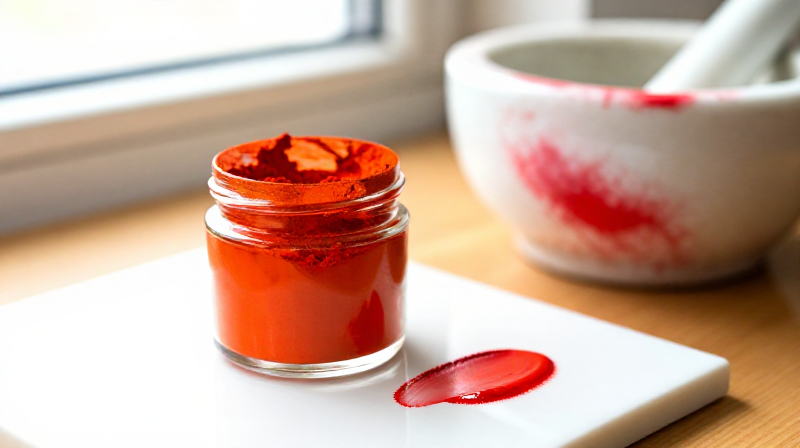
Spread the washed filter cake on a clean glass plate and dry at 100 °C for 4–6 hours. DPP red is thermally stable to above 350 °C — it is one of the most heat-resistant organic pigments known, comparable to the phthalocyanines. The dried mass is a hard, vivid red solid. In thick layers it appears dark and somewhat orange; the true brilliant red emerges when ground fine.
Grind to final pigment fineness
Grind to final pigment fineness
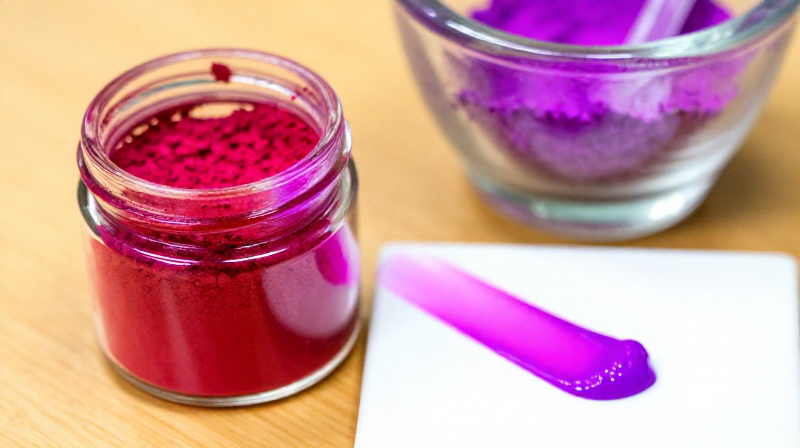
Grind the dried mass in a porcelain mortar. DPP red is a hard pigment — it requires vigorous grinding, similar to the phthalocyanines. As particle size decreases, the colour transforms from a dark, somewhat dull red to a vivid, brilliant, slightly orange-red with extraordinary intensity. The tinting strength is exceptional — a tiny amount produces a powerful red tint in white paint. Pass through a 120-mesh sieve to remove coarse particles.
Tools needed:
 Mortar and Pestle (Porcelain)
 120-Mesh Sieve
Store finished DPP red
Store finished DPP red
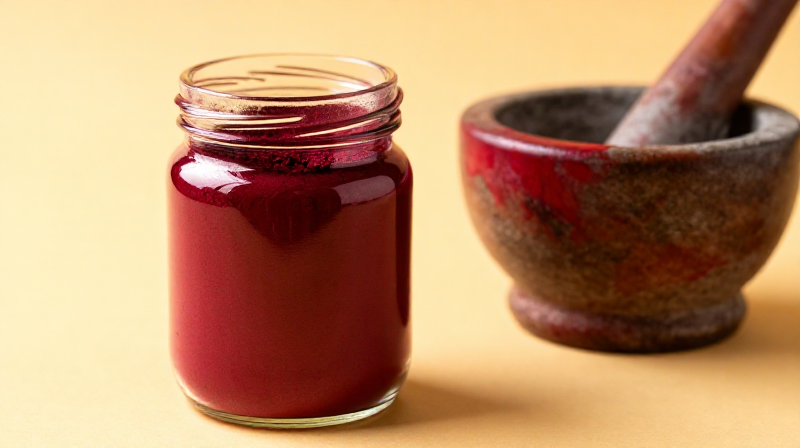
Transfer the sieved pigment to a glass jar with a tight-fitting lid. Label with the pigment name (DPP Red / Pyrrole Red, PR254, CI 56110), date, and properties: lightfastness ASTM I (excellent), heat stability above 350 °C, completely resistant to acids, alkalis, and all solvents. Expected yield from 5 ml diethyl succinate and 7 ml benzonitrile: approximately 3–5 g of finished pigment. This single molecule — discovered by accident in 1974 and commercialised in 1986 — represents the endpoint of a century of synthetic colour chemistry. From Para Red's crude beginnings in 1885 to DPP Red's perfection, the synthetic organic pigments transformed every surface in the modern world.
Tools needed:
 Glass Storage Jar with Lid
Materials
8- Placeholder
- 3 gPlaceholder
- 7 mlPlaceholder
- Placeholder
- Placeholder
- Placeholder
- Placeholder
- Placeholder
Tools Required
11- Placeholder
- Placeholder
- Placeholder
- Placeholder
- Placeholder
- Placeholder
- Placeholder
- Placeholder
- Placeholder
- Placeholder
Connected Blueprint Materials
Related Blueprints
These blueprints share knowledge with this one — techniques, materials, or principles that connect them in the learning graph.
Related blueprints
Other builds that share materials, tools, or techniques with this one.
CC0 Public Domain
This blueprint is released under CC0. You are free to copy, modify, distribute, and use this work for any purpose, without asking permission.
Support the Maker by purchasing products through their Blueprint where they earn a Maker Commission set by Vendors, or create a new iteration of this Blueprint and include it as a connection in your own Blueprint to share revenue.