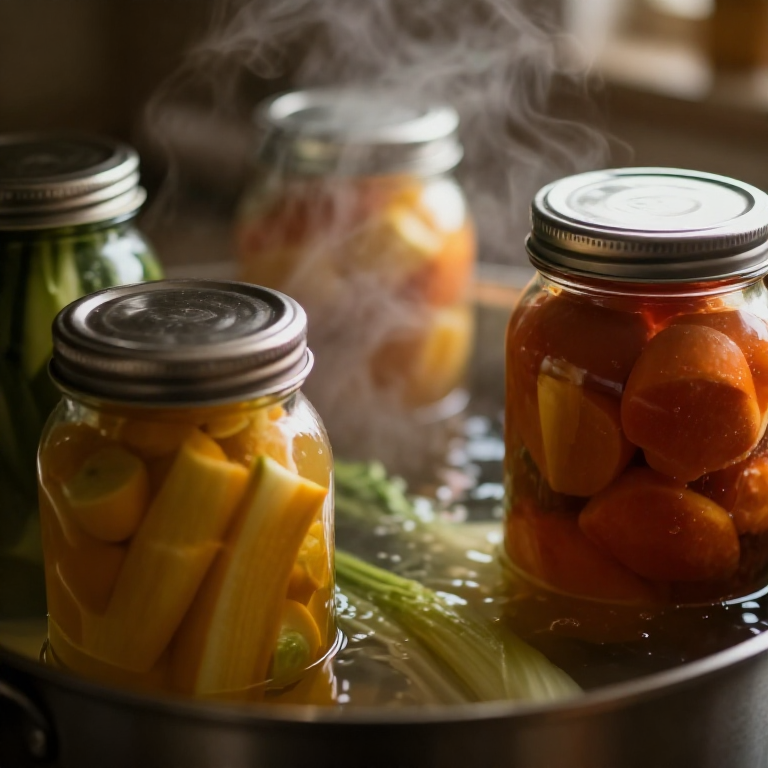


Preserving Food by Canning — Appert's Heat-and-Seal Method That Fed Armies
In 1810 a French confectioner named Nicolas Appert won a prize from Napoleon's government for solving a problem that had plagued every army and navy in history: how to keep food from spoiling. His answer was deceptively simple — pack food in a sealed container and heat it thoroughly. Food preserved this way kept for months, even years, and the modern canning industry was born.
Appert did not know why it worked; it would take Louis Pasteur, fifty years later, to show that heat kills the microbes that spoil food and the seal keeps new ones out. But the method worked perfectly without that knowledge. Soon glass jars gave way to soldered tin cans — lighter, unbreakable, and ideal for soldiers and sailors — and canned food spread around the world.
Canning sits alongside salting, drying, and smoking as one of humanity's great preservation methods, but it was the first to keep food fresh-tasting and the first born of the industrial age. One caution it shares with all low-acid preserving: ordinary boiling does not destroy the spores of botulism, so low-acid foods must be acidified or pressure-canned — a lesson learned long after Appert.
Instruções
Understand the principle
Understand the principle
Choose and prepare the food
Choose and prepare the food
Materiais para este passo:
 Produtos frescos da horta2 kg
Prepare the jars
Prepare the jars
Materiais para este passo:
 Frasco de vidro6 peças
Pack the jars
Pack the jars
Materiais para este passo:
 Sal de mesa50 g
Seal the jars
Seal the jars
Materiais para este passo:
 Pastilhas de cera de abelha100 g
Heat in a boiling water bath
Heat in a boiling water bath
Materiais para este passo:
 Água8 litros
Ferramentas necessárias:
 Panela alta
Time by the food
Time by the food
Ferramentas necessárias:
 Termómetro de ambiente
Cool and check the seal
Cool and check the seal
Ferramentas necessárias:
 Pinça para frascos
Reject any failures
Reject any failures
Store cool and dark
Store cool and dark
Move to the tin can
Move to the tin can
Materiais para este passo:
 Lata6 peças
Respect the botulism rule
Respect the botulism rule
Materiais
6- Referência
- 6 peçasReferência
- 50 gReferência
- Referência
- 8 litrosReferência
- 6 peçasReferência
Ferramentas necessárias
3- Referência
- Referência
- Referência
Blueprints relacionados
Estes blueprints compartilham conhecimento — técnicas, materiais ou princípios



CC0 Domínio Público
Este blueprint é liberado sob CC0. Você é livre para copiar, modificar, distribuir e usar este trabalho para qualquer finalidade, sem pedir permissão.
Apoie o Maker comprando produtos através do Blueprint, onde ele ganha uma Comissão Maker definida pelos vendedores, ou crie uma nova versão deste Blueprint e inclua-o como conexão no seu próprio Blueprint para compartilhar receita.