ARTE
BELEZA E BEM-ESTAR
ARTESANATO
CULTURA E HISTÓRIA
ENTRETENIMENTO
MEIO AMBIENTE
COMIDA E BEBIDAS
ENGENHARIA REVERSA
CIÊNCIAS
ESPORTES
TECNOLOGIA
TECNOLOGIA VESTÍVEL
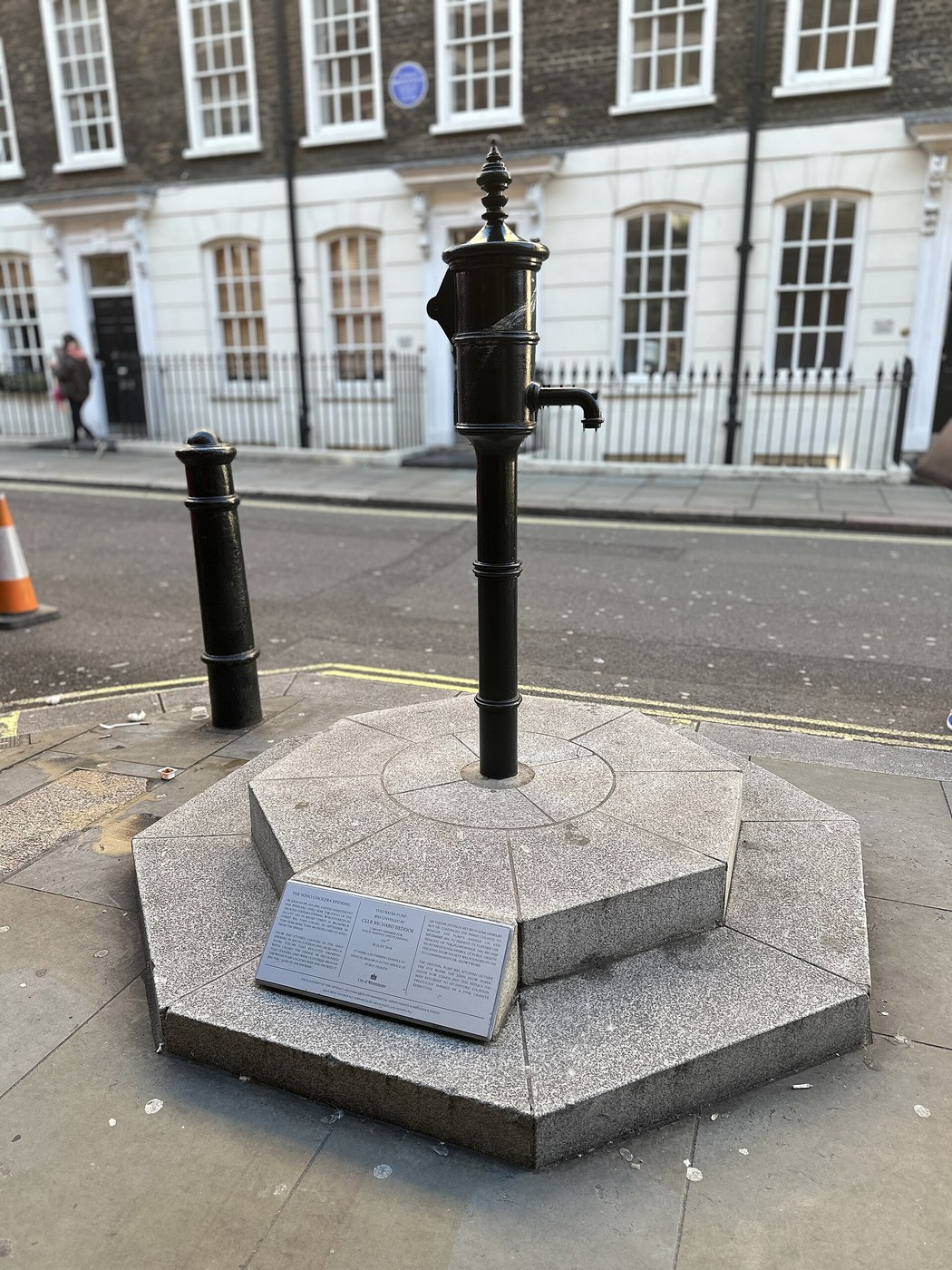


The Broad Street Pump
This is the only blueprint in the batch with no object in it. What John Snow built in the late summer of 1854 was a method, and the method has outlived every pump in London.
Cholera was killing people in Soho at a rate that emptied streets in days. The accepted explanation was bad air, and bad air was everywhere, which meant the theory explained the outbreak without predicting anything about it. Snow thought the cause was in the water, and he did something that sounds obvious now and was not then: he plotted every death on a street map and asked which water source each household actually used.
The pattern was a cluster around one pump in Broad Street. Better than the cluster were the exceptions, because the exceptions are what turn a correlation into a case. A workhouse inside the cluster had almost no deaths and had its own well. A brewery inside the cluster had none among its workers, who drank the beer. Deaths appeared well outside the cluster in households that sent someone to Broad Street because they preferred the taste.
Snow persuaded the parish to remove the pump handle on 8 September 1854. The outbreak was already declining and historians still argue about how much the removal changed, which is the honest position and does not weaken the method one bit.
You will run that analysis yourself.
Intermediário
4 hours 30 minutes
Instruções
1
1
State the two hypotheses so they can lose
State the two hypotheses so they can lose
Before any data, write down both explanations and what each one predicts. This is the step that does the work, and it is the step people skip.
Bad air predicts that risk falls off with distance from the source of the smell, that it affects everyone in an area more or less equally, and that people who spend more time outdoors in the miasma fare worse. It is a theory about place.
Waterborne transmission predicts that risk follows the water supply and nothing else. Two houses next door to each other should differ sharply if they draw from different pumps. A household far away that fetches water from the suspect source should be at high risk despite the distance. And an institution inside the affected area with its own supply should be spared.
Notice that these two theories agree almost everywhere. In the middle of the cluster both predict lots of deaths, so the middle of the cluster is worthless as evidence. The theories disagree only at the exceptions — the workhouse, the brewery, the distant household with a preference. Those are the informative points, and there are only a handful of them.
Write this down before you look at anything. Deciding in advance which observations would change your mind is the difference between analysis and decoration, and it is why Snow's map convinced people while other maps of the same outbreak did not.
2
2
Build the map, and let the exceptions do the work
Build the map, and let the exceptions do the work
A carregar o notebook Jupyter…
Ferramentas necessárias:
 Computador de secretária
3
3
The inference, as a chain you can audit
The inference, as a chain you can audit
An epidemiological argument is a chain, and a chain is only as good as the weakest link you have actually checked. This diagram lays Snow's out so each step can be attacked separately.
Follow it from the observation to the action. Note that the chain does not end at proof — it ends at a decision made under uncertainty, which is what public health always is. The pump handle came off while the case was still incomplete, because the cost of being wrong about removing it was a walk to a different pump, and the cost of being wrong about leaving it was measured in funerals.
The branches marked as challenges are the ones a good critic raises, and each has a response drawn beside it. Work through them. An argument you cannot attack on your own behalf is one you do not yet understand.
Flow
Loading...
4
4
How many exceptions do you actually need?
How many exceptions do you actually need?
A carregar o notebook Jupyter…
Ferramentas necessárias:
Computador de secretária5
5
Run it on something of your own
Run it on something of your own
The method is not about cholera and it is worth proving that to yourself on data you can gather.
Pick something with a plausible point source and a spatial footprint. Damp in a building against the position of a leak. Corrosion on a fence against distance from a road that is salted. Which taps in a workshop are used by people who report a taste. Slug damage across a garden against the position of a compost heap. Any of these is a real inference problem with the same shape.
Then work the four steps in order. Write both hypotheses first, and write what each predicts. Record exposure per subject, not per location, because the denominators are where these analyses die. Compute rates per head. And then go looking specifically for the cases where the two explanations disagree, because those are the only observations that will move you.
Expect the exceptions to be rare and expect to have to go and find them deliberately — they almost never turn up in data you already had. That is the practical content of Snow's method and the reason it is still taught.
Where this stops. This is an analysis technique, and it is genuinely yours to use. What it is not is a way to draw conclusions about anyone's health. Real outbreak investigation involves case definitions agreed before counting, laboratory confirmation, control of confounders, and ethical review of how the data is collected and held — and the same map that identifies a source can identify individuals, which is a serious matter. Use it on buildings, gardens, workshops and materials. If you ever think you are looking at a real cluster of illness, the correct action is not to publish a map. It is to tell a public health authority, who have the powers and the duty to investigate properly.
Ferramentas necessárias:
Computador de secretáriaBlueprints relacionados
Estes blueprints compartilham conhecimento — técnicas, materiais ou princípios


CC0 Domínio Público
Este blueprint é liberado sob CC0. Você é livre para copiar, modificar, distribuir e usar este trabalho para qualquer finalidade, sem pedir permissão.
Apoie o Maker comprando produtos através do Blueprint, onde ele ganha uma Comissão Maker definida pelos vendedores, ou crie uma nova versão deste Blueprint e inclua-o como conexão no seu próprio Blueprint para compartilhar receita.