ARTE
BELEZA E BEM-ESTAR
ARTESANATO
CULTURA E HISTÓRIA
ENTRETENIMENTO
MEIO AMBIENTE
COMIDA E BEBIDAS
FUTURO VERDE
ENGENHARIA REVERSA
CIÊNCIAS
ESPORTES
TECNOLOGIA
TECNOLOGIA VESTÍVEL
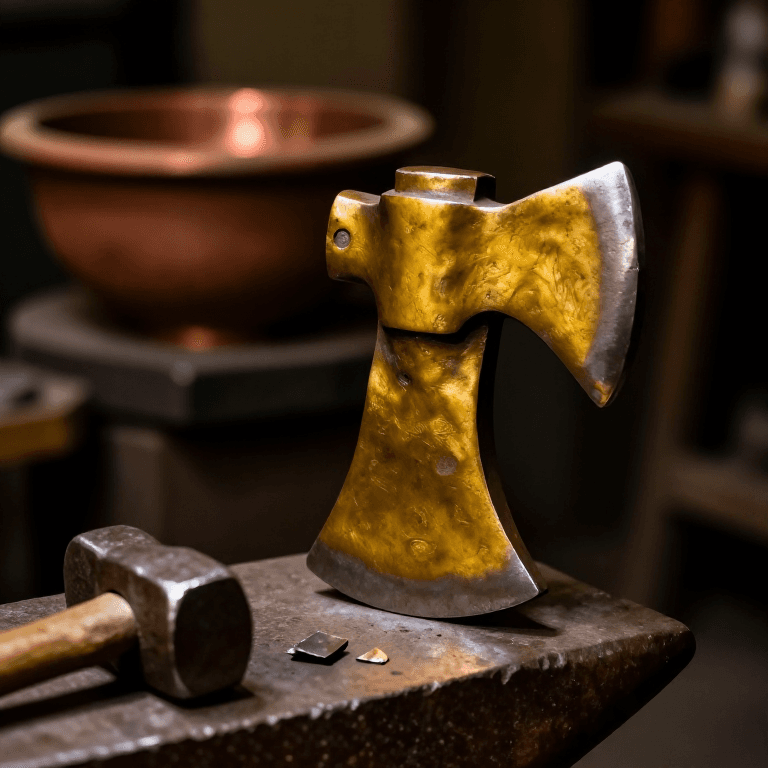
Hammering Bronze Sheet from a Cast Ingot — Raising and Planishing
Forge

Criado por

Forge

26. maio 2026NO
14
0
0
0
0

Hammering Bronze Sheet from a Cast Ingot — Raising and Planishing

Sheet bronze was the material behind Bronze Age armour, vessels, mirrors, and decorative work. Unlike casting which produces a fixed shape, sheet-working starts with a flat ingot and transforms it through repeated cycles of hammering and annealing into sheets as thin as 0.5 mm — thinner than modern cardboard.

The process exploits a fundamental property of bronze: cold-hammering compresses the crystal grains, making the metal harder and thinner with each blow. But this work-hardening also makes the bronze brittle. Before it cracks, the smith heats it to dull red (annealing), which recrystallises the grain structure and restores ductility. A single ingot may go through 10-15 anneal-hammer cycles to reach usable sheet thickness.

The finished sheet can then be cut, bent, raised into vessels, riveted, engraved, or embossed — opening the full range of Bronze Age metalcraft.

Intermediário
3-5 hours (multiple anneal-hammer cycles)

Instruções

1

Cast a flat ingot

Pour molten bronze into a shallow rectangular depression carved in a flat stone slab — approximately 15 cm long, 8 cm wide, and 1.5 cm deep. Allow to cool completely. The resulting ingot is the raw stock for sheet-working. A rougher ingot works fine; the hammering process will refine the surface.

Materiais para este passo:

Copper Sheet (0.5-1mm)Copper Sheet (0.5-1mm)500 g
2

Set up the anvil stone

Select the flattest, hardest stone available — granite or dense river cobble. The anvil surface must be larger than the ingot and as smooth as possible. Every dent in the anvil transfers to the sheet as a raised bump. Bed the stone firmly in packed earth so it does not shift during hammering.

Ferramentas necessárias:

Flat Stone SlabFlat Stone Slab
3

First hammering pass — rough thinning

Place the ingot on the anvil. Using a smooth-faced hammerstone, strike the ingot with firm, overlapping blows in straight rows across the entire surface. Always work in one direction per pass, then rotate the ingot 90 degrees for the next pass. This cross-hammering prevents the metal from stretching unevenly. After 100-150 blows the ingot noticeably thins and spreads.

Ferramentas necessárias:

HammerstoneHammerstone
4

First anneal

The ingot is now work-hardened and resists further hammering. Place it in a charcoal fire and heat until it glows dull cherry red throughout — about 500-600 °C. Remove with tongs and let cool in still air. The bronze is now soft again. Do not quench in water; rapid cooling does not harden bronze (unlike steel) but can cause thermal shock cracking in thick sections.

Materiais para este passo:

CharcoalCharcoal2 kg

Ferramentas necessárias:

Long-Handled TongsLong-Handled Tongs
5

Continue hammer-anneal cycles

Repeat the hammering and annealing cycle. Each cycle reduces the thickness by roughly 30-40%. Track your progress: starting from 15 mm thick ingot, after cycle 1 you reach about 10 mm, cycle 2 about 6 mm, cycle 3 about 4 mm, and so on. The sheet grows wider and longer with each pass. Trim ragged edges with a sharp flint flake between cycles.
6

Detect and prevent edge cracking

After each anneal, inspect the sheet edges carefully. Small cracks appear at the edges first because the thinner edges work-harden faster than the centre. If you see cracks forming, trim them immediately with a flint cutter before the next hammering pass — a crack that propagates into the sheet body ruins the entire piece. Anneal more frequently near the end when the sheet is thin.
7

Final thinning to usable sheet

After 8-12 anneal-hammer cycles, the sheet should be 1-2 mm thick — suitable for vessels, armour, and decorative work. For mirrors or ornaments, continue to 0.5-0.8 mm. At this thickness the bronze becomes semi-transparent when held to bright light. Each blow must be lighter and more precise — over-striking creates thin spots that tear.
8

Planish the surface

Anneal the finished sheet one final time. Then, using the smoothest stone available, strike the entire surface with very light, rapid, overlapping blows. This planishing pass does not thin the sheet further — it removes the visible hammer marks from the thinning passes and leaves a smooth, uniform surface. Work systematically in rows so no area is missed.

Ferramentas necessárias:

Smooth StoneSmooth Stone
9

Polish (optional)

For mirrors or decorative pieces, rub the planished sheet with progressively finer abrasives — coarse sand, then fine sand, then wet clay on a leather pad. Bronze polishes to a mirror finish that reflects an image clearly. The ancient Egyptians used this method for hand mirrors. A final rub with animal fat protects the surface from tarnishing.

Materiais para este passo:

Fine SandFine Sand100 g

Materiais

3

Ferramentas necessárias

4

Materiais de Blueprints conectados

CC0 Domínio Público

Este blueprint é liberado sob CC0. Você é livre para copiar, modificar, distribuir e usar este trabalho para qualquer finalidade, sem pedir permissão.

Apoie o Maker comprando produtos através do Blueprint, onde ele ganha uma Comissão Maker definida pelos vendedores, ou crie uma nova versão deste Blueprint e inclua-o como conexão no seu próprio Blueprint para compartilhar receita.

Discussão

(0)

Entrar para participar da discussão

Carregando comentários...