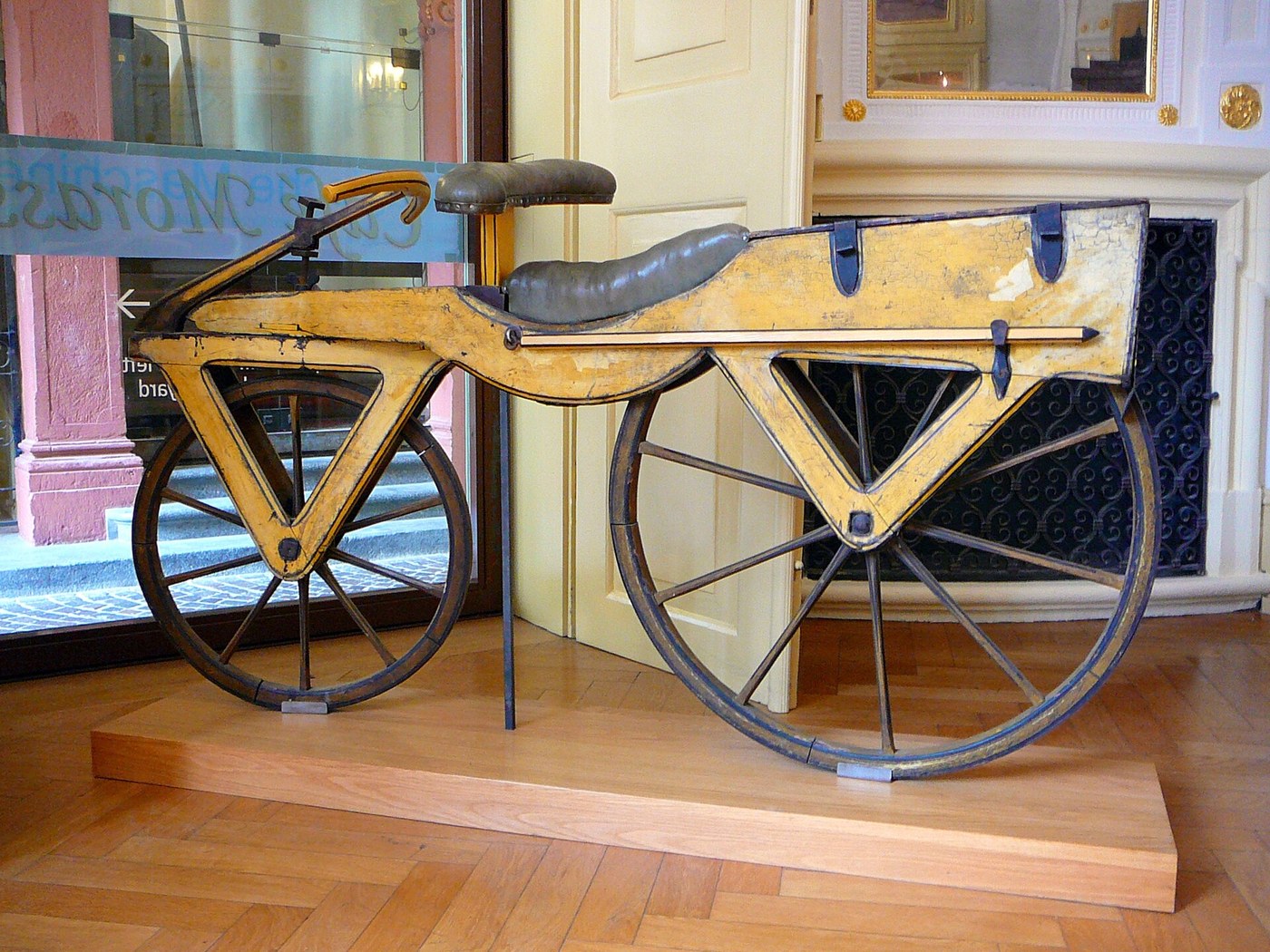


Draisine
Two wheels in line, a beam between them, a saddle, and a steerable front fork. No pedals, no chain, no gears — you sit astride it and push the ground with your feet.
It looks like an incomplete bicycle and it is not. The draisine of 1817 solved the problem everyone assumed was unsolvable: that a two-wheeled vehicle in line cannot balance. It can, because a steerable front wheel lets the rider steer into a fall and bring the wheels back under the centre of mass. Every bicycle since inherits that discovery; the pedals and chain came decades later and are, in balance terms, details.
Build it and you learn the thing directly, because you cannot pedal your way out of a wobble. The only thing keeping you up is the steering.
Instruções
Wear a helmet from the first test ride
Wear a helmet from the first test ride
This machine has no brakes and stops by dragging your feet. Helmet, gloves, and a flat open surface away from traffic and slopes. Learn it on grass before anything harder.
Size the frame to the rider
Size the frame to the rider
Measure the rider's inside leg. The saddle must sit low enough that both feet rest flat on the ground while seated — this machine is propelled and stopped entirely by the feet.
Ferramentas necessárias:
 Measuring Ruler
Make the backbone beam
Make the backbone beam
Shape a straight hardwood beam about 1.1 m long as the spine, deeper in the middle where the bending load is greatest. The originals were made entirely of wood.
Materiais para este passo:
 Hardwood Board2 peças
Ferramentas necessárias:
 Hand Saw
Fit the rear fork rigidly
Fit the rear fork rigidly
Fix the rear fork solidly to the beam with no movement at all. The rear wheel never steers; any play there shows up as a weave the rider constantly has to correct.
Build the steering head
Build the steering head
Make a bearing at the front of the beam for the front fork to rotate in — a simple wooden or metal-bushed pivot. Smooth and free, but not sloppy.
Materiais para este passo:
 Brass Rod1 peça
Rake the steering head backward
Rake the steering head backward
Angle the steering axis back from vertical by 15-20°. This rake is what makes the machine self-stabilising — it creates trail, so the front wheel tends to straighten itself and to steer into a lean without the rider consciously doing it.
Measure the trail you have built
Measure the trail you have built
Extend the steering axis to the ground and measure how far ahead of the tyre contact patch it lands. That distance is trail. Too little and the machine darts; too much and it refuses to turn.
Fit the wheels
Fit the wheels
Mount two wheels of equal size — around 600-700 mm — running true on their axles. Equal wheels keep the frame level and the geometry predictable.
Fit the saddle and the arm rest
Fit the saddle and the arm rest
Mount an adjustable saddle over the beam and a padded rest ahead of it for the forearms. The originals had a rest to brace against while pushing hard — it turns the arms into part of the drive.
Balance the machine before riding it
Balance the machine before riding it
Hold it upright and check it does not fall consistently to one side. A machine that is heavier on one side will always want to turn that way.
Learn to scoot before you glide
Learn to scoot before you glide
Walk it along seated, both feet down, letting it roll. Do not lift your feet yet. Get used to the machine going where the handlebars point.
Glide with feet up and steer into the fall
Glide with feet up and steer into the fall
Push off and lift your feet for a few metres. When it leans left, steer left. It feels wrong and it is the whole trick — steering into a lean drives the wheels back under you and stands the machine up.
Find the minimum stable speed
Find the minimum stable speed
Glide progressively slower and note the speed below which you cannot hold it. Below that, steering corrections cannot move the contact patch fast enough. Every two-wheeler has this threshold.
Ferramentas necessárias:
 Stopwatch
Test the effect of trail directly
Test the effect of trail directly
If your fork lets you change the rake, ride it steeper and slacker and compare. Steeper is twitchy and quick; slacker is stable and lazy. You have just tuned the parameter every bicycle designer still tunes.
History & Context
History & Context
1817, Karl Drais. Drais, working in Baden, built a two-wheeled steerable running machine — the Laufmaschine — made entirely of wood, with no pedals. He rode it publicly on 12 June 1817, covering about 13 km near Mannheim in roughly an hour. Europe called it the draisine, and in England it became the dandy horse.
Why 1817. The 1815 eruption of Mount Tambora produced the "year without a summer" in 1816: failed harvests across Europe, famine, and the slaughter of horses that could no longer be fed. Drais conceived the machine as a substitute for a horse during that shortage. It is one of the clearest cases in the history of technology of a specific environmental catastrophe producing a specific invention.
What it actually proved. Before the draisine it was widely assumed a two-wheeler in line could not be balanced by a rider. Drais showed it could — and the reason is steering. A rider corrects a lean by steering into it, which moves the contact patches back beneath the centre of mass. Frame geometry helps: rake and trail make the front wheel tend to self-centre and to fall into a turn. Pedals, cranks and chains, added over the following decades, changed how the machine is driven, not how it stays up.
It went out of fashion fast. Draisines were a craze in 1818-19 and then largely disappeared — they were banned from pavements in several cities after collisions, and on unpaved roads a machine propelled by scuffing your feet is hard work. The line resumes decades later with pedals on the front wheel, then the chain-driven safety bicycle with equal wheels, which is a different machine again and already exists as its own blueprint here.
And it came back. The modern balance bike given to small children is a draisine: two wheels, a saddle, no pedals, propelled by the feet. It is used because it teaches balance and steering first and drive second — which is exactly the order in which the bicycle was actually invented.
Blueprints relacionados
Estes blueprints compartilham conhecimento — técnicas, materiais ou princípios


CC0 Domínio Público
Este blueprint é liberado sob CC0. Você é livre para copiar, modificar, distribuir e usar este trabalho para qualquer finalidade, sem pedir permissão.
Apoie o Maker comprando produtos através do Blueprint, onde ele ganha uma Comissão Maker definida pelos vendedores, ou crie uma nova versão deste Blueprint e inclua-o como conexão no seu próprio Blueprint para compartilhar receita.