

Dyeing Pale Yellow with Mullein — The Roadside Dye of Medieval Europe
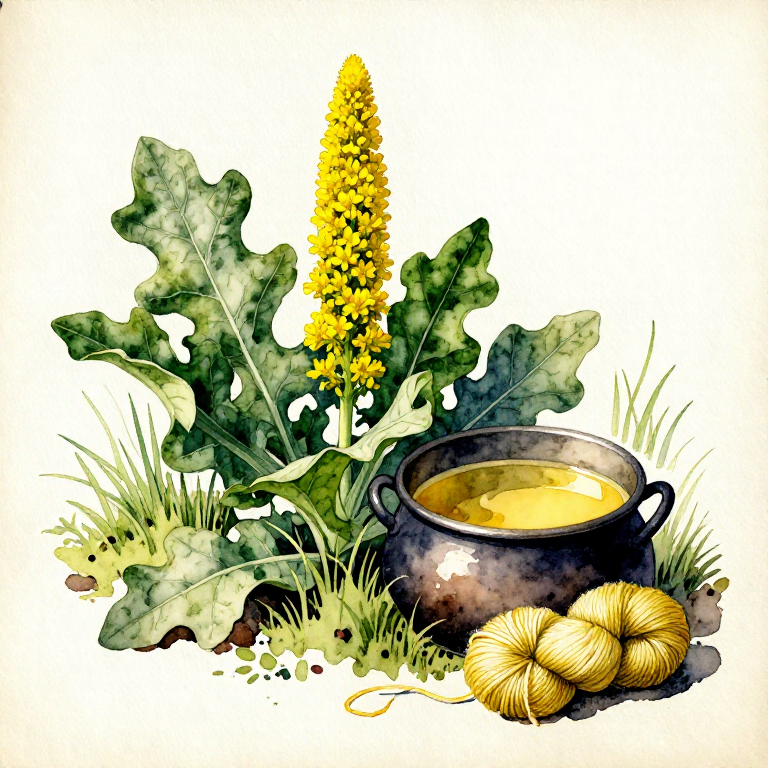
Great mullein (Verbascum thapsus) is a tall, woolly biennial plant found along roadsides, dry banks, and waste ground across Europe, Asia, and (as an introduced species) North America. Its large, soft, grey-green leaves covered in dense woolly hairs are unmistakable. In its second year, the plant sends up a tall flowering spike (up to 2 metres) covered in small yellow flowers. Both leaves and flowers have been used as a dye source since the medieval period, producing soft, pale yellow on alum-mordanted wool.
Mullein was a staple of the medieval cottage dyer — growing freely wherever the soil was poor and dry. The plant was also valued for its many medicinal uses (respiratory ailments, earaches, wound treatment) and as a torch when the dried flower stalk was dipped in tallow. Roman soldiers reportedly dipped mullein stalks in tallow for battlefield torches — hence the Latin name 'Verbascum' may derive from 'barbascum' (bearded), referring to the hairy leaves.
As a dye, mullein produces a gentle, pale yellow — softer and more muted than weld or goldenrod. The flowers give the strongest colour but are tedious to collect in quantity. The leaves, being much larger, are more practical as a dye source even though the colour is slightly paler. Mullein is an ideal beginner's dye for foragers — the plant is easy to identify, abundant, and the process requires only basic equipment.
Instruções
Gather and weigh the mullein leaves and flowers
Gather and weigh the mullein leaves and flowers
Use 200-300% WOF of fresh mullein leaves, or 100% WOF dried. For 100 g of wool, gather 200-300 g of fresh leaves or 100 g dried. Harvest the large, woolly rosette leaves from first-year plants or the lower leaves from second-year flowering plants. If available, include the yellow flowers — they give the strongest colour. Tear or chop large leaves into manageable pieces. The woolly leaf surface traps air and floats — push leaves down into the water when soaking.
Materiais para este passo:
 Folhas e flores de verbasco (secas)100 g
Ferramentas necessárias:
 Balança digital de cozinha
Soak in warm water for one hour
Soak in warm water for one hour
Place the mullein leaves in a dye pot with 4 litres of warm water and soak for at least one hour. The woolly leaf surfaces resist wetting initially — push them under the water and stir. The water will turn a pale golden-yellow as flavonoid pigments dissolve. Mullein releases dye more slowly than most flower sources due to the dense hair covering on the leaves.
Ferramentas necessárias:
 Panela alta
Simmer at 80°C for 30 minutes
Simmer at 80°C for 30 minutes
Bring the pot to 80°C and hold for 30 minutes. Stir occasionally. The liquid will deepen to a warm, pale golden-yellow. Do not boil — moderate heat extracts the best colour from mullein. The woolly leaf fibres will soften and darken as pigment transfers to the water.
Ferramentas necessárias:
 Termómetro de cozinha
 Colher de pau para mexer
Strain out the leaves
Strain out the leaves
Strain the dye liquor through a fine mesh strainer into a clean pot. The woolly mullein leaf fibres will cling to wool if not thoroughly strained — use muslin cloth if available for the cleanest results. Press the leaves to extract remaining liquid. The strained liquor should be a clear, pale golden-yellow.
Ferramentas necessárias:
 Peneira de malha fina
Dye alum-mordanted wool at 80°C for 45 minutes
Dye alum-mordanted wool at 80°C for 45 minutes
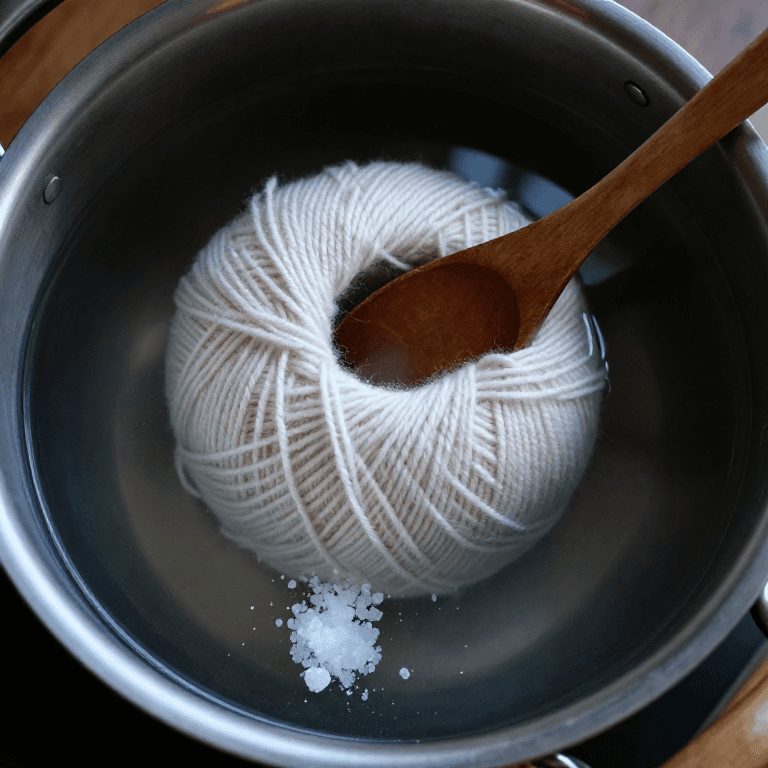
Pre-wet the alum-mordanted wool in lukewarm water for 15 minutes, squeeze gently, and lower it into the mullein dye bath at room temperature. Slowly raise to 80°C over 15 minutes, then hold for 45 minutes. Turn gently every 10 minutes. The wool will develop a soft, pale yellow — gentle and muted, lighter than goldenrod or weld. The colour has a warm, creamy quality. Alum mordanting is essential for any visible colour from mullein.
Materiais para este passo:
 Meada de lã100 g
 Alúmen (alúmen de potássio)10 g
Cool overnight, rinse, and dry
Cool overnight, rinse, and dry
Turn off the heat and let the wool cool in the dye bath overnight. Remove, squeeze gently, and rinse in lukewarm water until the runoff is clear. The final colour is a soft, pale creamy-yellow — the gentlest of the plant yellows. Lightfastness is moderate. The subtle colour makes mullein-dyed wool an excellent base for over-dyeing with indigo (producing green) or with madder (producing warm orange). Dry in shade.
Materiais
3- Referência
- 100 gReferência
- Referência
Ferramentas necessárias
5- Referência
- Referência
- Referência
- Referência
- Referência
Materiais de Blueprints conectados
Este projeto faz

Blueprints relacionados
Estes blueprints compartilham conhecimento — técnicas, materiais ou princípios
CC0 Domínio Público
Este blueprint é liberado sob CC0. Você é livre para copiar, modificar, distribuir e usar este trabalho para qualquer finalidade, sem pedir permissão.
Apoie o Maker comprando produtos através do Blueprint, onde ele ganha uma Comissão Maker definida pelos vendedores, ou crie uma nova versão deste Blueprint e inclua-o como conexão no seu próprio Blueprint para compartilhar receita.