
Dyeing Yellow with Yarrow — The Ancient Wound-Herb of Every Meadow
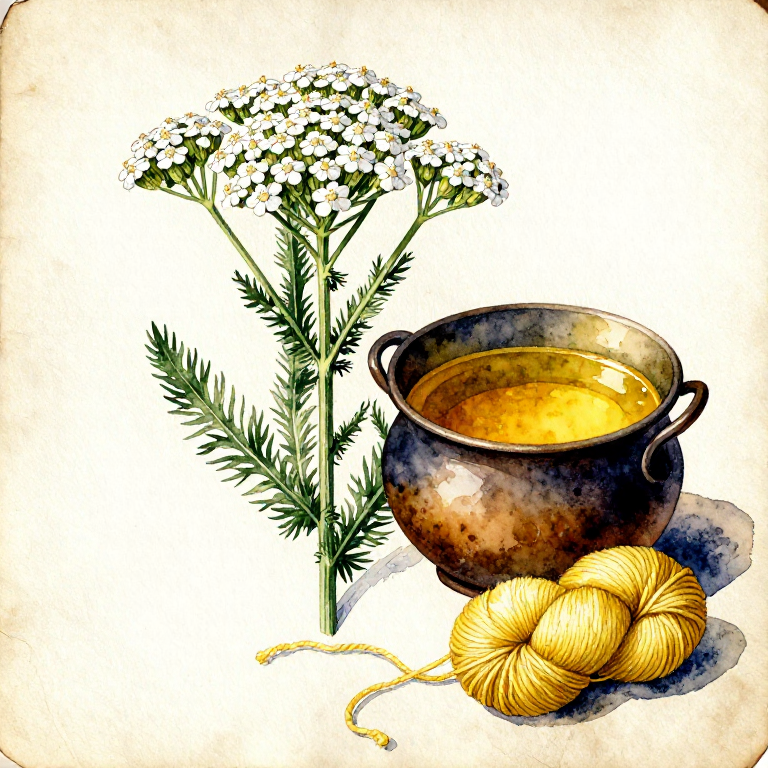
Yarrow (Achillea millefolium) is one of humanity's oldest companion plants. Named after the Greek hero Achilles — who according to Homer used yarrow to staunch his soldiers' battlefield wounds — this hardy perennial grows wild across virtually every temperate grassland in Europe, Asia, and North America. Its feathery, finely divided leaves and flat-topped flower clusters are a familiar sight in meadows, roadsides, and field edges from sea level to alpine zones. Archaeological evidence of yarrow use dates to Neanderthal burial sites over 60,000 years old.
As a dye plant, yarrow produces a clear, warm yellow on alum-mordanted wool. The flowers and upper leaves contain luteolin and apigenin — flavonoid pigments from the same chemical family that makes weld and dyer's chamomile effective dyes. The colour is a soft, warm yellow, lighter and more golden than weld but with respectable lightfastness for a flower-based dye. With iron modification, yarrow yellow shifts to a muted olive-green — a useful shade for blending into natural colour palettes.
Yarrow is one of the most beginner-friendly dye plants: it grows almost everywhere, requires no specialist knowledge to identify (the feathery leaves and flat flower heads are distinctive), and the dyeing process uses only basic equipment. For new natural dyers, yarrow and onion skins are the ideal starting materials — free, abundant, and forgiving of imprecise technique.
Instruções
Harvest and weigh the yarrow flowers and leaves
Harvest and weigh the yarrow flowers and leaves
Use 200% WOF of fresh yarrow, or 100% WOF dried. For 100 g of wool, gather 200 g of fresh flowering tops or 100 g dried. Harvest when the flowers are fully open — peak bloom gives the strongest yellow. Cut the upper 15-20 cm of the plant, including flower heads and upper leaves. Both flowers and leaves contain dye, but the flower heads are richest. Yarrow is easy to identify: feathery, finely divided leaves (hence 'millefolium' — thousand leaves) and flat-topped clusters of small white or pale pink flowers. Avoid any plant you cannot positively identify.
Materiais para este passo:
 Milefólio (Achillea millefolium)100 g
Ferramentas necessárias:
 Balança digital de cozinha
Soak the yarrow in warm water for one hour
Soak the yarrow in warm water for one hour
Place the yarrow flowers and leaves in a dye pot with 4 litres of warm water and soak for at least one hour. The water will turn a pale greenish-yellow as the flavonoid pigments begin to dissolve. Fresh yarrow releases colour faster than dried. If using dried yarrow, extend the soak to 2-3 hours or overnight for best extraction. The aromatic, slightly medicinal scent of yarrow will be noticeable during soaking.
Ferramentas necessárias:
 Panela alta
Simmer at 80°C for 30-40 minutes
Simmer at 80°C for 30-40 minutes
Bring the pot to a gentle simmer (75-80°C) and hold for 30-40 minutes. Stir occasionally. Do not boil — excessive heat degrades the delicate flavonoid yellows toward dull brown. The liquid will deepen to a warm golden-yellow. The flower heads will lose their colour and turn brownish as the pigment transfers to the water. Yarrow has a pleasant herbal aroma during simmering — far more agreeable than some dye plants.
Ferramentas necessárias:
 Termómetro de cozinha
 Colher de pau para mexer
Strain out the plant material
Strain out the plant material
Strain the dye liquor through a fine mesh strainer into a clean pot. Press the plant material to extract all remaining yellow liquid. Yarrow flowers and leaves become soft and pulpy during simmering — strain thoroughly to prevent fragments from tangling with the wool. The strained liquor should be a clear, warm golden-yellow.
Ferramentas necessárias:
 Peneira de malha fina
Dye alum-mordanted wool at 80°C for 45 minutes
Dye alum-mordanted wool at 80°C for 45 minutes
Pre-wet the alum-mordanted wool in lukewarm water for 15 minutes, squeeze gently, and lower it into the yarrow dye bath at room temperature. Slowly raise to 80°C over 15 minutes, then hold for 45 minutes. Turn gently every 10 minutes. The wool will develop a warm, clear yellow — soft golden in tone, less green than nettle and less vivid than weld, but with a pleasant warmth. The alum mordant is essential for good colour uptake and fastness with yarrow.
Materiais para este passo:
 Meada de lã100 g
 Alúmen (alúmen de potássio)10 g
Cool overnight, rinse, and dry
Cool overnight, rinse, and dry
Turn off the heat and let the wool cool in the dye bath overnight. Remove, squeeze gently, and rinse in lukewarm water until the runoff is clear. The final colour is a warm, soft yellow — the colour of late summer meadows where yarrow blooms. Lightfastness is moderate — better than marigold or dahlia, but not as permanent as weld. The luteolin content gives yarrow better longevity than most flower-based yellows. With prolonged sunlight exposure, the colour will gradually soften but retains a warm tone rather than greying. Dry in shade.
Materiais
3- Referência
- 100 gReferência
- Referência
Ferramentas necessárias
5- Referência
- Referência
- Referência
- Referência
- Referência
Materiais de Blueprints conectados
Este projeto faz

Blueprints relacionados
Estes blueprints compartilham conhecimento — técnicas, materiais ou princípios
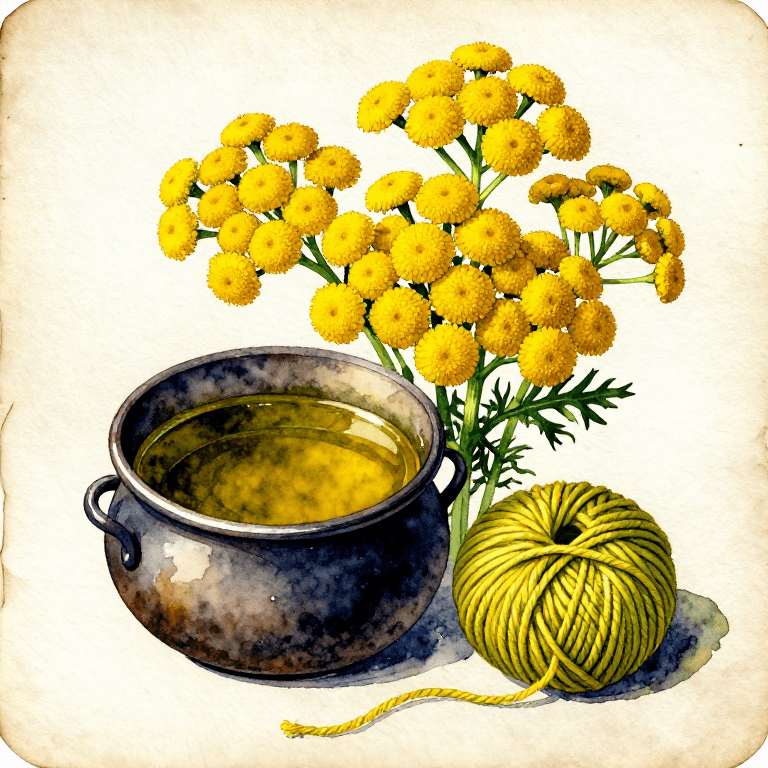
Dyeing Yellow-Green with Tansy — The Bitter Herb of Medieval Dye Gardens
por Tex
Têxtil e Couro
Dyeing with Birch Bark — Salmon-Pink and Cinnamon from the Northern Forest
por Tex
Têxtil e Couro
Dyeing Pale Yellow with Mullein — The Roadside Dye of Medieval Europe
por Tex
Têxtil e Couro
CC0 Domínio Público
Este blueprint é liberado sob CC0. Você é livre para copiar, modificar, distribuir e usar este trabalho para qualquer finalidade, sem pedir permissão.
Apoie o Maker comprando produtos através do Blueprint, onde ele ganha uma Comissão Maker definida pelos vendedores, ou crie uma nova versão deste Blueprint e inclua-o como conexão no seu próprio Blueprint para compartilhar receita.