Colaboração
ARTE
BELEZA E BEM-ESTAR
ARTESANATO
CULTURA E HISTÓRIA
ENTRETENIMENTO
MEIO AMBIENTE
COMIDA E BEBIDAS
ENGENHARIA REVERSA
CIÊNCIAS
ESPORTES
TECNOLOGIA
TECNOLOGIA VESTÍVEL
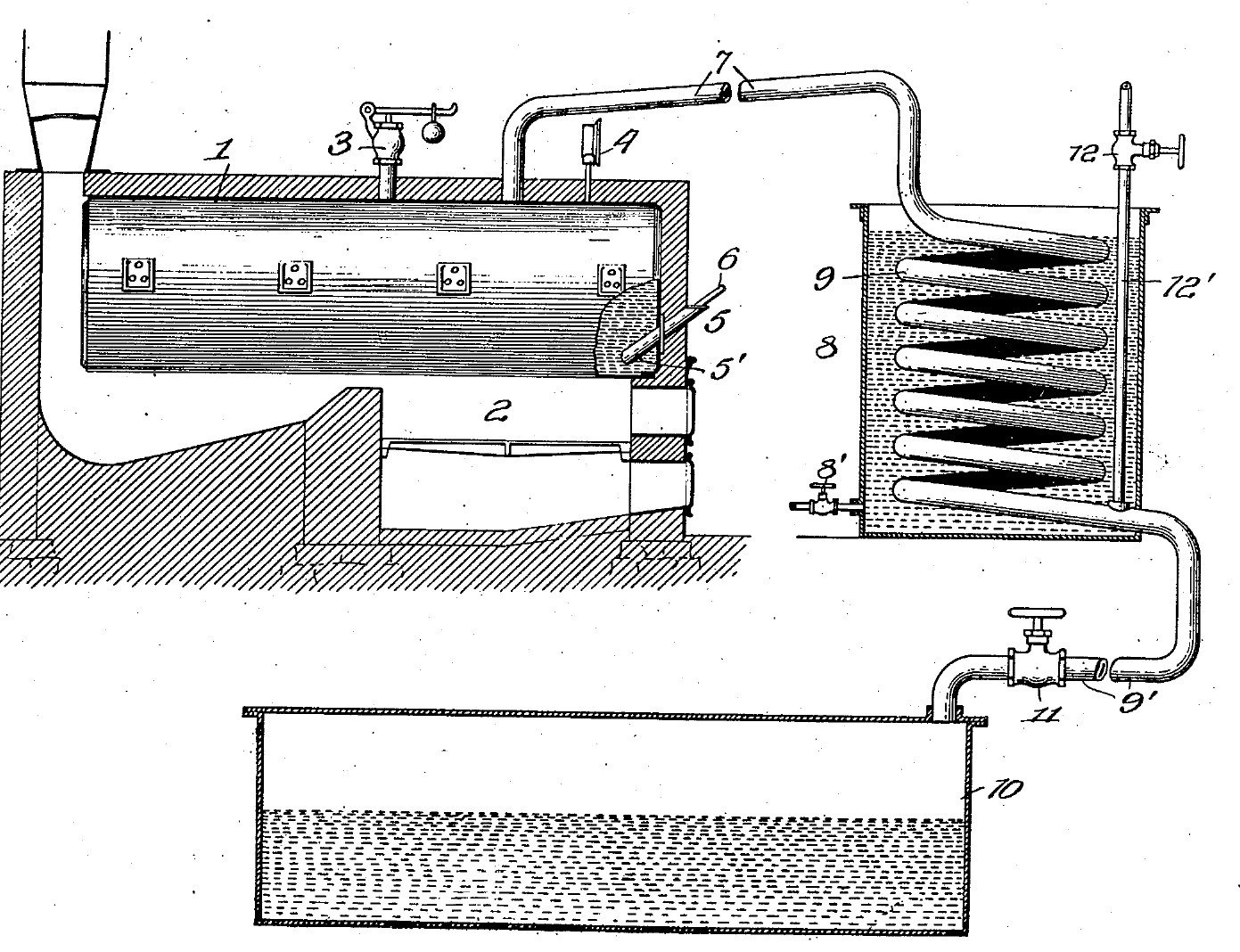


Gasoline by Pressure Cracking: Heavy Residue Distilled at 650-850 °F under 4-5 Atmospheres (Burton, US 1,049,667)
Straight distillation leaves most of a barrel of crude as heavy oil. Burton's 1913 patent turns that residue into gasoline: distil it hot while its own vapour is held at 4 to 5 atmospheres, all the way through the condenser. The heat and pressure break the heavy oil into light oil. Cracked gasoline is the first rung toward high-octane fuel.
Feed: the fuel-oil and gas-oil residue left after the light cuts, boiling at about 600 to 700 °F (claim: above 500 °F).
Source: W. M. Burton, US 1,049,667 (1913), assigned to Standard Oil (Indiana). Not given: charge size, run time, yield. Burton claims the gasoline stays in the paraffin series; that is his claim. A fired still under pressure needs a working safety valve. Picture: the patent drawing.
Especialista
2 days
Instruções
1
1
Fill the pressure still with residue
Fill the pressure still with residue
The still is a closed, boiler-like holder over a fire chamber, with a safety valve, a pressure gauge, and a thermometer in an oil-filled tube slanting into it. Fill it with the heavy residue left after the gasoline and illuminating oils have been distilled off.
Materiais para este passo:
 Resíduo de petróleo1 still charge
Ferramentas necessárias:
 Alambique de pressão
 Manómetro
 Termómetro
2
2
Close the outlet and fire it
Close the outlet and fire it
A pipe rises from the top of the still to a water-cooled condenser coil, then runs to a receiver tank. Keep the shut-off valve after the coil closed and fire the still. The vapours build up 4 to 5 atmospheres on the liquid, and its boiling point rises from 500-600 °F to 750-800 °F.
Ferramentas necessárias:
Alambique de pressão Serpentina do condensador
 ÁguaManómetro
3
3
Distil at 650 to 850 °F under pressure
Distil at 650 to 850 °F under pressure
Distil at about 650 to 850 °F. Keep the pressure on the vapours the whole way, in the still and while they condense in the coil. The heat and pressure turn the heavy oil into low-boiling oil.
Ferramentas necessárias:
Alambique de pressãoTermómetroManómetro4
4
Draw off the gasoline from time to time
Draw off the gasoline from time to time
Open the shut-off valve now and then to run the condensed gasoline into the receiver. Do it often enough that the coil never fills with liquid.
Ferramentas necessárias:
Serpentina do condensador Tanque de petróleo
5
5
Let off the gas
Let off the gas
Gas that will not condense collects in the coil and blocks it. Release it from time to time through the relief valve on the pipe rising from the lower end of the coil. Burton does not say what becomes of it. Ours: collect it under pressure if it is to be used.
Ferramentas necessárias:
Serpentina do condensador Garrafa de gás sob pressão
Materiais
1- 1 still chargeReferência
Blueprints relacionados
Estes blueprints compartilham conhecimento — técnicas, materiais ou princípios
CC0 Domínio Público
Este blueprint é liberado sob CC0. Você é livre para copiar, modificar, distribuir e usar este trabalho para qualquer finalidade, sem pedir permissão.
Apoie o Maker comprando produtos através do Blueprint, onde ele ganha uma Comissão Maker definida pelos vendedores, ou crie uma nova versão deste Blueprint e inclua-o como conexão no seu próprio Blueprint para compartilhar receita.