ARTE
BELEZA E BEM-ESTAR
ARTESANATO
CULTURA E HISTÓRIA
ENTRETENIMENTO
MEIO AMBIENTE
COMIDA E BEBIDAS
ENGENHARIA REVERSA
CIÊNCIAS
ESPORTES
TECNOLOGIA
TECNOLOGIA VESTÍVEL
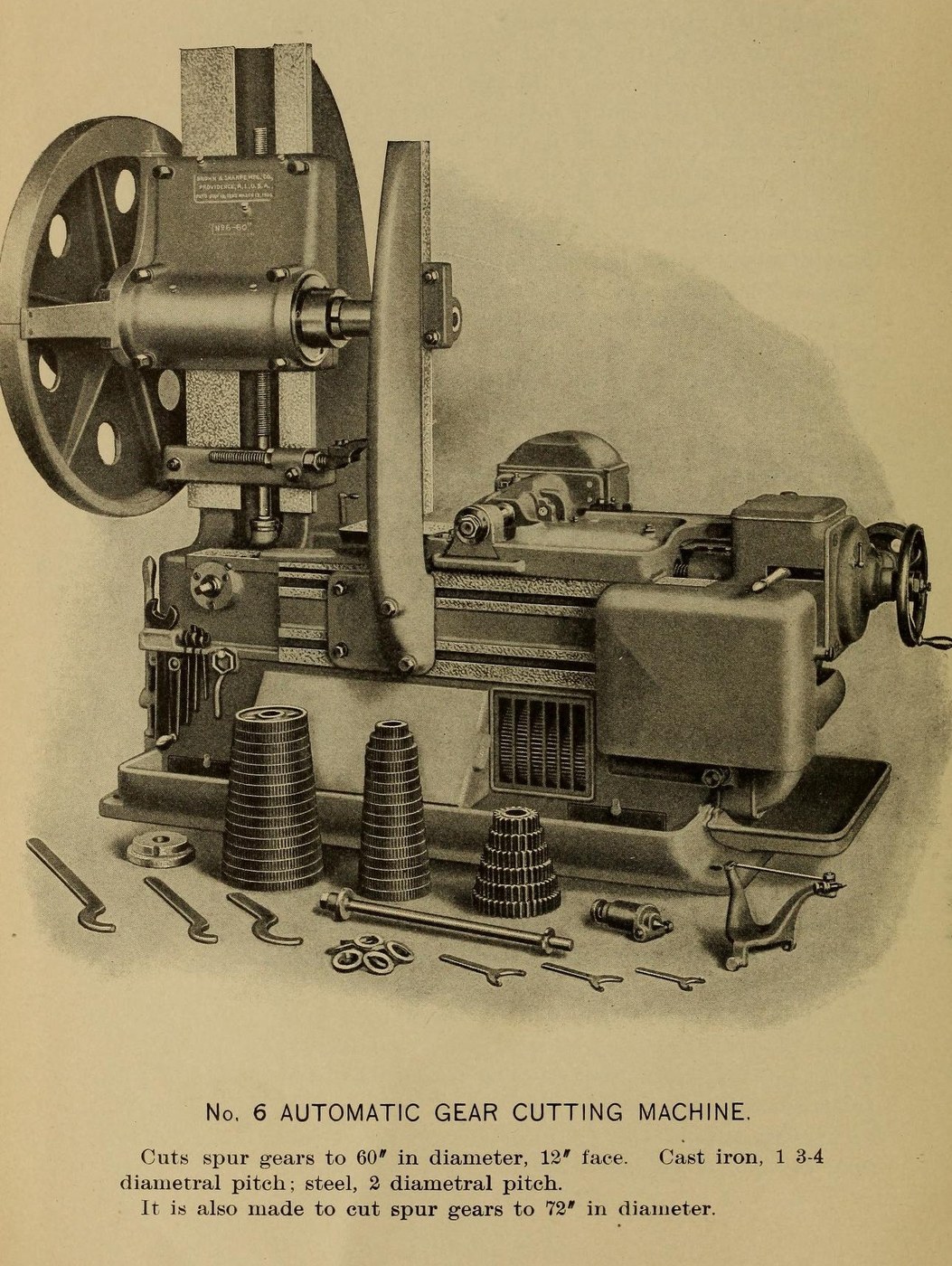


Gear Wheel: a Cast-Iron Spur Wheel Cut with an Involute Cutter (Brown & Sharpe 1911)
A gear wheel is the large toothed wheel that a small pinion drives: it turns slower than the pinion, with more force.
Brown & Sharpe's Practical Treatise on Gearing (1911) gives every size from two numbers, the number of teeth N and the diametral pitch P (teeth per inch of pitch diameter): the blank is (N+2)/P across, the teeth are cut 2.157/P deep, and the face of a cast-iron gear is 2 1/2 times the pitch. It also gives the cutter number for each tooth count and the speed to run it.
The example here, 60 teeth at 12 P on a blank 5 1/6 in across, is the book's own. The mating pinion, the bore and the milling machine with a dividing head are ours.
Source: Brown & Sharpe Mfg. Co. (1911), pp. 17-19, 86-89, 129-130, 146. Picture: their p. 20, the No. 6 Automatic Gear Cutting Machine with cut spur gears.
Avançado
A day
Instruções
1
1
Read Brown & Sharpe
Read Brown & Sharpe
"Diametral Pitch is the number of teeth to one inch of diameter of pitch circle." "Add 2 to the number of teeth in a wheel and divide the sum by the diametral pitch; and the quotient will be the whole diameter of the gear or the diameter of the addendum circle. Thus, for 60 teeth, 12 P, the diameter of gear blank will be 5 1/6 inches."
2
2
Work out the sizes
Work out the sizes
Choose the number of teeth N and the diametral pitch P; the wheel and its pinion must have the same P. Then:
- pitch diameter = N/P
- blank diameter = (N+2)/P
- circular pitch = 3.1416/P
- tooth thickness at the pitch line = 1.5708/P
- whole depth of the space = 2.157/P
- centre distance = half the sum of the teeth in both wheels, divided by P.
A larger P gives smaller, finer teeth; a smaller P gives larger, stronger ones. For 60 teeth at 12 P: pitch diameter 5 in, blank 5 1/6 in, circular pitch .262 in, tooth .131 in thick, depth .180 in; with a 20-tooth pinion the centres are 3 1/3 in apart.
3
3
Turn the blank
Turn the blank
Cut a slice from a cast-iron bar a little larger than the blank. Bore it for its shaft, mount it on an arbor and turn it in the lathe to the blank diameter, (N+2)/P (5 1/6 in for the example), measuring with a micrometer. Brown & Sharpe give the face width of cast-iron gears, for general use, as 2 1/2 times the circular pitch: .65 in for 12 P. Round off the outer corners of the rim for handling while you turn it.
Materiais para este passo:
 Barra de ferro fundido1 peça
Ferramentas necessárias:
 Torno mecânico
 Ferramenta de corte para torno
 Arrastador de torno
 Micrómetro
 Óculos de segurança
4
4
Choose the cutter
Choose the cutter
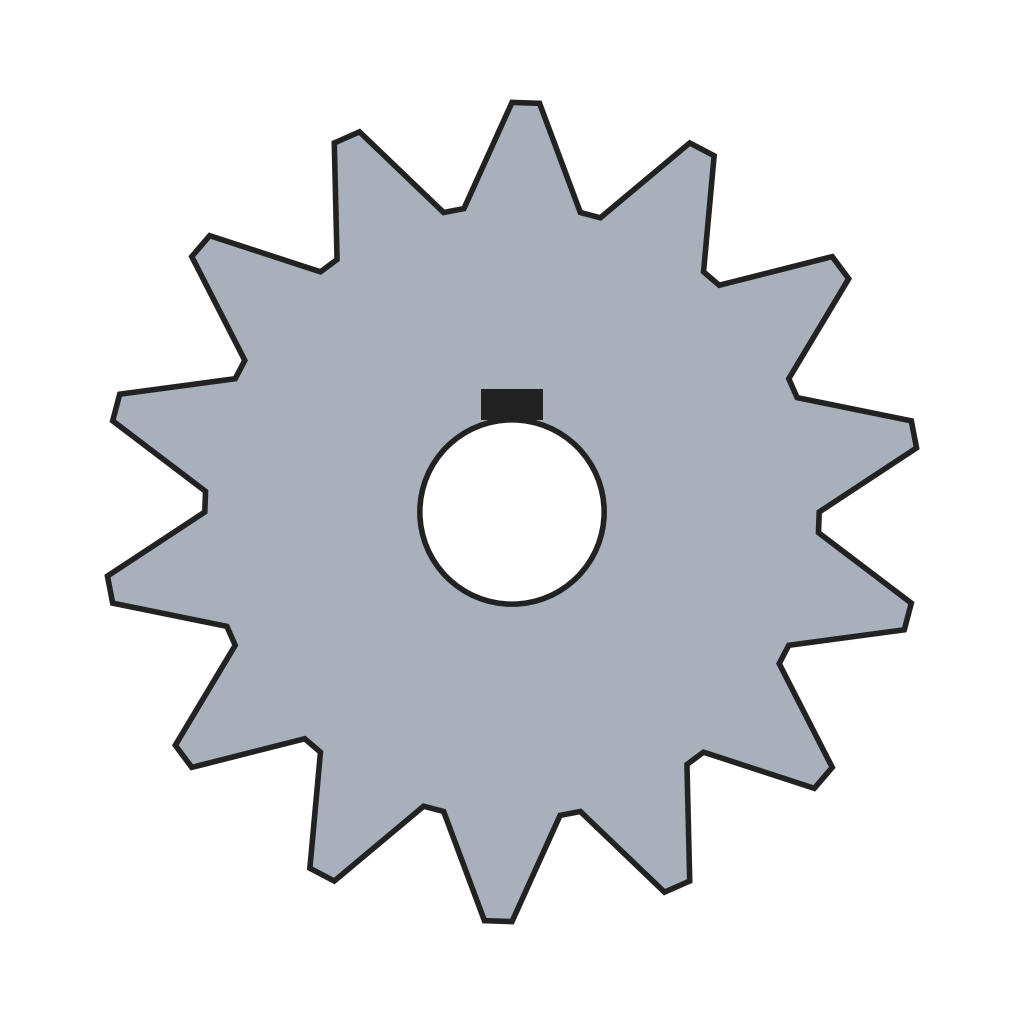
One involute cutter of the right pitch cuts a range of tooth counts. Brown & Sharpe's numbers are:
- No. 1: 135 teeth to a rack
- No. 2: 55 to 134
- No. 3: 35 to 54
- No. 4: 26 to 34
- No. 5: 21 to 25
- No. 6: 17 to 20
- No. 7: 14 to 16
- No. 8: 12 and 13.
The 60-tooth wheel needs a No. 2, 12 P cutter; its 20-tooth pinion needs a No. 6, 12 P. The range and number are stamped on each cutter.
Ferramentas necessárias:
 Fresa módulo de evolvente
5
5
Set the blank and centre the cutter
Set the blank and centre the cutter
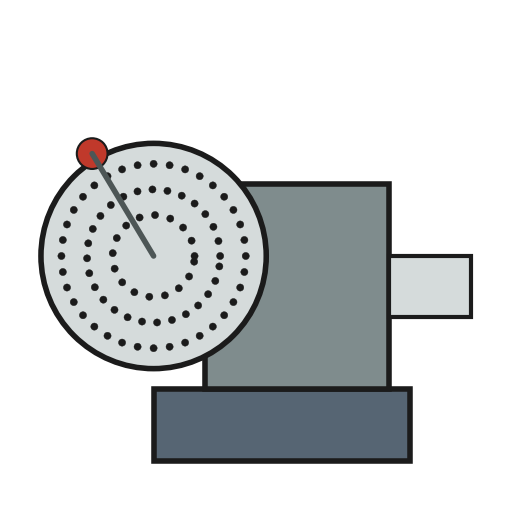
Set the dividing head to divide the circle into N equal parts. Wheels more than 3 or 4 in across are best held on a taper shank arbor in the work spindle; small gears can go on an arbor dogged to the spindle, with room for the dog to pass the cutter arbor. To centre the cutter, mount a plain round arbor between the centres, raise the work until the cutter sinks a small gash in it, and move the work until the gash is central.
Ferramentas necessárias:
 Fresadora
 Cabeçote divisorFresa módulo de evolventeArrastador de torno
6
6
Cut the teeth
Cut the teeth
Set the depth to the whole depth, 2.157/P (.180 in for 12 P), and cut one space. Drop the work away from the cutter before running back, index one division and cut the next, all the way round. Brown & Sharpe's average for a 12 P cutter (2 in across) in cast iron is 135 turns a minute, feeding .027 in per turn; brass can run twice as fast. Wheels coarser than 8 P, and large wheels, are better cut twice round when accuracy matters, as heat makes a single pass inaccurate. Check the tooth thickness, 1.5708/P, with a gear tooth vernier. If the pair binds, cut a little deeper; if one wheel must be smaller, make it the follower.
Ferramentas necessárias:
FresadoraCabeçote divisorFresa módulo de evolvente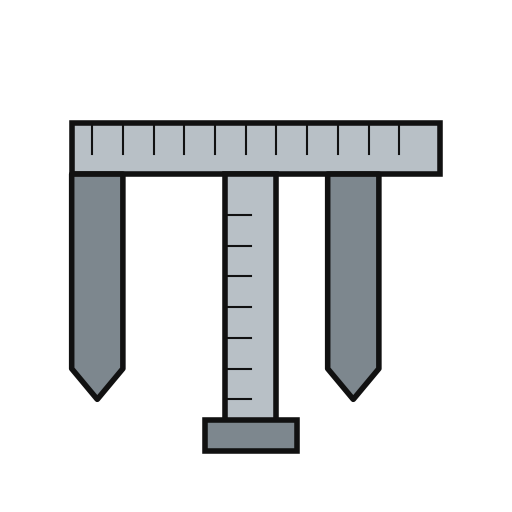 Paquímetro para dentes de engrenagemÓculos de segurança
7
7
Keep the cutter sharp
Keep the cutter sharp
Grind the cutter at set times, for example every two hours or after a set number of gears, instead of waiting until it is visibly dull: a formed cutter run dull is soon ruined. Grind only the tooth faces, radially, so the form does not change, with a free-cutting wheel. Do not let the wheel glaze, as that draws the temper of the cutter.
Ferramentas necessárias:
 Esmeriladora de bancadaÓculos de segurança
8
8
History and honest limits
History and honest limits
Brown & Sharpe of Providence, Rhode Island, made gear cutters and gear-cutting machines and printed this treatise in editions from 1886 to 1911. Their own examples include 5 P cast-iron gears of 75 teeth, roughed and then finished with a 5 P cutter, and a 4 P cutter finishing 86-tooth cast-iron gears at one cut.
The book gives the sizes, cutters and speeds but not how to cast the blank; the slice of cast-iron bar, the bore, the 20-tooth mate and the use of a milling machine with a dividing head are ours.
Materiais
1- 1 peçaReferência
Ferramentas necessárias
10- Referência
- Referência
- Referência
- Referência
- Referência
- Referência
- Referência
- Referência
- Referência
- Referência
Este projeto faz
Blueprints relacionados
Estes blueprints compartilham conhecimento — técnicas, materiais ou princípios
CC0 Domínio Público
Este blueprint é liberado sob CC0. Você é livre para copiar, modificar, distribuir e usar este trabalho para qualquer finalidade, sem pedir permissão.
Apoie o Maker comprando produtos através do Blueprint, onde ele ganha uma Comissão Maker definida pelos vendedores, ou crie uma nova versão deste Blueprint e inclua-o como conexão no seu próprio Blueprint para compartilhar receita.