ARTE
BELEZA E BEM-ESTAR
ARTESANATO
CULTURA E HISTÓRIA
ENTRETENIMENTO
MEIO AMBIENTE
COMIDA E BEBIDAS
ENGENHARIA REVERSA
CIÊNCIAS
ESPORTES
TECNOLOGIA
TECNOLOGIA VESTÍVEL
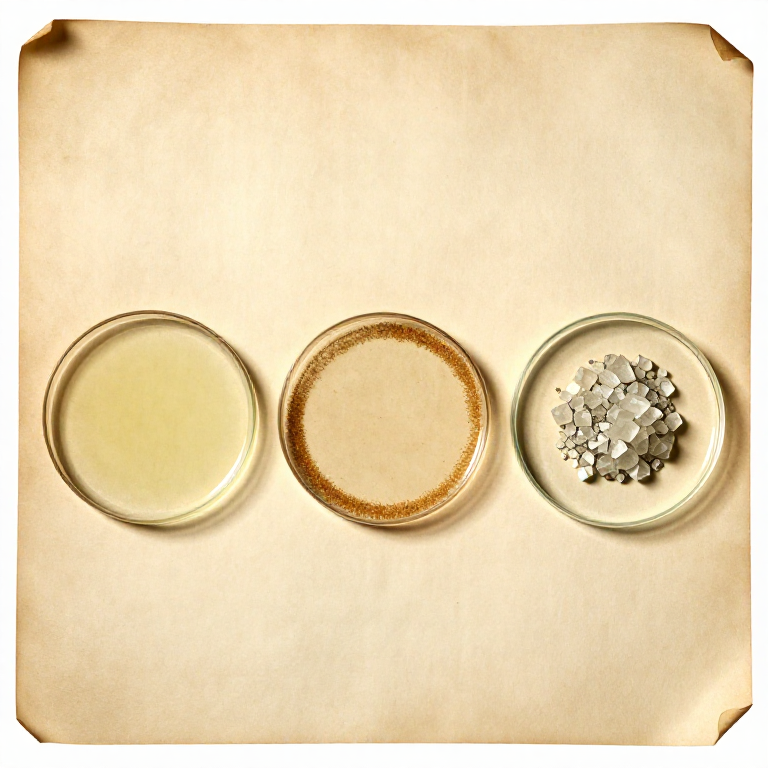


Getting the Solid Back: Evaporate, Crystallise, and Dry to Constant Mass
Boiling a solution dry gives you everything that was dissolved in it, including the impurities. Letting it crystallise slowly gives you the substance you wanted and leaves most of the impurities in the liquid — because a growing crystal is fussy about what it lets in.
So evaporating to dryness and crystallising are not two ways of doing the same job. The first is for recovering everything; the second is for purifying.
Then there is the question of when it is actually DRY, which cannot be answered by looking. The answer is a measurement loop: dry, weigh, dry again, weigh again, and stop when the mass stops changing.
Intermediário
3 hours
Instruções
1
1
Evaporate gently, and never to the last drop over heat
Evaporate gently, and never to the last drop over heat
Use a wide, shallow evaporating dish rather than a beaker: evaporation happens at the surface, so the area is what sets the speed, and a wide dish is faster at a much lower temperature.
Stop while a little liquid remains and let the rest go at room temperature. Once the liquid is nearly gone there is nothing left to absorb the heat, the solid overheats in seconds, and it spits, decomposes or bakes onto the dish.
A steam bath or a hot plate on a low setting is better than a flame for anything that matters. Direct flame heats one spot far above the boiling point of the solution, and many substances that survive 100 degrees do not survive that.
Materiais para este passo:
 Água destilada1 litro
 Cloreto de sódio (sal)1 peça
Ferramentas necessárias:
 Cápsula de evaporação
 Placa de aquecimento
 Vidro de relógio
2
2
Crystallise slowly, and crystallise on purpose
Crystallise slowly, and crystallise on purpose
Dissolve the solid in the smallest volume of hot solvent that will take it, then let it cool UNDISTURBED. Slow cooling grows few, large, pure crystals; rapid cooling or stirring gives a mass of tiny ones that trap the mother liquor and everything dissolved in it.
If nothing appears, it is usually because there is too much solvent or because there is no nucleus to start on. Boil a little solvent off, scratch the inside of the glass with a rod at the surface, or add one seed crystal.
Then filter the crystals off cold and rinse them with a SMALL amount of ICE-COLD solvent. Rinsing with warm solvent dissolves the product you just spent an hour growing, which is the most disheartening way to lose a yield.
Materiais para este passo:
Água destilada1 litro Sulfato de cobre penta-hidratado (CuSO4·5H2O)1 peça
Ferramentas necessárias:
 Copo de vidro (gobelé)
 Vareta de vidro
 Funil de Büchner (porcelana)
 Papel de filtro
3
3
Dry to constant mass, which is a measurement not a judgement
Dry to constant mass, which is a measurement not a judgement
A carregar o notebook Jupyter…
Materiais para este passo:
Cloreto de sódio (sal)1 peçaFerramentas necessárias:
 Estufa de secagem
 Exsicador de vidro
 Balança de precisão
 Computador de secretária
4
4
Work out the yield, and be honest about it
Work out the yield, and be honest about it
Percentage yield is what you got divided by what the equation says you could have got. Both numbers have to be real: the mass actually recovered and dried, and the theoretical mass calculated from the LIMITING reagent.
Yields above 100% mean the product is not dry, or it has picked up something. That is worth treating as a fault rather than a bonus, because a wet product weighs more and is worth less.
Record where the losses went, in the notebook: left in the mother liquor, stuck to the filter paper, lost in the rinse, spilled. Those lines are what make the next attempt better, and a yield with no explanation attached is a number nobody can improve.
Ferramentas necessárias:
Balança de precisão Calculadora
Materiais
3- 2 litrosReferência
- 1 peçaReferência
- Referência
Ferramentas necessárias
12- Referência
- Referência
- Referência
- Referência
- Referência
- Referência
- Referência
- Referência
- Exsicador de vidro10% de comissãoReferência
- Referência
- Referência
- Referência
Blueprints relacionados
Estes blueprints compartilham conhecimento — técnicas, materiais ou princípios


CC0 Domínio Público
Este blueprint é liberado sob CC0. Você é livre para copiar, modificar, distribuir e usar este trabalho para qualquer finalidade, sem pedir permissão.
Apoie o Maker comprando produtos através do Blueprint, onde ele ganha uma Comissão Maker definida pelos vendedores, ou crie uma nova versão deste Blueprint e inclua-o como conexão no seu próprio Blueprint para compartilhar receita.