ARTE
BELEZA E BEM-ESTAR
ARTESANATO
CULTURA E HISTÓRIA
ENTRETENIMENTO
MEIO AMBIENTE
COMIDA E BEBIDAS
ENGENHARIA REVERSA
CIÊNCIAS
ESPORTES
TECNOLOGIA
TECNOLOGIA VESTÍVEL
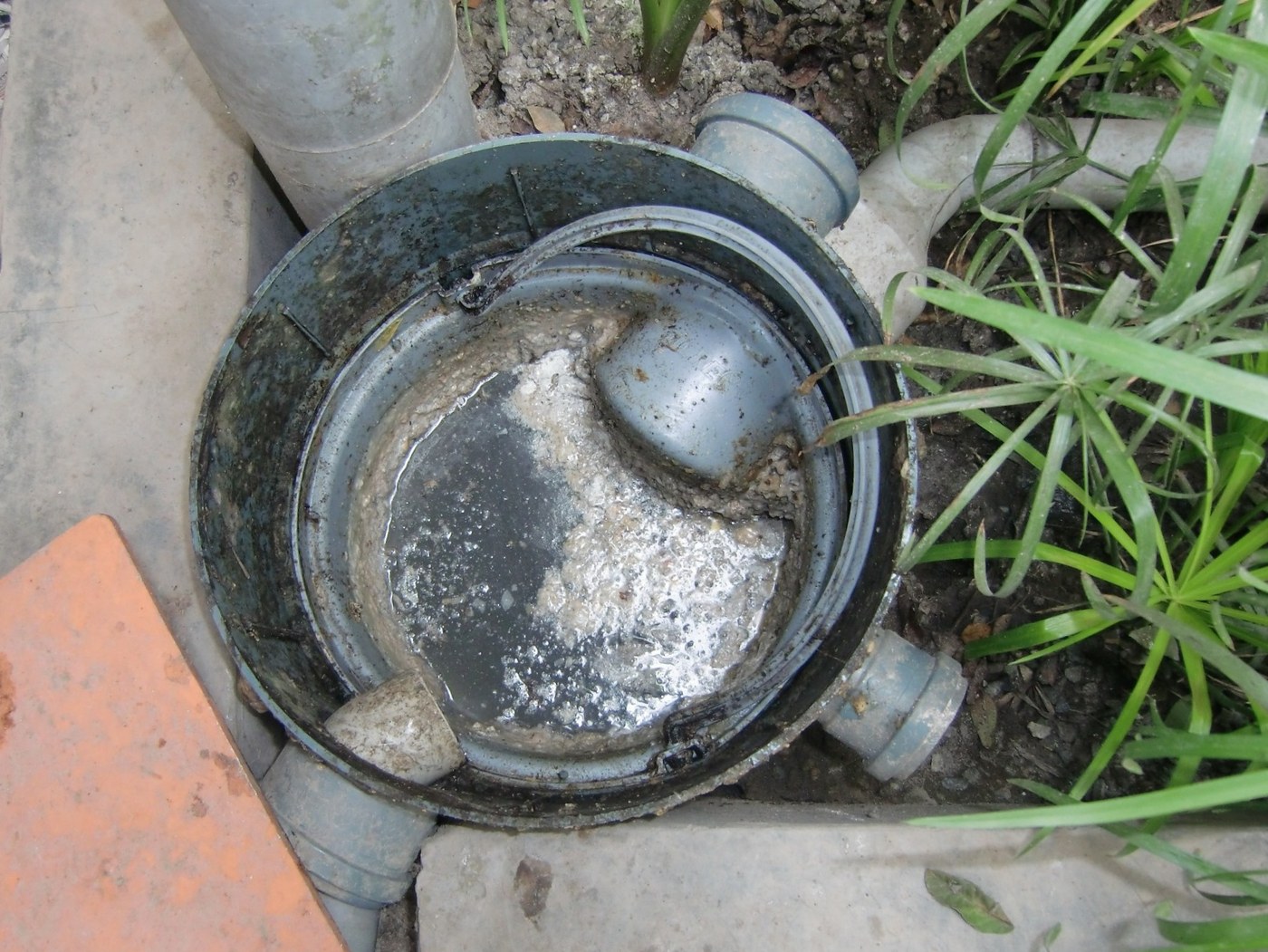


The Grease Interceptor
Fats, oils and grease are the single commonest cause of sewer blockage, and the mechanism is worth stating precisely because the popular version is wrong. Warm grease going down a kitchen sink is a liquid and travels perfectly well. It cools in the drain, congeals on the pipe wall, and then does something worse: the fatty acids in it react with calcium in the wastewater and in concrete pipes to form calcium salts of fatty acids — literally soap, but a hard insoluble one. That is what a fatberg is made of. It is not solidified fat, it is saponified fat, and it is why the deposits are rock-hard rather than greasy.
So the answer is to take the grease out while it is still grease, close to where it is produced, before it has cooled and reacted.
A grease interceptor does that with nothing but time and gravity. Fats are less dense than water — typically 900 to 930 kilograms per cubic metre against 1000 — so given a quiet volume and enough residence time they rise. The interceptor is a small tank with the inlet and outlet arranged so water must travel down, across and up again, while anything that floats stays behind at the top and anything that sinks stays behind at the bottom.
It is the same physics as the sedimentation tank, run upside down. There, particles denser than water settle and are removed from the bottom. Here, droplets lighter than water rise and are removed from the top. Both are Stokes' law, and both are sized by the same rule: the rise or fall velocity must exceed the overflow rate.
The device is simple. Getting it to work is a maintenance problem rather than an engineering one, and the reason is arithmetic you will do: an interceptor sized for a busy kitchen fills with grease in weeks, and a full interceptor does not merely stop working — it starts DISCHARGING what it collected, in slugs, which is worse than never having fitted one.
Intermediário
5 hours
Instruções
1
1
Build the tank, and get the baffles right
Build the tank, and get the baffles right
The tank is trivial. The baffles are the device.
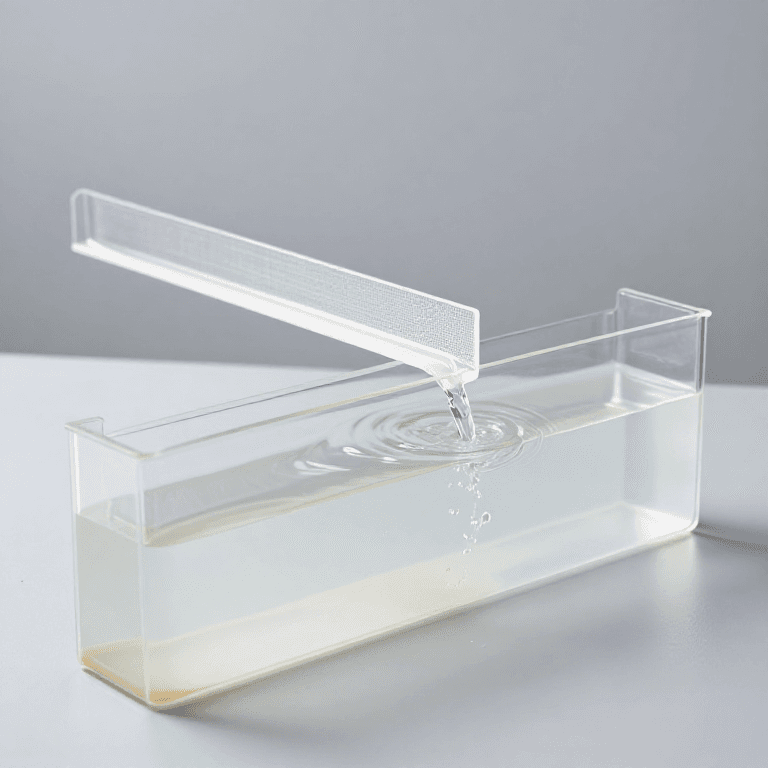
THE VESSEL. A clear container of about 20 litres — clear, because the whole point is watching three layers form and you cannot manage what you cannot see. Real ones are opaque, which is precisely why real ones are neglected.
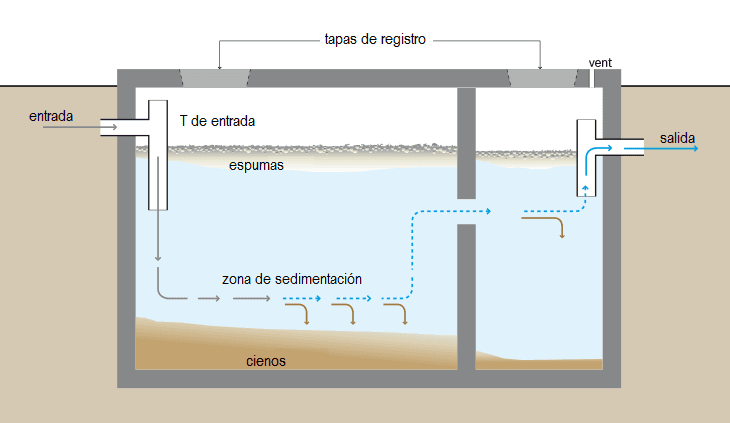
THE INLET. Water enters and must be brought DOWN below the grease layer without disturbing it. Fit a vertical dip pipe from the inlet reaching to about one third of the depth, and put a small tee on its top so incoming flow is broken before it descends. An inlet that dumps water onto the surface stirs the accumulated grease straight back into suspension and out of the outlet, and the interceptor becomes a mixing vessel.
THE OUTLET. Water must leave from the MIDDLE — below the floating grease, above the settled solids. A vertical outlet pipe with its intake at about two thirds depth, turning up and over to the outlet. This is exactly the draw-from-the-middle arrangement the septic tank blueprint uses, for exactly the same reason.
THE BAFFLE. A vertical plate across the tank, hanging from above the water line down to about half depth, dividing the tank into an inlet chamber and an outlet chamber. Flow must pass UNDER it. The baffle does two jobs: it stops floating grease travelling directly to the outlet, and it stops incoming turbulence reaching the outlet side, so the outlet chamber is always quieter than the inlet chamber and does the final separation.
Set the water line by the outlet height, and leave at least 150 millimetres of freeboard above it. That space is where the grease lives, and an interceptor with no freeboard has nowhere to store what it captures.
A VENT is required on the real thing and easy to forget. The interceptor sits in a drain line, so it needs to breathe or it will siphon. Take a small vent up from the outlet chamber. Without it, a strong discharge can pull the tank down and drag the grease layer out with it.
TEST IT COLD FIRST. Run clean water through at the design rate and dye-test it: inject food colouring at the inlet and watch the path. You should see the dye travel down the dip pipe, along the floor, under the baffle, and up to the outlet — a long, slow, orderly route. If the dye reaches the outlet quickly across the surface, the baffle is too shallow or the inlet is too high, and the tank is short-circuiting.
Measure the actual residence time with the dye and compare it with volume divided by flow. As with every tank in this domain, you will get less than theory. Sixty to seventy percent is respectable.
Materiais para este passo:
 Buckets (20 liter)2 peças
 Acrylic Sheet1 square metre
 Clear PVC Pipe (32mm)3 metre
 PVC Pipe Fittings Assortment (32mm)1 conjunto
 Silicone Sealant1 peça
 Food Colouring (Concentrated)1 peça
Ferramentas necessárias:
 Hole Saw Kit
 Cordless Drill/Driver
 Hacksaw
 Stopwatch
 Bucket
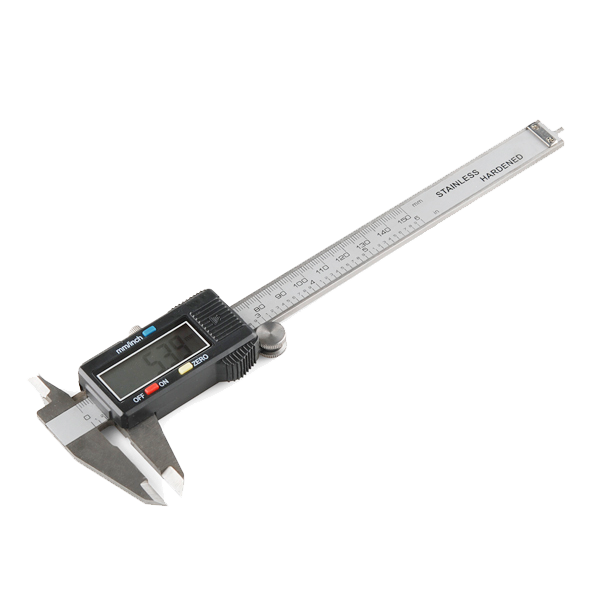 Digital Calipers - 152.4 mm
2
2
Feed it real kitchen waste and find the two ways it fails
Feed it real kitchen waste and find the two ways it fails
Make up a realistic feed: warm water at about 45 degrees with vegetable oil and a little washing-up liquid, which is exactly what leaves a kitchen sink. Measure the oil in.
MEASURE THE CAPTURE EFFICIENCY. Feed a known mass of oil in over a period, then measure how much leaves in the outlet — catch the effluent, let it stand and separate, and weigh the oil recovered. Capture divided by input is your efficiency. A well-made interceptor at a sensible flow should hold 80 to 95 percent.
NOW FIND FAILURE ONE: TOO FAST. Raise the flow rate and repeat. Efficiency falls, and it falls faster than you expect, because rise velocity is fixed by droplet size and density while the overflow rate rises linearly with flow. At some flow, droplets simply do not have time to reach the surface before the water carrying them reaches the outlet. Find that flow. It is your device's rated capacity, and the reason real interceptors are sized on peak flow rather than on daily volume.
FIND FAILURE TWO: DETERGENT, and this is the one that surprises people. Repeat the efficiency test with a generous dose of washing-up liquid — a realistic amount for a commercial kitchen.
Efficiency collapses. Detergent is a surfactant, and its entire purpose is to keep oil dispersed in water as fine droplets rather than letting it coalesce. Stokes' law says rise velocity goes as the SQUARE of droplet diameter, so a surfactant that cuts droplet size from 500 micrometres to 50 cuts the rise velocity by a factor of a hundred. Emulsified grease passes straight through an interceptor that would have caught it easily.
This is not a defect in the interceptor. It is a genuine limit of gravity separation, and it explains a real operational fact: interceptors in kitchens that use a lot of hot detergent perform far worse than their rating, and the answer is upstream practice — scrape plates, use less detergent, avoid very hot washes into the interceptor — rather than a bigger tank.
FIND FAILURE THREE: FULL. Keep running the interceptor without cleaning it. The grease layer thickens, and the effective volume — the water between the bottom of the grease and the top of the sludge — shrinks. Residence time falls in proportion. Efficiency drops steadily.
Then the important part: keep going. When the grease layer reaches the bottom of the baffle, flow is forced through it, and the interceptor begins DISCHARGING accumulated grease in slugs. Measure that. The outlet concentration briefly exceeds the inlet concentration — the device is now worse than no device at all, because it is delivering weeks of accumulated grease into the sewer in concentrated batches.
That is why the rule is a maintenance rule: clean it when the combined grease and solids reach 25 percent of the liquid depth. Not when it stops working — well before, because by the time it visibly stops working it has already been making things worse.
Materiais para este passo:
 Olive Oil (Pomace Grade, 1L)5 litros
 Mild Soap1 peça
 Glass Fibre Filter Papers (1.2 micron)50 peças
 Separating Funnel1 peça
Ferramentas necessárias:
 Precision Digital Scale (0.01g)
 Thermometer (Lab)Stopwatch
 Graduated Cylinder (100 ml)
 Digital Microscope
3
3
Stokes upside down, and the maintenance interval nobody keeps
Stokes upside down, and the maintenance interval nobody keeps
A carregar o notebook Jupyter…
Ferramentas necessárias:
 Desktop Computer
Materiais
10- 2 peçasReferência
- 1 square metreReferência
- 3 metreReferência
- 1 conjuntoReferência
- 1 peçaReferência
- Referência
- 5 litrosReferência
- 1 peçaReferência
- Referência
- 1 peçaReferência
Ferramentas necessárias
11- Referência
- Referência
- Referência
- Referência
- Referência
- Digital Calipers - 152.4 mm10% de comissãoR$74.32
- Referência
- Referência
- Referência
- Referência
- Referência
Blueprints relacionados
Estes blueprints compartilham conhecimento — técnicas, materiais ou princípios
CC0 Domínio Público
Este blueprint é liberado sob CC0. Você é livre para copiar, modificar, distribuir e usar este trabalho para qualquer finalidade, sem pedir permissão.
Apoie o Maker comprando produtos através do Blueprint, onde ele ganha uma Comissão Maker definida pelos vendedores, ou crie uma nova versão deste Blueprint e inclua-o como conexão no seu próprio Blueprint para compartilhar receita.