Colaboração
ARTE
BELEZA E BEM-ESTAR
ARTESANATO
CULTURA E HISTÓRIA
ENTRETENIMENTO
MEIO AMBIENTE
COMIDA E BEBIDAS
ENGENHARIA REVERSA
CIÊNCIAS
ESPORTES
TECNOLOGIA
TECNOLOGIA VESTÍVEL
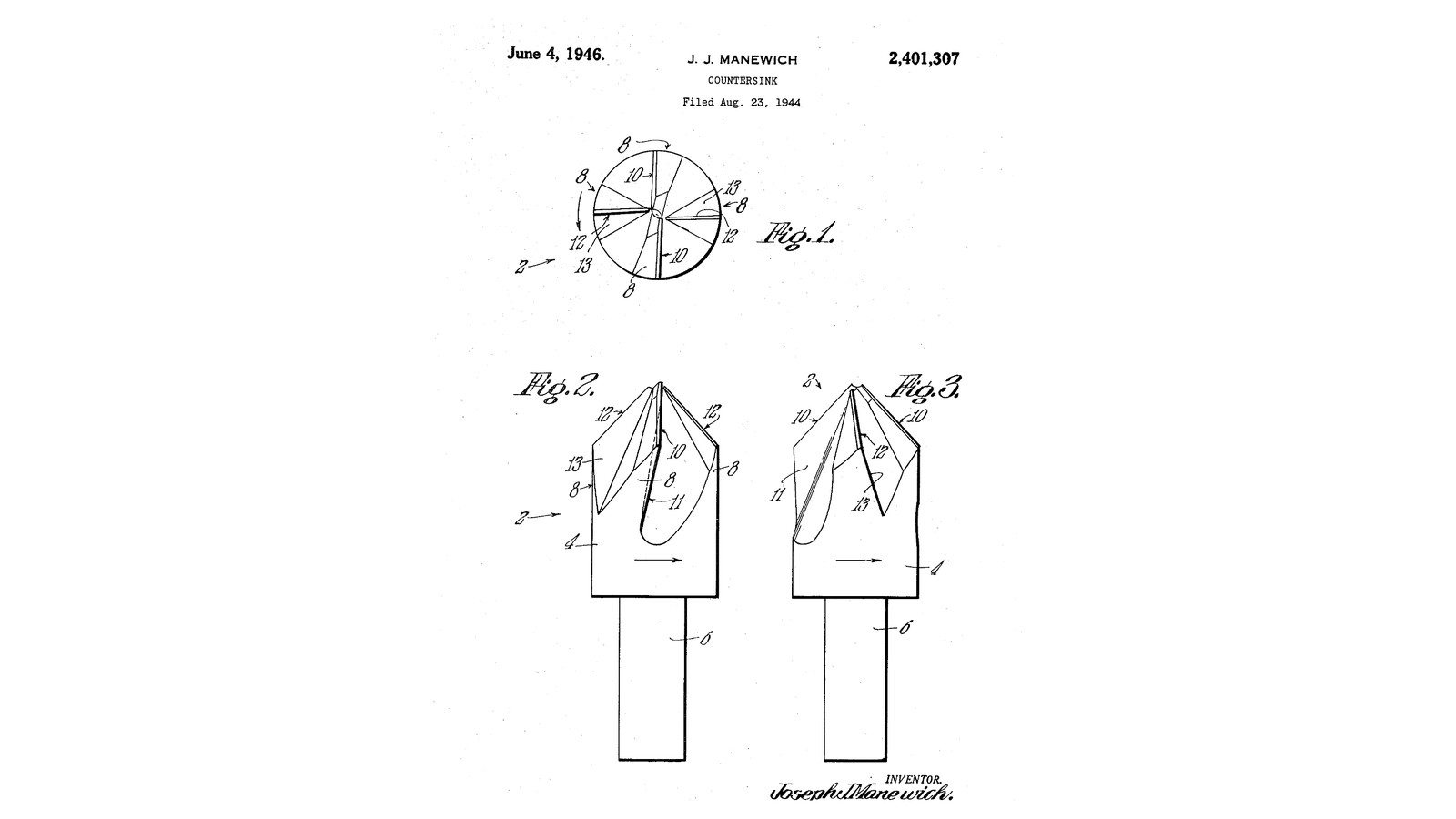


Four-Edge Chatterless Countersinks: Two Pairs of Edges Set Off the Centre Lines, One Raked Each Way (Manewich, 1946)
Joseph J. Manewich of Longmeadow, Massachusetts, received US 2,401,307, dated 4 June 1946, for a countersink that does not chatter. Four teeth are gashed in the cone. The inner ends of one pair of edges sit just ahead of a line through the centre, with their faces raked back. The other pair sit just behind a line at right angles, raked forwards. The edges keep changing how they meet the work as the tool goes in, and each steadies the one opposite, so it can run faster and leaves round, smooth countersinks.
We make a set of three in tool steel. The patent gives no sizes or angles; ours are stated.
Avançado
About 1 day
Instruções
1
1
Why the edges are set off the centre lines
Why the edges are set off the centre lines
A carregar o notebook Jupyter…
2
2
Read US 2,401,307
Read US 2,401,307
"It has been found that the countersink tool by reason of its novel construction and arrangement may be operated at a higher speed than may those of the prior art while at the same time objectionable chatter is eliminated."
3
3
Turn the blanks
Turn the blanks
From octagonal tool steel turn three blanks: a 90 degree cone to a point, 12, 16 and 20 mm across, a short body 4 and an 8 mm shank 6 50 mm long with three filed flats. Heat each to a cherry red and let it cool slowly in the air.
Materiais para este passo:
 Barra octogonal de aço para ferramentas2 peças
Ferramentas necessárias:
 Torno mecânico
 Placa de torno de 3 castanhas
 Ferramenta de corte para torno
 Goiva de sangrar
 Transferidor
 Paquímetro digital de 6 polegadas
 Jogo de limas
 Forja
 Tenaz de forja
 Óculos de segurança
4
4
Mark and gash the four teeth 8
Mark and gash the four teeth 8
Blue the cone and scribe two diameters across its end at right angles. Mark the positive pair's edges 10 parallel to the first diameter, 0.5 mm ahead of it in the direction of turning, and the negative pair's edges 12 parallel to the second, 0.5 mm behind it. File or grind a gash 11 ahead of each edge, down the cone: for the edges 10 the face raked back about 8 degrees (positive), for the edges 12 raked forward about 5 degrees (negative). Give each edge a little clearance behind it.
Ferramentas necessárias:
 Jogo de limas de agulha
 Morsa de máquinaJogo de limas
 Esmeriladora de bancadaTransferidor
5
5
Harden and temper
Harden and temper
Heat each head to a cherry red, until a magnet no longer sticks, and quench it point first in water, moving it about. Rub it bright with a stone, heat the shank gently 20 mm behind the head, and quench again as soon as a light straw colour reaches the cutting edges.
Ferramentas necessárias:
ForjaTenaz de forja Íman pequeno
 Balde de têmpera
 Água
 Pedra de amolar
 Luvas de soldadorÓculos de segurança
6
6
Hone and test
Hone and test
Hone all four edges lightly with the stone. Countersink holes in hardwood and in a scrap of aluminium at a higher speed than usual: the cone should be round and smooth, with no chatter marks.
Ferramentas necessárias:
Pedra de amolar Berbequim sem fios
 Jogo de brocas
 Tábua de madeira de leiÓculos de segurança
7
7
Troubleshooting
Troubleshooting
Four-edge countersink troubleshooting.
Flow
Loading...
8
8
History and honest limits
History and honest limits
**Joseph J. Manewich** of Longmeadow, Massachusetts, US 2,401,307, dated 4 June 1946, filed 23 August 1944. He claimed cutting edges in two pairs, "the innermost portions of the cutting edges of one pair thereof disposed adjacent said longitudinal axis and forwardly" of a plane through it, and those of the other pair "rearwardly" of another plane at right angles. He calls the first positive edges with positive rake and the second negative with negative rake. He gives no sizes, offsets or angles; ours are stated, with the house hardening.
Materiais
1- Referência
Ferramentas necessárias
21- Referência
- Referência
- Referência
- Referência
- Referência
- Referência
- Referência
- Referência
- Referência
- Referência
- Referência
- Referência
- Referência
- Referência
- Referência
- Referência
- Referência
- Referência
- 1 vendor sell this, none ship to you yetReferência
- Referência
- Referência
Este projeto faz

Blueprints relacionados
Estes blueprints compartilham conhecimento — técnicas, materiais ou princípios
CC0 Domínio Público
Este blueprint é liberado sob CC0. Você é livre para copiar, modificar, distribuir e usar este trabalho para qualquer finalidade, sem pedir permissão.
Apoie o Maker comprando produtos através do Blueprint, onde ele ganha uma Comissão Maker definida pelos vendedores, ou crie uma nova versão deste Blueprint e inclua-o como conexão no seu próprio Blueprint para compartilhar receita.