Colaboração
ARTE
BELEZA E BEM-ESTAR
ARTESANATO
CULTURA E HISTÓRIA
ENTRETENIMENTO
MEIO AMBIENTE
COMIDA E BEBIDAS
ENGENHARIA REVERSA
CIÊNCIAS
ESPORTES
TECNOLOGIA
TECNOLOGIA VESTÍVEL
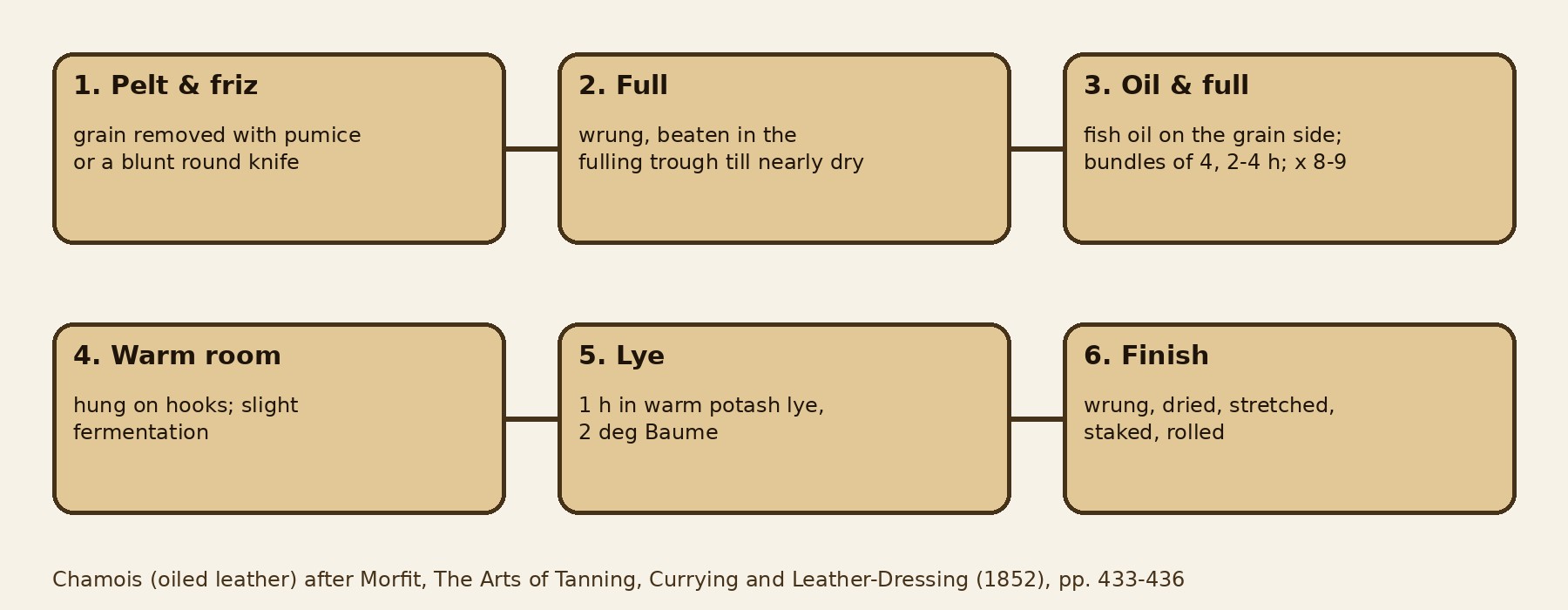


Chamois Wash Leather: Frized Pelts Fulled With Fish Oil Eight or Nine Times (Morfit, 1852)
Oil-tawed chamois or wash leather, from Campbell Morfit's Arts of Tanning, Currying and Leather-Dressing (1852): sheep, goat or deer pelts with the grain rubbed off, beaten again and again with fish oil until it is worked right in, warmed so the oil sets in the fibre, then washed of excess oil in weak potash lye and finished soft. No tannin, no alum.
Avançado
About 2 weeks
Instruções
1
1
Oil budget
Oil budget
A carregar o notebook Jupyter…
2
2
Read The Arts of Tanning
Read The Arts of Tanning
"Oiled leather is commonly known as chamois, or wash-leather ... from its property of bearing wetting and washing."
3
3
Make pelts and friz
Make pelts and friz
Choose the finest goat, sheep, lamb or deer skins (or thin split sides). Bring them to pelt as for kid leather: wash, lime, fleece, beam and bran. Then friz them: rub with a pumice stone, or work under the round edge of a blunt knife, to remove the grain, even the thickness and soften the skin.
Materiais para este passo:
 Pele de ovelha12 peças
 Cal apagada1 peça
 Farelo de trigo1 peça
Ferramentas necessárias:
 Tina de curtimenta
 Cavalete de descarnar
 Faca de descarnar
 Pedra-pomes
4
4
Oil and full
Oil and full
Wring the skins and beat them in the fulling trough until nearly dry. Spread each on the table and sprinkle the grain side with cod or other fish oil, fold them in bundles of four, and beat again 2 to 4 hours. Open and air them briefly, grease again, and full again. Repeat eight or nine times until thoroughly imbued, with no greasy look. 3 to 5 gallons of oil serve a gross of skins. (By hand: beat them in a tub with a heavy wooden mallet, our method.)
Materiais para este passo:
 Óleo de peixe1 peça
Ferramentas necessárias:
Tina de curtimenta Maço de madeira
5
5
Warm and set
Warm and set
Hang the skins on hooks from wooden hangers in a warm drying room (his is about 6 ft high and 12 ft square, heated by steam-pipes or a stove). A slight fermentation sets the oil into the fibre.
6
6
Wash out the excess
Wash out the excess
Handle the skins for an hour in slightly warm potash lye of 2 deg Baume, which turns the excess oil to soap. Wring them at the peg, dry, finish on the stretcher and the stake (horse), and smooth with rollers. For a buff colour dip them in an oak-bark infusion (a dye here, not a tan).
Materiais para este passo:
 Hidróxido de potássio1 peça
 Casca de carvalho (triturada)1 peça
Ferramentas necessárias:
Tina de curtimenta Balde de 20 litros
7
7
Troubleshooting
Troubleshooting
Chamois troubleshooting.
Flow
Loading...
8
8
History and honest limits
History and honest limits
From Campbell Morfit, **The Arts of Tanning, Currying, and Leather-Dressing** (1852), "Oiled Leather" (checked on the archive.org scan artsoftanningcur00morf, pp. 433-436). He refers back to kid leather for the pelt stage. Hand fulling, the tools and the diagram are ours.
Materiais
6- 12 peçasReferência
- 1 peçaReferência
- 1 peçaReferência
- 1 peçaReferência
- 1 peçaReferência
- Referência
Ferramentas necessárias
6- Referência
- Referência
- Referência
- Referência
- Referência
- Referência
Este projeto faz
Blueprints relacionados
Estes blueprints compartilham conhecimento — técnicas, materiais ou princípios
CC0 Domínio Público
Este blueprint é liberado sob CC0. Você é livre para copiar, modificar, distribuir e usar este trabalho para qualquer finalidade, sem pedir permissão.
Apoie o Maker comprando produtos através do Blueprint, onde ele ganha uma Comissão Maker definida pelos vendedores, ou crie uma nova versão deste Blueprint e inclua-o como conexão no seu próprio Blueprint para compartilhar receita.