ARTE
BELEZA E BEM-ESTAR
ARTESANATO
CULTURA E HISTÓRIA
ENTRETENIMENTO
MEIO AMBIENTE
COMIDA E BEBIDAS
ENGENHARIA REVERSA
CIÊNCIAS
ESPORTES
TECNOLOGIA
TECNOLOGIA VESTÍVEL
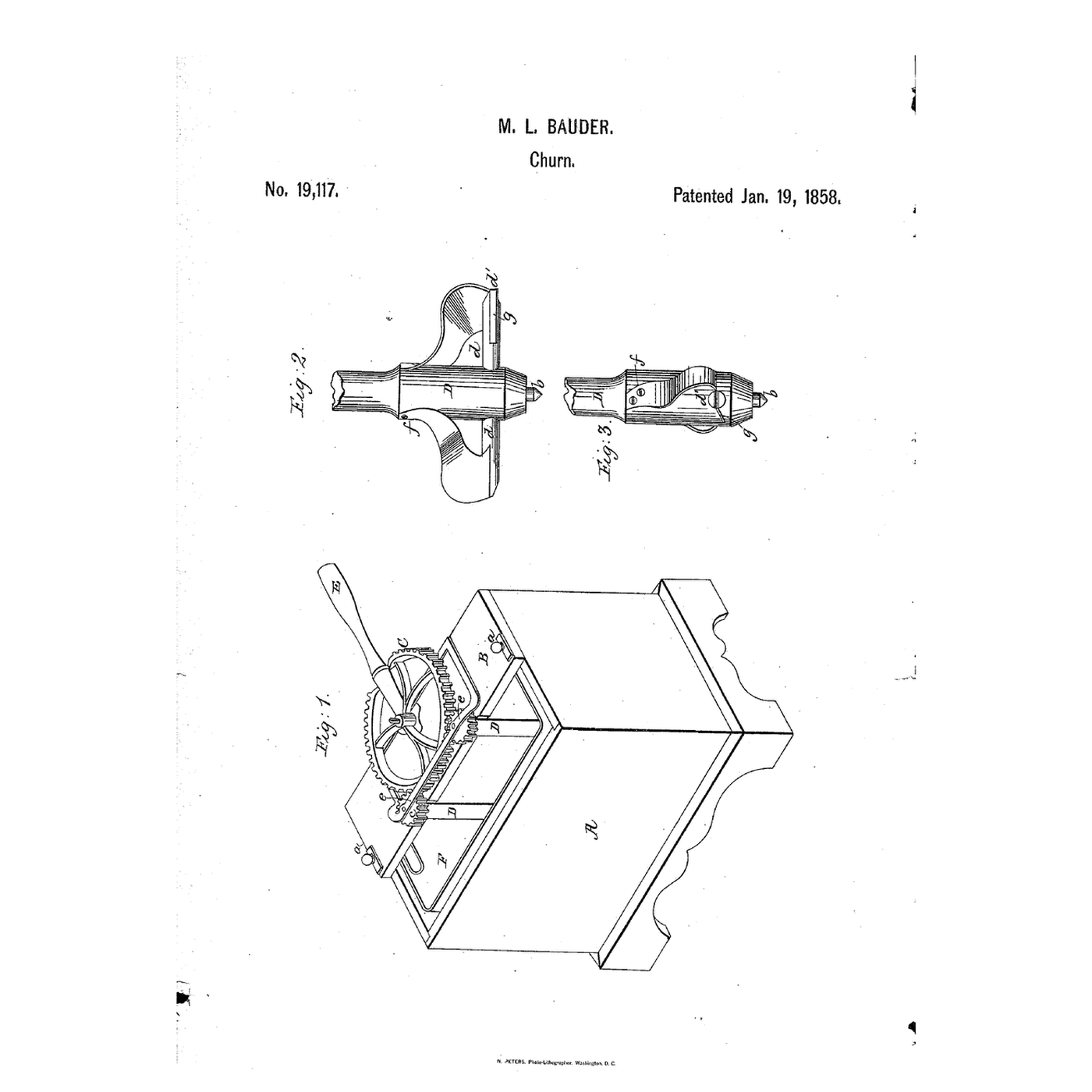


Ogee-Float Twin-Shaft Churn: Two Rocking Shafts Drive the Cream's Currents Into Each Other
Michael L. Bauder of Elyria, Ohio, received US 19,117, dated 19 January 1858, for an elongated churn in a wooden case that holds hot or cold water round it, with two upright shafts carrying ogee-curved floats, both rocked by one segment wheel, "driving the currents of cream violently into each other at the central parts of the churn."
This rung prints the floats, hubs, segment wheel and pinions, builds the churn and makes butter.
Avançado
About 5 hours, plus printing
Instruções
1
1
One handle, two shafts
One handle, two shafts
A carregar o notebook Jupyter…
2
2
Water round the churn before it
Water round the churn before it
The Crowells temper with water under the churn; Bauder's case holds water all round it.
3
3
Read US 19,117
Read US 19,117
"My invention consists first of two sets of beaters on two shafts so situated in an ovoid or elongated vessel that the beater on one shaft whirls all the cream in one end of the churn alternately forward and backward, while the beater on the other shaft whirls all the cream in the other end of the churn in the opposite direction, for the purpose of driving the currents of cream violently into each other at the central parts of the churn where the air is drawn into the cream."
4
4
Print the parts
Print the parts
Print four ogee floats (/uploads/blueprints/ogee-float-twin-shaft-churn-ogee-float.stl), two arm hubs (/uploads/blueprints/ogee-float-twin-shaft-churn-arm-hub.stl), the segment wheel with its handle (/uploads/blueprints/ogee-float-twin-shaft-churn-segment-wheel.stl) and two pinions (/uploads/blueprints/ogee-float-twin-shaft-churn-pinion.stl). Print in PETG at 0.2 mm layers, 30 % infill, 4 walls; wash before first use.
Materiais para este passo:
 Filamento PETG1 peça
Ferramentas necessárias:
 Impressora 3D de filamento (FDM)
5
5
Vessel, case and shafts
Vessel, case and shafts
Stand a long rectangular food-grade container inside a larger one, spaced off by short pine cleats, so water can be poured between them. Stand two 10 mm square hardwood shafts in the inner one, 87 mm either side of the middle, each with a hub and a 10 mm square hardwood arm through it carrying a float at each end; set the two arms at right angles.
Materiais para este passo:
 Recipiente de armazenamento de grau alimentar2 peças
 Tábua de pinho1 peça
 Cavilhas de madeira dura1 peça
 Cola de madeira1 peça
Ferramentas necessárias:
 Serrote
 Berbequim sem fios
 Jogo de brocas
6
6
Segment and pinions
Segment and pinions
Fix a pine bar across the outer container, with bearing holes for the shafts and a pivot for the segment wheel between them. Fix a pinion on each shaft's top and mount the segment so it meshes both.
Materiais para este passo:
Tábua de pinho1 peça Varão de aço macio1 peça
 Parafuso para madeira n.º 8 x 1"1 peça
Ferramentas necessárias:
SerroteBerbequim sem fios Conjunto de chaves de fendas
7
7
The build in 3D
The build in 3D
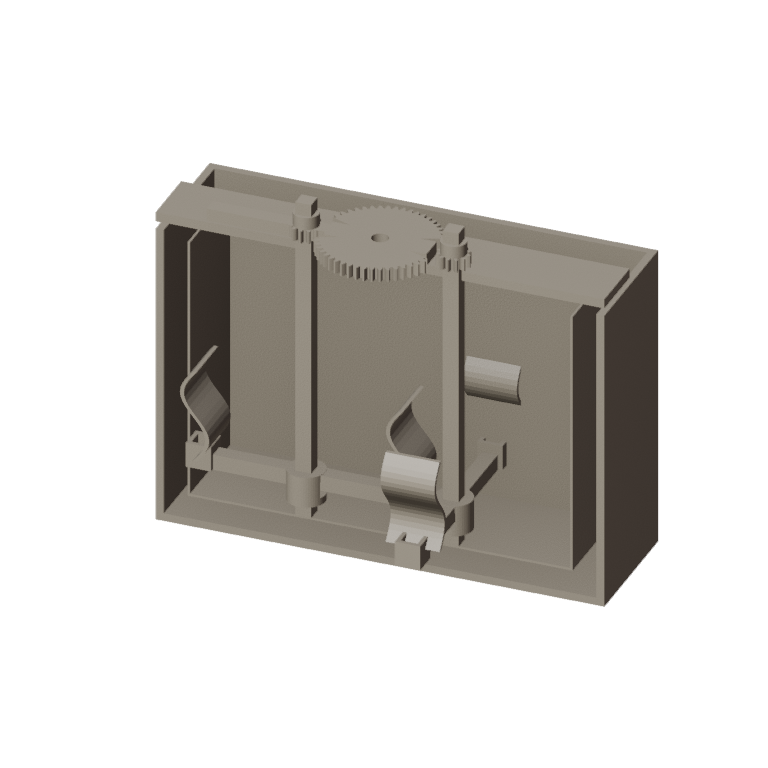
FreeCAD model of this build: the case and inner vessel cut away to show the two shafts with their ogee floats at right angles, and the segment wheel meshing both pinions.
8
8
Temper and churn
Temper and churn
Let the heavy cream stand until it reaches about 15 °C, checked with the thermometer. Pour cold or lukewarm water into the space between the containers to set the temperature. Pour 2 litres of cream into the inner one and rock the handle steadily left and right; time until the butter comes. Pour off the buttermilk, add cold water, churn a little and pour off again until it runs clear; work in a pinch of salt and weigh the butter.
Materiais para este passo:
 Natas para bater2000 ml
 Sal marinho grosso1 peça
 Água1 peça
Ferramentas necessárias:
 Termómetro de sonda permanente
 Cronómetro
 Balança digital de cozinha
 Taça grande de aço inoxidável
9
9
Troubleshooting
Troubleshooting
Twin-shaft churn troubleshooting.
Flow
Loading...
10
10
History and honest limits
History and honest limits
**Michael L. Bauder** of Elyria, Lorain County, Ohio, US 19,117, 19 January 1858. His inner body was zinc or tin; he wrote that the case could also serve as a refrigerator for packing butter, and that the churn is best worked with half the cover off. He did not claim shafts with beaters in round churns, nor a reciprocating motion; he claimed the elongated vessel with the two armed shafts in the case. Two containers and printed parts stand in for his. FDM prints hold food in their layer lines, so wash well and replace when worn.
Materiais
10- 1 peçaReferência
- Referência
- 1 peçaReferência
- 1 peçaReferência
- 1 peçaReferência
- 1 peçaReferência
- Referência
- 2000 mlReferência
- 1 peçaReferência
- 1 peçaReferência
Ferramentas necessárias
9- Referência
- Referência
- 1 vendor sell this, none ship to you yetReferência
- Referência
- Referência
- Referência
- Referência
- Referência
- Referência
Ficheiros de design
1Blueprints relacionados
Estes blueprints compartilham conhecimento — técnicas, materiais ou princípios
Screw-Turned Pendulum Dash Churn: The Swing Lifts the Dasher, a Screw Turns It as It Goes
por Martin
COMIDA E BEBIDAS
3
0
0
0
0
0
Water-Jacketed Churn: Hot or Cold Water Under a Metal Plate Tempers the Cream
por Karen
COMIDA E BEBIDAS
1
0
0
0
0
0
Churning Butter from Cream — The 5,000-Year-Old Fat Separation
por TheChef
ARTESANATO
47
0
0
0
0
0
CC0 Domínio Público
Este blueprint é liberado sob CC0. Você é livre para copiar, modificar, distribuir e usar este trabalho para qualquer finalidade, sem pedir permissão.
Apoie o Maker comprando produtos através do Blueprint, onde ele ganha uma Comissão Maker definida pelos vendedores, ou crie uma nova versão deste Blueprint e inclua-o como conexão no seu próprio Blueprint para compartilhar receita.