ARTE
BELEZA E BEM-ESTAR
ARTESANATO
CULTURA E HISTÓRIA
ENTRETENIMENTO
MEIO AMBIENTE
COMIDA E BEBIDAS
ENGENHARIA REVERSA
CIÊNCIAS
ESPORTES
TECNOLOGIA
TECNOLOGIA VESTÍVEL
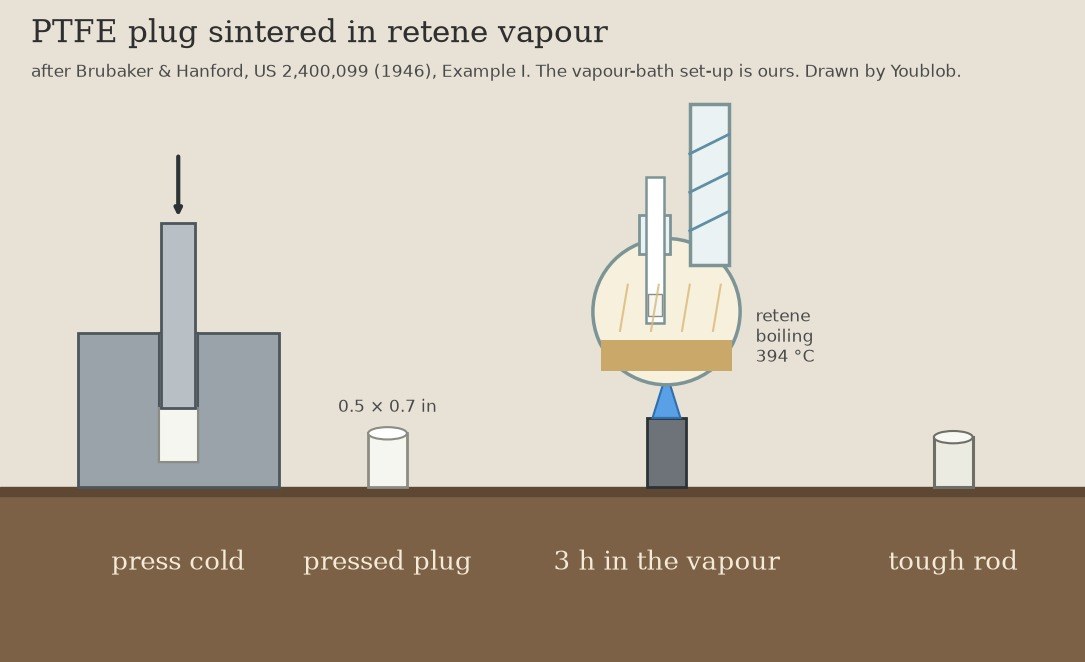


PTFE Rod: a Plug Sintered in Boiling Retene Vapour (Brubaker & Hanford 1946)
The first example of du Pont's way to shape PTFE: press a small rod of powder cold, then heat it above 327 °C out of the mould. Here the heat comes from the vapour of boiling retene, which boils at 394 °C, so the temperature holds steady by itself. The plug comes out sintered into one tough piece.
Source: M. M. Brubaker and W. E. Hanford (du Pont), US 2,400,099 (1946), Example I. The pressure is the patent's usual range, as the example gives none. The mould, press and the vapour-bath set-up are ours. Picture drawn by Youblob.
Avançado
1 day
Instruções
1
1
Press a plug from the powder
Press a plug from the powder
At room temperature, press small particles of PTFE in a mould into a plug 0.5 in across and 0.7 in long. The example gives no pressure; the patent's usual range is 100–3000 lb/sq in.
Materiais para este passo:
 Pó de resina de PTFE1 as required for the plug
Ferramentas necessárias:
 Molde de compressão
 Prensa hidráulica
 Régua
2
2
Set up a retene vapour bath
Set up a retene vapour bath
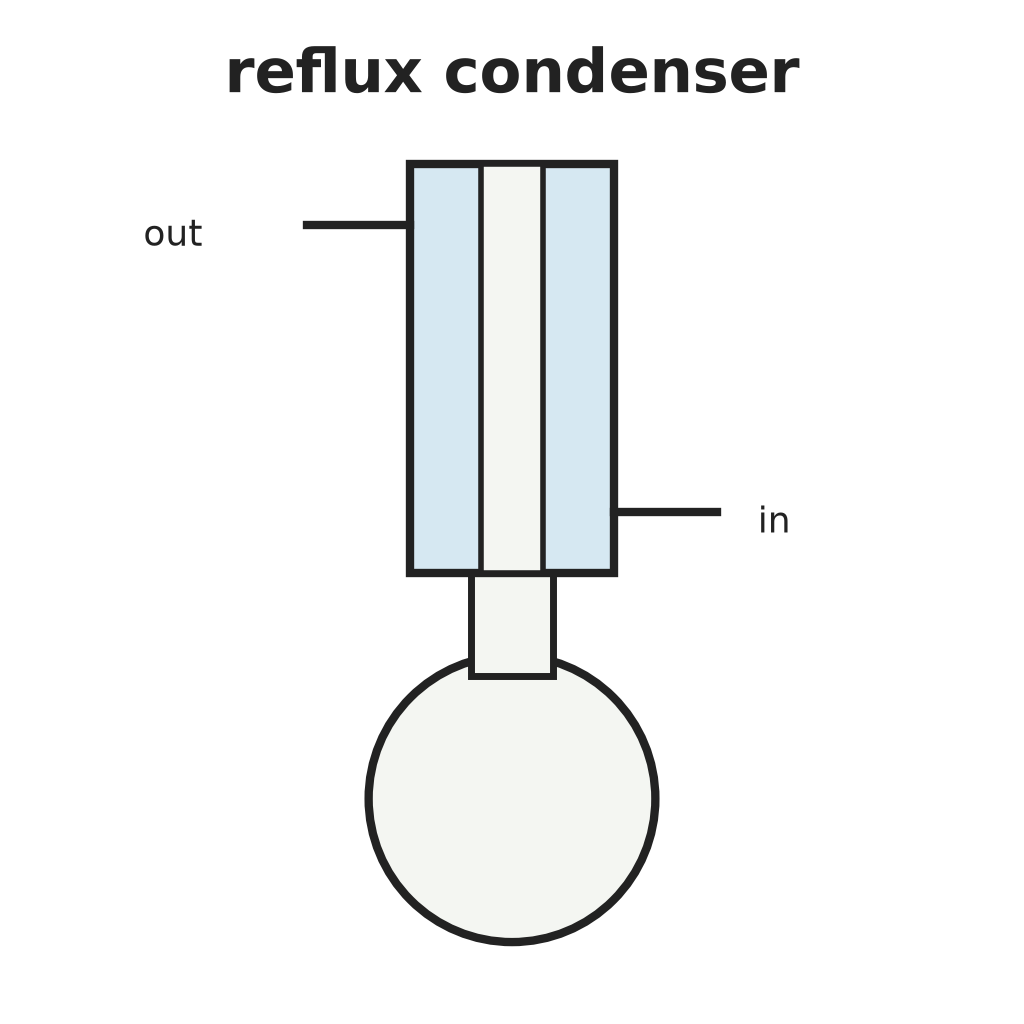
Boil retene so its vapour fills the space round a glass tube. Ours: retene in a flask on a burner, a reflux condenser on top, and the tube standing in the vapour.
Ferramentas necessárias:
 Reteno
 Balão de destilação de vidro
 Condensador de refluxo
 Bico de Bunsen
 Tubos de ensaio
3
3
Sinter for 3 hours
Sinter for 3 hours
Take the plug out of the mould, put it in the glass tube, and heat it in the vapour of boiling retene (394 °C) for 3 hours.
Ferramentas necessárias:
Tubos de ensaioRetenoBico de Bunsen4
4
Cool it under the retene
Cool it under the retene
Remove the heat source and let the plug cool where it is. It is now sintered together into a tough mass.
Ferramentas necessárias:
Tubos de ensaioMateriais
1- 1 as required for the plugReferência
Este projeto faz

Blueprints relacionados
Estes blueprints compartilham conhecimento — técnicas, materiais ou princípios


CC0 Domínio Público
Este blueprint é liberado sob CC0. Você é livre para copiar, modificar, distribuir e usar este trabalho para qualquer finalidade, sem pedir permissão.
Apoie o Maker comprando produtos através do Blueprint, onde ele ganha uma Comissão Maker definida pelos vendedores, ou crie uma nova versão deste Blueprint e inclua-o como conexão no seu próprio Blueprint para compartilhar receita.