ARTE
BELEZA E BEM-ESTAR
ARTESANATO
CULTURA E HISTÓRIA
ENTRETENIMENTO
MEIO AMBIENTE
COMIDA E BEBIDAS
ENGENHARIA REVERSA
CIÊNCIAS
ESPORTES
TECNOLOGIA
TECNOLOGIA VESTÍVEL
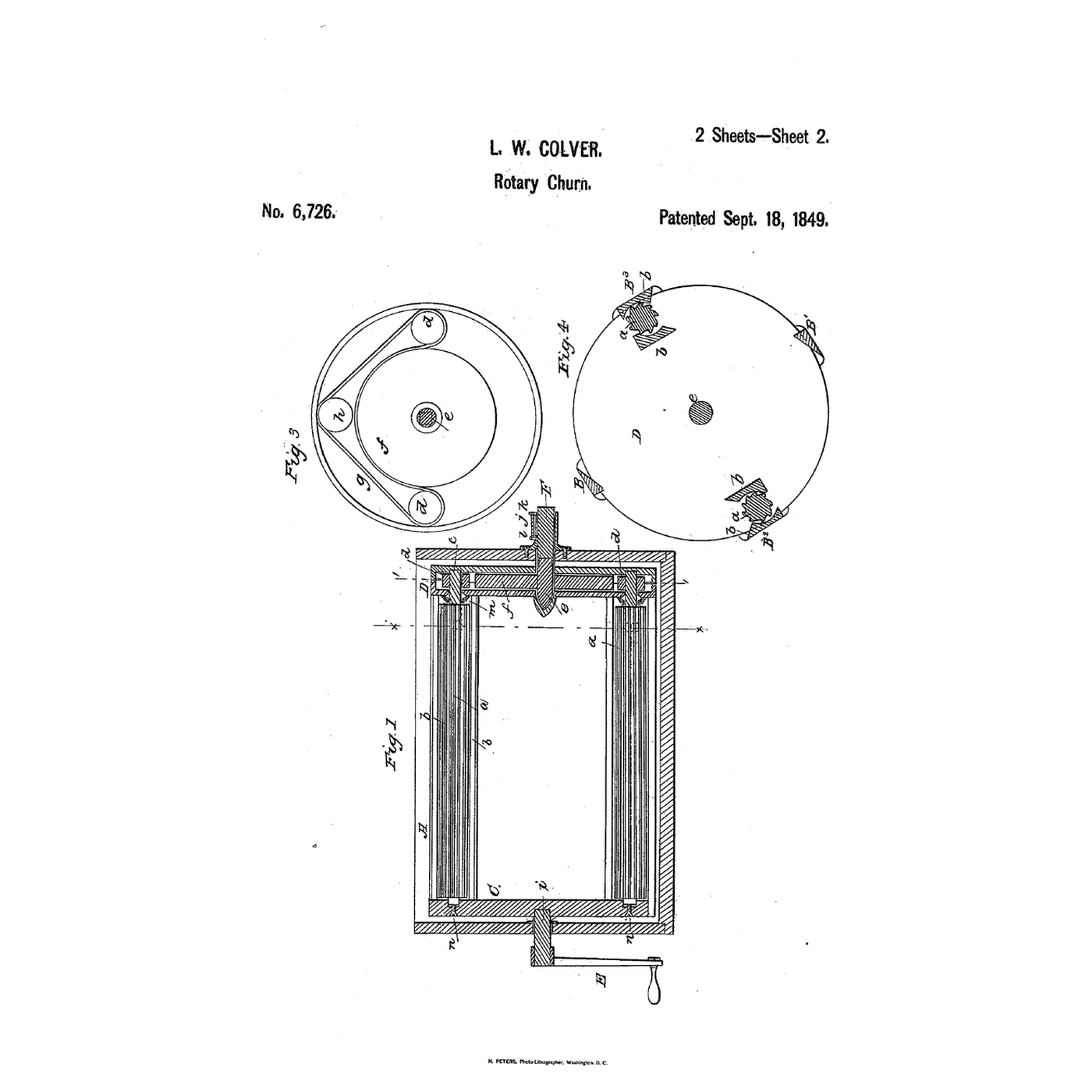


Self-Turning Roller Churn: Fluted Rollers Spun by a Fixed Wheel as the Dasher Turns
Colver's improvement consisted "in giving the beaters of a churn dasher a revolving motion on their own axis."
Lewis W. Colver of St. Louis, Missouri, received US 6,726, dated 18 September 1849, for a rotary churn-dasher of four horizontal beaters between a cross at one end and a round flat case at the other. Two are wedge beaters; the other two are fluted rollers with hook-shaped flutes, each between two edge-beaters whose inner faces curve in toward it. A belt from a large stationary pulley inside the case turns the rollers fast as the dasher goes round; "the granules of butter are drawn by the hooked flutes into the converging spaces between the rolls and the edge beaters, thus compressing them together."
This rung works out the rollers' speed, then prints the fixed gear, rollers, beaters and end pieces, builds the dasher in a box, and makes butter.
Avançado
About 6 hours, plus printing
Instruções
1
1
How fast the rollers spin
How fast the rollers spin
A carregar o notebook Jupyter…
2
2
Wheels carried round a fixed wheel
Wheels carried round a fixed wheel
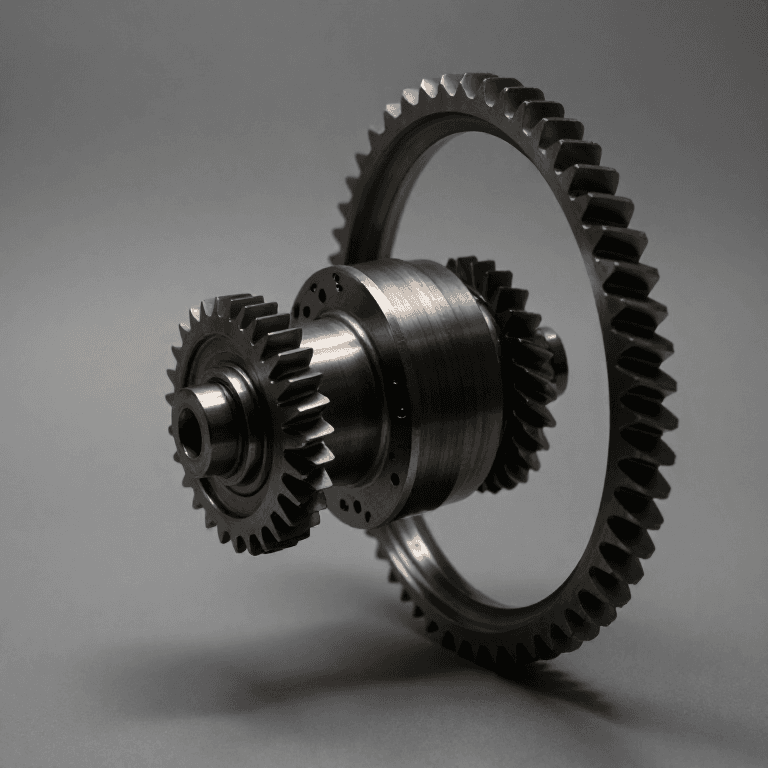
The embedded blueprint explains gears carried round a central gear. Colver's rollers are such planets: the central wheel stands still and the dasher carries them round it.
3
3
Read US 6,726
Read US 6,726
"The central pulley is held stationary and the dasher is revolved around it, and as the central pulley is much larger than the others the velocity of the rollers are proportionately increased." And: "I have hitherto described the fluted rollers as driven by a belt, that being most convenient in practice, but it is evident that cogwheels may be employed for the same purpose."
4
4
Print the parts
Print the parts
Print the fixed gear (/uploads/blueprints/self-turning-roller-churn-fixed-gear.stl), two fluted rollers with their pinions (/uploads/blueprints/self-turning-roller-churn-fluted-roller.stl), two pairs of edge-beaters (/uploads/blueprints/self-turning-roller-churn-edge-beaters.stl), two wedge beaters (/uploads/blueprints/self-turning-roller-churn-wedge-beater.stl), the cross (/uploads/blueprints/self-turning-roller-churn-cross.stl), the case plate (/uploads/blueprints/self-turning-roller-churn-case-plate.stl) and the crank arm (/uploads/blueprints/self-turning-roller-churn-crank-arm.stl). Print in PETG at 0.2 mm layers, 30 % infill, 4 walls; wash before first use.
Materiais para este passo:
 Filamento PETG1 peça
Ferramentas necessárias:
 Impressora 3D de filamento (FDM)
5
5
Build the dasher
Build the dasher
Bolt the beaters between the cross and the case plate with M3 screws: wedge beaters on two opposite arms, edge-beater pairs on the other two. Drop a fluted roller between each pair, its gudgeons in the cross and the case plate, its pinion beyond the plate. Screw a short 10 mm square hardwood stub into the cross's centre for the crank.
Materiais para este passo:
 Parafusos de máquina1 peça
 Porca sextavada1 peça
 Cavilhas de madeira dura1 peça
Ferramentas necessárias:
 Conjunto de chaves de fendas
 Chave inglesa ajustável
 Serrote
6
6
Fix the gear and fit the box
Fix the gear and fit the box
Take a food-safe box about 230 × 190 × 190 mm. Screw the fixed gear to the inside of one end on the dasher's axis, with a 10 mm steel pin through its centre into the case plate's hole, so the dasher turns round it and its teeth mesh the rollers' pinions. Drill the other end for the crank stub and glue the crank arm and handle on.
Materiais para este passo:
 Recipiente de armazenamento de grau alimentar1 peça
 Varão de aço macio1 peça
 Parafuso para madeira n.º 8 x 1"1 peça
 Cola de madeira1 peça
Ferramentas necessárias:
 Berbequim sem fios
 Jogo de brocas
 Serra de arco para metaisConjunto de chaves de fendas
7
7
The build in 3D
The build in 3D
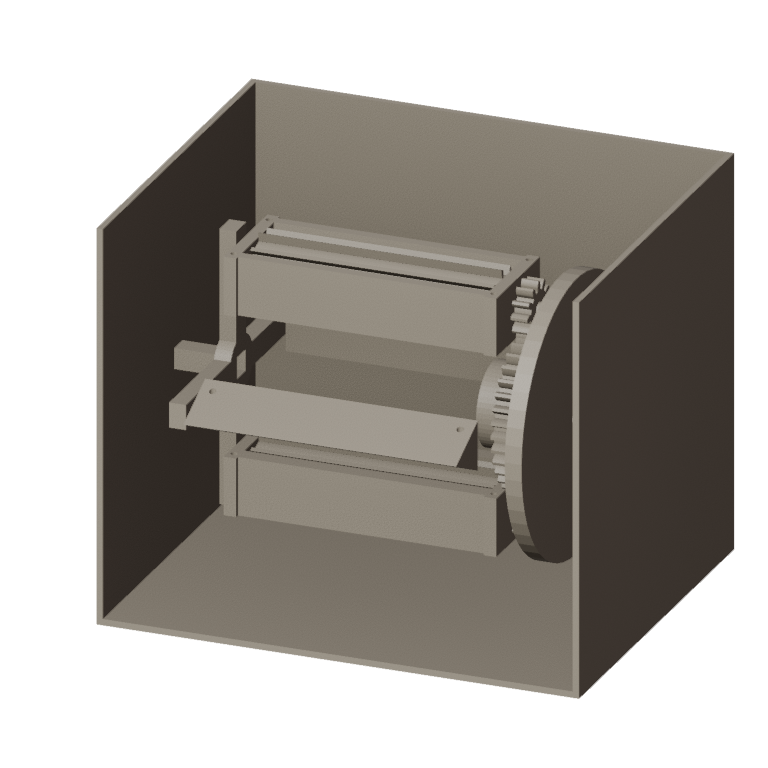
FreeCAD model of this build, not of the patent: the box with one side off to show the dasher of wedge beaters and fluted rollers between edge-beaters, the fixed gear meshing the rollers' pinions at the case end, and the crank.
8
8
Crank and make butter
Crank and make butter
Let the heavy cream stand until it reaches about 15 °C, checked with the thermometer. Pour in 1.5 litres. Crank steadily; the rollers spin on their own as the dasher turns. Time until the butter comes. Pour off the buttermilk, add cold water, churn a little and pour off again until it runs clear; work in a pinch of salt and weigh the butter.
Materiais para este passo:
 Natas para bater1500 ml
 Sal marinho grosso1 peça
 Água1 peça
Ferramentas necessárias:
 Termómetro de sonda permanente
 Cronómetro
 Balança digital de cozinha
 Taça grande de aço inoxidável
9
9
Rollers that do not spin, gears that jam
Rollers that do not spin, gears that jam
Self-turning roller churn troubleshooting.
Flow
Loading...
10
10
History and honest limits
History and honest limits
**Lewis W. Colver** of St. Louis, Missouri, received US 6,726, dated 18 September 1849, signed 9 July 1849. The dasher was held by a sliding bolt and wedge so it could be withdrawn; the gudgeons and the round case were packed so the cream could not get into it; a fourth pulley kept the belt's sides from rubbing. He claimed making the beaters of revolving churn dashers to turn upon their own axes.
**Honest limits.** Printed gears stand in for his belt and pulleys, as he allowed; our gears are open to the cream, where his were inside a packed case. FDM prints hold food in their layer lines, so wash well and replace when worn. Your times and weights are the result.
Materiais
11- 1 peçaReferência
- 1 peçaReferência
- 1 peçaReferência
- 1 peçaReferência
- Referência
- 1 peçaReferência
- Referência
- 1 peçaReferência
- 1500 mlReferência
- 1 peçaReferência
- 1 peçaReferência
Ferramentas necessárias
11- Referência
- Referência
- Referência
- Referência
- 1 vendor sell this, none ship to you yetReferência
- Referência
- Referência
- Referência
- Referência
- Referência
- Referência
Ficheiros de design
1Blueprints relacionados
Estes blueprints compartilham conhecimento — técnicas, materiais ou princípios


CC0 Domínio Público
Este blueprint é liberado sob CC0. Você é livre para copiar, modificar, distribuir e usar este trabalho para qualquer finalidade, sem pedir permissão.
Apoie o Maker comprando produtos através do Blueprint, onde ele ganha uma Comissão Maker definida pelos vendedores, ou crie uma nova versão deste Blueprint e inclua-o como conexão no seu próprio Blueprint para compartilhar receita.