ARTE
BELEZA E BEM-ESTAR
ARTESANATO
CULTURA E HISTÓRIA
ENTRETENIMENTO
MEIO AMBIENTE
COMIDA E BEBIDAS
ENGENHARIA REVERSA
CIÊNCIAS
ESPORTES
TECNOLOGIA
TECNOLOGIA VESTÍVEL


The Capo: A Movable Nut You Clamp With One Hand
A song in a key that is awkward on the guitar can be played in an easy shape if every string is raised by the same amount. A clamp across the neck at a fret does exactly that.
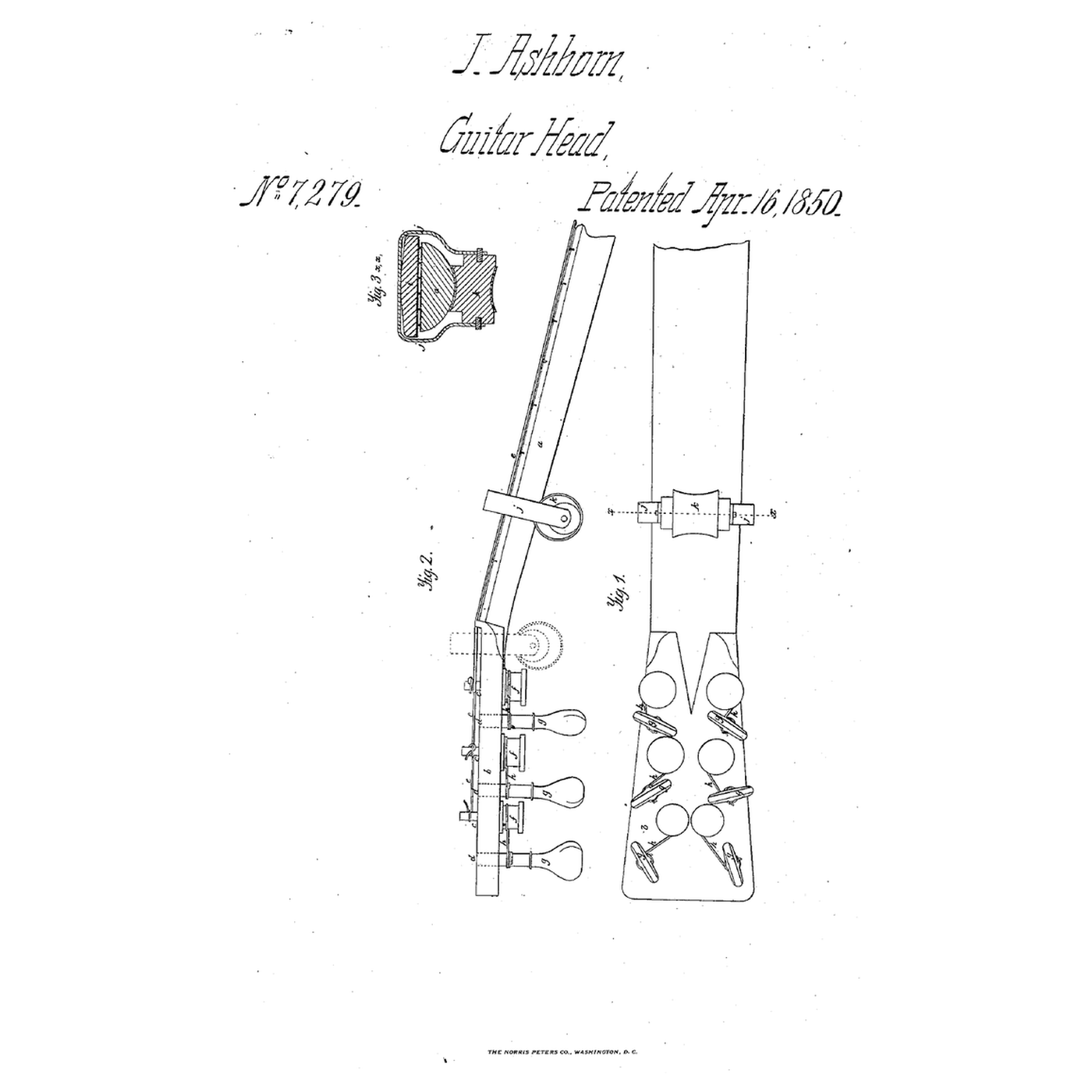
James Ashborn of Walcottville, Connecticut, received US 7,279, dated 16 April 1850, for improvements in the "Guitar-Head and Capo Tasto". The capo tasto — "the clamp used on the handle of a guitar to determine the vibrating length of the strings" — becomes a plate lined underneath, held by a strap round the neck and drawn tight by an eccentric roller, so it can be set on any fret "with one hand only" and pushed back onto the head when not needed. The same patent gears the tuning pegs through cords on enlarged spindles.
This rung works out what a capo does to the pitch, what it must press, and how Ashborn's pegs geared the tuning.
Iniciante
About 2 hours
Instruções
1
1
Semitones, clamp force and peg gearing
Semitones, clamp force and peg gearing
A carregar o notebook Jupyter…
2
2
Why each fret is a twelfth root of two
Why each fret is a twelfth root of two
A capo only works because the frets divide the string evenly by pitch. The embedded blueprint places them.
3
3
Read US 7,279
Read US 7,279
Ashborn notes that the use of the capo tasto "(the clamp used on the handle of a guitar to determine the vibrating length of the strings to set the instrument for playing in difficult keys), as heretofore made, is attended with great difficulty", so much so "that many performers have abandoned the use of it."
The second part of his invention combines with the capo tasto, "or plate for pressing the strings onto any particular fret of the handle, a metal or other strap attached thereto and passing down on each side of the handle, and an eccentric roller journaled to the said strap and acting against the under surface of the handle, so that the said plate may, with one hand only, be drawn down onto the strings, and adjusted or liberated therefrom by simply turning the said roller", the whole being pushed back onto the head beyond the last fret, where it does not interfere with the strings.
The first part winds the strings on spindles whose part below the head is enlarged — "from three to four times the diameter of the spindle on which the strings are wound" — driven by catgut from pegs of smaller diameter, "thereby increasing the leverage of the pins to overcome the tension of the strings" without the metal of a geared head.
4
4
Tune, clamp and measure
Tune, clamp and measure
Fit new strings to a cigar-box or acoustic guitar and tune it. Put the capo at the second, third and fifth frets in turn and measure each open string's pitch with a tuner app, checking the notebook's semitone steps.
Loosen the capo until one string buzzes and note which: the thickest strings need the most force. Hook the spring scale under a single string just behind a fret and pull it down 1 mm to feel the force the capo supplies for all six.
Materiais para este passo:
 Jogo de cordas de guitarra (acústica, bronze fosforoso)1 peça
Ferramentas necessárias:
 Capotraste de guitarra (de gatilho, universal)
 Kit de guitarra de caixa de charutos
 Dinamómetro (balança de mola)
 Paquímetro digital de 6 polegadas
5
5
A capo that buzzes or detunes
A capo that buzzes or detunes
Capo troubleshooting.
Flow
Loading...
6
6
History and honest limits
History and honest limits
**James Ashborn** of Walcottville, Connecticut, received US 7,279, dated 16 April 1850, for improvements in the guitar head and the capo tasto.
**Honest limits.** String tensions and the pressing geometry in the notebook are examples; real capo force depends on the pad, the action and the string gauges.
Materiais
1- Referência
Ferramentas necessárias
4- Referência
- Referência
- Referência
Blueprints relacionados
Estes blueprints compartilham conhecimento — técnicas, materiais ou princípios


CC0 Domínio Público
Este blueprint é liberado sob CC0. Você é livre para copiar, modificar, distribuir e usar este trabalho para qualquer finalidade, sem pedir permissão.
Apoie o Maker comprando produtos através do Blueprint, onde ele ganha uma Comissão Maker definida pelos vendedores, ou crie uma nova versão deste Blueprint e inclua-o como conexão no seu próprio Blueprint para compartilhar receita.