ARTE
BELEZA E BEM-ESTAR
ARTESANATO
CULTURA E HISTÓRIA
ENTRETENIMENTO
MEIO AMBIENTE
COMIDA E BEBIDAS
ENGENHARIA REVERSA
CIÊNCIAS
ESPORTES
TECNOLOGIA
TECNOLOGIA VESTÍVEL
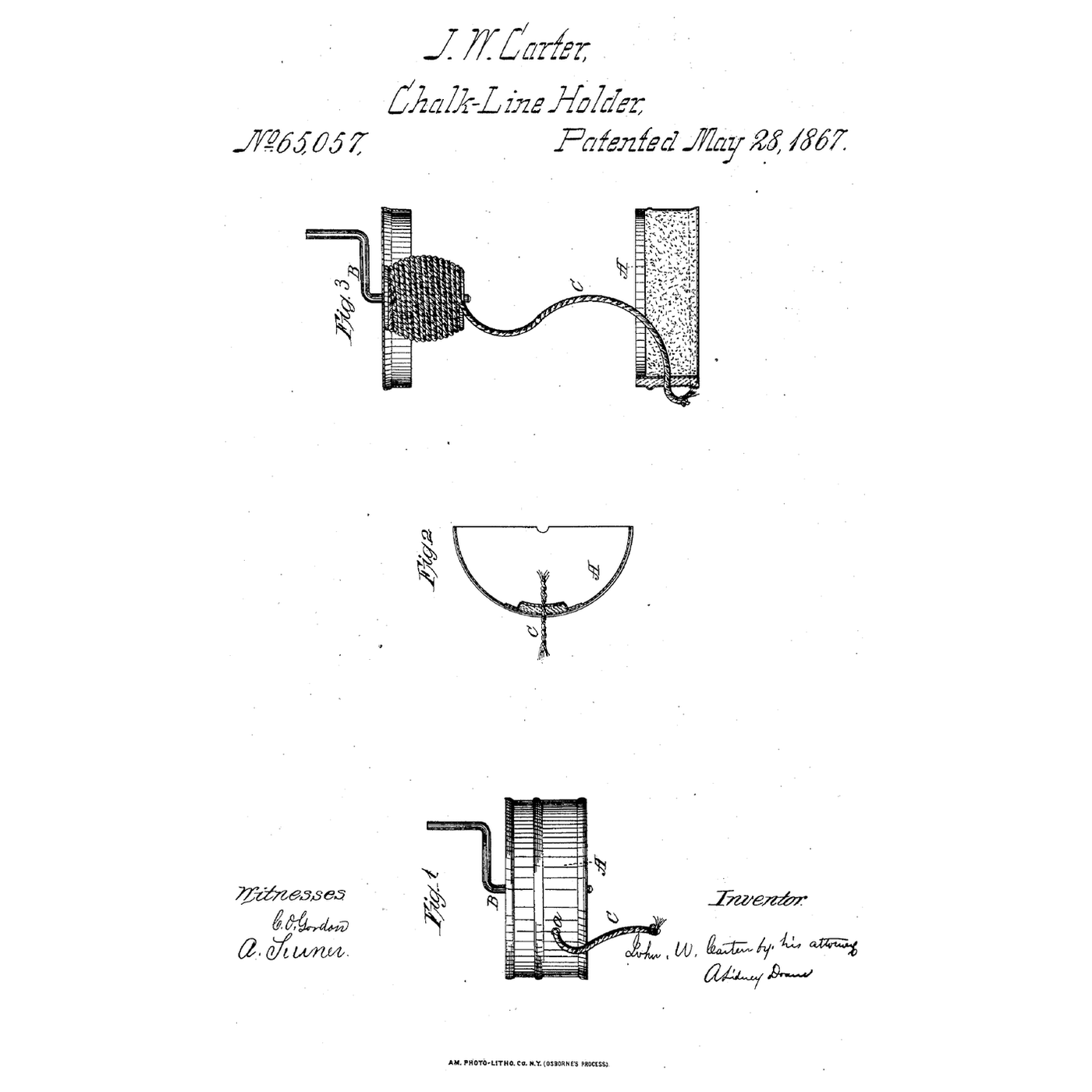


The Chalk-Line Marker: The Cord Winds on a Spindle Inside the Chalk
Carpenters and stone-cutters chalked their cord by hand, then held it tight at both ends and snapped it to mark a line to saw or cut by.
John W. Carter of New York received US 65,057, dated 28 May 1867, for "a new and useful article for the use of carpenters, stone-cutters, and others, which I term a chalk-marker": a receptacle, round or of any shape, made in two pieces and filled with chalk or other marking material, with a spindle inside on which the cord is wound, its end coming out through an opening. "As the cord is drawn therefrom it is chalked by coming into contact with the chalk or other material placed in the receptacle", and it is wound back by a crank on the spindle.
This rung works out how much chalk each draw takes, then makes the box from two tin lids with a cranked spindle, fills it, and snaps lines on a board.
Iniciante
About 3 hours
Instruções
1
1
Chalk per draw
Chalk per draw
A carregar o notebook Jupyter…
2
2
A chalk-line reel before it
A chalk-line reel before it
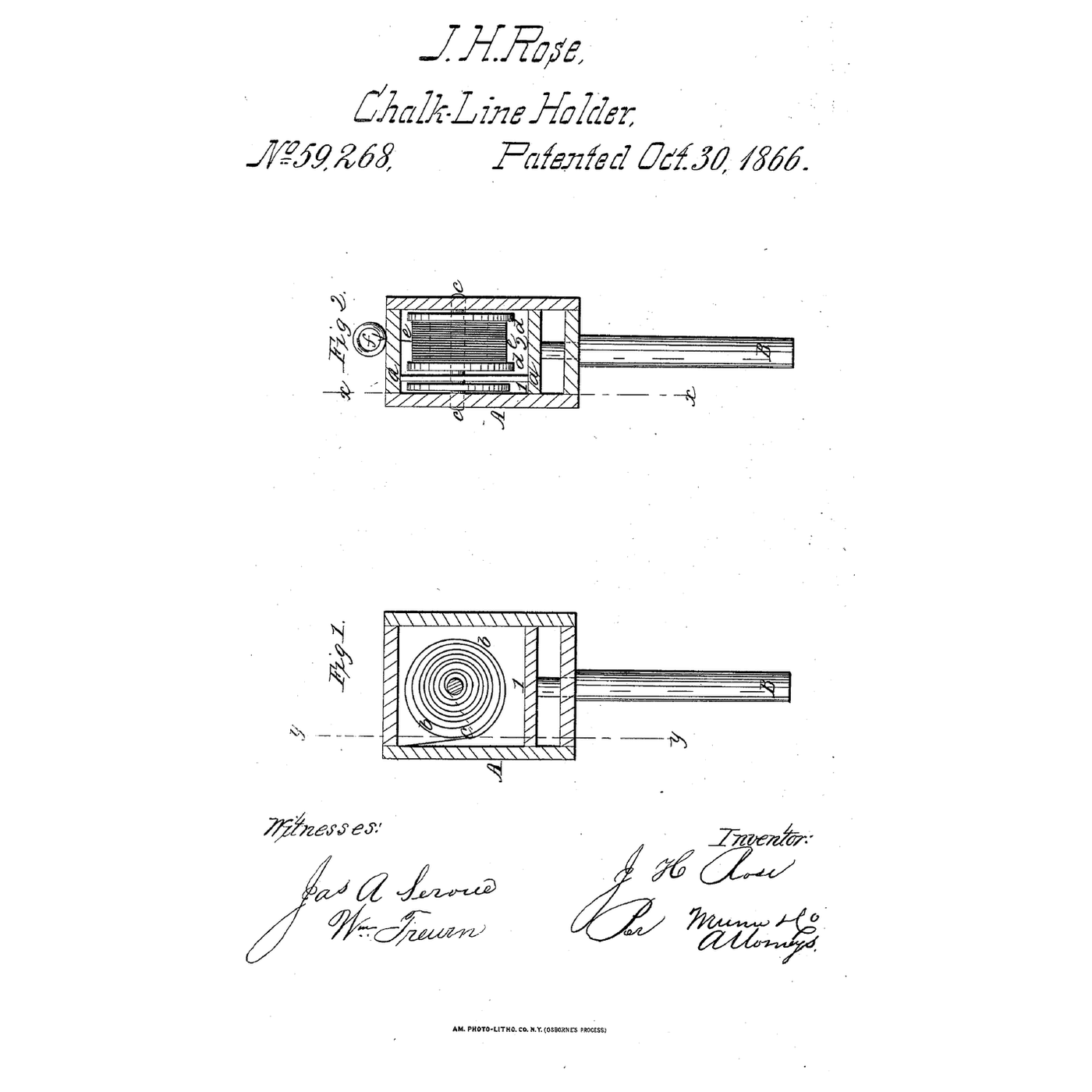
The embedded blueprint reels the line back with a coil spring. Carter puts the reel inside the chalk so the line is chalked as it comes out.
3
3
Read US 65,057
Read US 65,057
"Heretofore the carpenter, stone-cutter, or other artisan, has made use of a string or cord which was chalked by hand and placed upon the board, stone, or other article upon which the mark was to be impressed, in order that the same might answer as a guide to saw or cut by. The string was then held rather tightly at each end and snapped so as to impress upon the board or stone a mark to serve as a guide to saw or cut by."
"A shows a receptacle for the chalk or other marking material employed. This receptacle may be made circular or of any convenient shape, and may be made of two pieces, as clearly shown in fig. 3 of the drawings. B is a spindle or shaft inserted within the receptacle A through suitable openings, and C is the cord which is wound upon the spindle or shaft, one end of the same projecting through the opening a in the receptacle."
4
4
Make the marker and snap lines
Make the marker and snap lines
**Box.** Take two tin-can lids or shallow tins that fit rim to rim, drill each in the middle for the spindle, and drill a small hole a in the rim of one for the cord.
**Spindle and crank.** Bend a steel rod into a crank at one end, pass it through both halves, and glue a wooden spool on it inside. Tie the cord to the spool and wind it on, leading its end out through the hole.
**Fill.** Half fill the box with powdered marking chalk and close the two halves with tape or a band.
**Test.** Hook the cord's end on a nail at one end of a board, draw it out across the board, hold it tight and snap it. Wind it back with the crank. Weigh the box before and after ten snaps.
Materiais para este passo:
 Lata2 peças
 Varão de aço macio0.2 metro
 Bloco de madeira dura1 peça
 Cola de madeira1 peça
 Cordel de algodão15 metros
 Giz de marcação1 peça
 Tábua de pinho1 peça
 Pregos1 peça
Ferramentas necessárias:
 Tesoura de chapa
 Berbequim sem fios
 Jogo de brocas
 Torno de bancada
 Martelo
 Limas (lima de mão)
 Balança digital de cozinha
 Cordão de marcar
5
5
A marker whose line comes out bare, clogs or leaks chalk
A marker whose line comes out bare, clogs or leaks chalk
Chalk-line marker troubleshooting.
Flow
Loading...
6
6
History and honest limits
History and honest limits
**John W. Carter** of New York, New York, received US 65,057, dated 28 May 1867. The spindle might be provided with a spool on which the cord was wound, and could be turned by a crank or in any convenient way. He thought the invention particularly valuable for its cheapness and the rapidity of the work. His claim is the spindle and cord in combination with the chalk-receptacle.
**Honest limits.** Two tins and a bent rod stand in for his receptacle and spindle. The notebook's coating is a rough example; your weighing gives the real figure.
Materiais
8- 2 peçasReferência
- 0.2 metroReferência
- 1 peçaReferência
- 1 peçaReferência
- 15 metrosReferência
- 1 peçaReferência
- 1 peçaReferência
- 1 peçaReferência
Ferramentas necessárias
8- Referência
- 1 vendor sell this, none ship to you yetReferência
- Referência
- Referência
- Referência
- Referência
- Referência
- Referência
Blueprints relacionados
Estes blueprints compartilham conhecimento — técnicas, materiais ou princípios


CC0 Domínio Público
Este blueprint é liberado sob CC0. Você é livre para copiar, modificar, distribuir e usar este trabalho para qualquer finalidade, sem pedir permissão.
Apoie o Maker comprando produtos através do Blueprint, onde ele ganha uma Comissão Maker definida pelos vendedores, ou crie uma nova versão deste Blueprint e inclua-o como conexão no seu próprio Blueprint para compartilhar receita.