ARTE
BELEZA E BEM-ESTAR
ARTESANATO
CULTURA E HISTÓRIA
ENTRETENIMENTO
MEIO AMBIENTE
COMIDA E BEBIDAS
ENGENHARIA REVERSA
CIÊNCIAS
ESPORTES
TECNOLOGIA
TECNOLOGIA VESTÍVEL
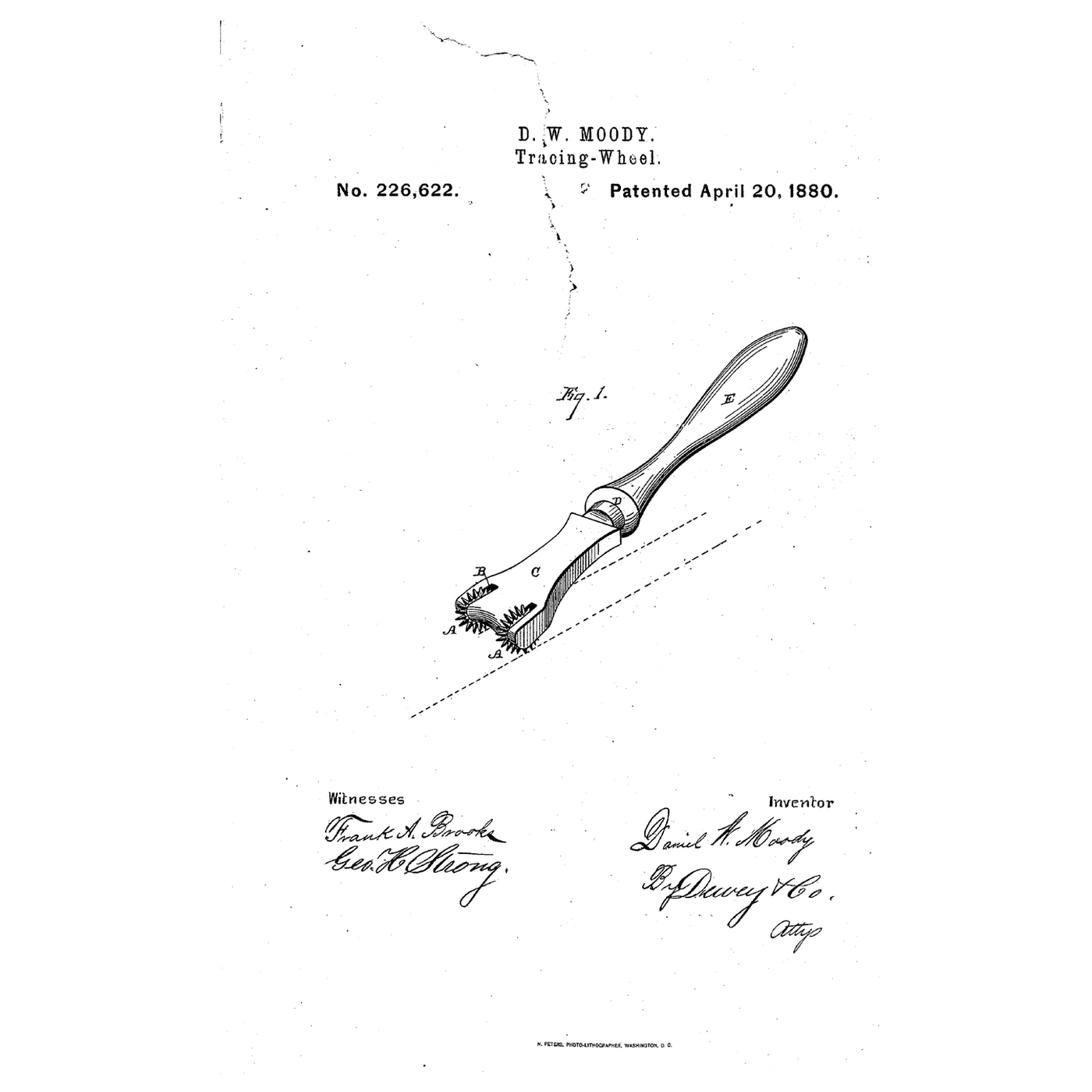


The Double Tracing Wheel: The Pattern Line and the Cutting Line at Once
A paper pattern gives the sewing line, but the cloth must be cut wider to leave a seam allowance. Marking that second line by eye makes it uneven, and measuring it at every point is slow.
Daniel W. Moody of San Francisco received US 226,622, dated 20 April 1880 (filed 19 January 1880), for a tracing wheel with "two parallel toothed or star wheels", so that "when one of the wheels is made to traverse the desired pattern the other will form a line upon which the goods are to be cut, so as to give the necessary width for the seam".
This rung works out how much cloth a seam allowance adds to a panel, then marks and cuts a piece with a double line.
Iniciante
About 2 hours
Instruções
1
1
Cloth added by the allowance
Cloth added by the allowance
A carregar o notebook Jupyter…
2
2
What the second line is for
What the second line is for
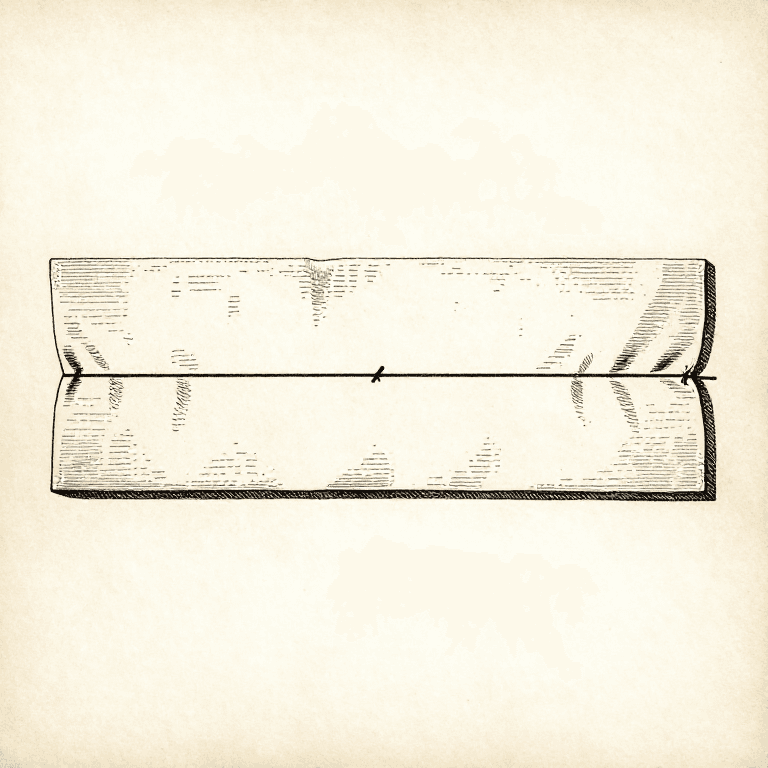
The embedded blueprint explains the seam allowance itself. Moody's second wheel marks it.
3
3
Read US 226,622
Read US 226,622
"When a pattern has been traced by this wheel it is necessary to mark out a line for cutting, which must be at such a distance from the pattern-line as will insure sufficient material to form the seam. This is either done in an irregular manner, without measurement, or sometimes by careful measurements at frequent intervals and marking to indicate the points and guide the cutter."
"The distance between the wheels might be made adjustable, if desired; but I have found that in practice a fixed distance of about five-eighths of an inch will give the proper width for all seams."
4
4
Trace a pattern and its cutting line
Trace a pattern and its cutting line
Draw a simple pattern piece on kraft paper and cut it out. Pin it to the cloth over a sheet of carbon paper, carbon side down.
Run the tracing wheel round the paper's edge to transfer the sewing line. Then mark a second line 16 mm (5/8 inch) outside it: with a double wheel in one pass, or with the single wheel guided along the ruler.
Cut on the outer line and sew on the inner one. Measure the finished allowance at several points with the tape measure and see how even it is. Compare the cloth used with the notebook.
Materiais para este passo:
 Tecido de algodão (leve)1 peça
 Rolo de papel kraft (castanho)1 peça
 Papel químico1 peça
 Alfinetes de costura10 peças
Ferramentas necessárias:
 Carretilha de costura
 Tesoura de alfaiate
 Régua
Régua Fita métrica
 Giz de alfaiate
5
5
A traced line that is faint, wanders or tears
A traced line that is faint, wanders or tears
Tracing wheel troubleshooting.
Flow
Loading...
6
6
History and honest limits
History and honest limits
**Daniel W. Moody** of San Francisco filed US 226,622 on 19 January 1880; it is dated 20 April 1880. He notes the handle, shank and frame may be made in one piece of malleable iron or brass.
**Honest limits.** The notebook uses rectangles; curved pieces and corners change the figure a little. 5/8 inch is Moody's figure, not a rule for every seam. The panel sizes are examples. Your measured allowance is the measurement.
Materiais
4- 1 peçaReferência
- Referência
- 1 peçaReferência
- 10 peçasReferência
Ferramentas necessárias
5- Referência
- Referência
- Referência
- 1 vendor sell this, none ship to you yetReferência
- Referência
Blueprints relacionados
Estes blueprints compartilham conhecimento — técnicas, materiais ou princípios


CC0 Domínio Público
Este blueprint é liberado sob CC0. Você é livre para copiar, modificar, distribuir e usar este trabalho para qualquer finalidade, sem pedir permissão.
Apoie o Maker comprando produtos através do Blueprint, onde ele ganha uma Comissão Maker definida pelos vendedores, ou crie uma nova versão deste Blueprint e inclua-o como conexão no seu próprio Blueprint para compartilhar receita.