ARTE
BELEZA E BEM-ESTAR
ARTESANATO
CULTURA E HISTÓRIA
ENTRETENIMENTO
MEIO AMBIENTE
COMIDA E BEBIDAS
ENGENHARIA REVERSA
CIÊNCIAS
ESPORTES
TECNOLOGIA
TECNOLOGIA VESTÍVEL
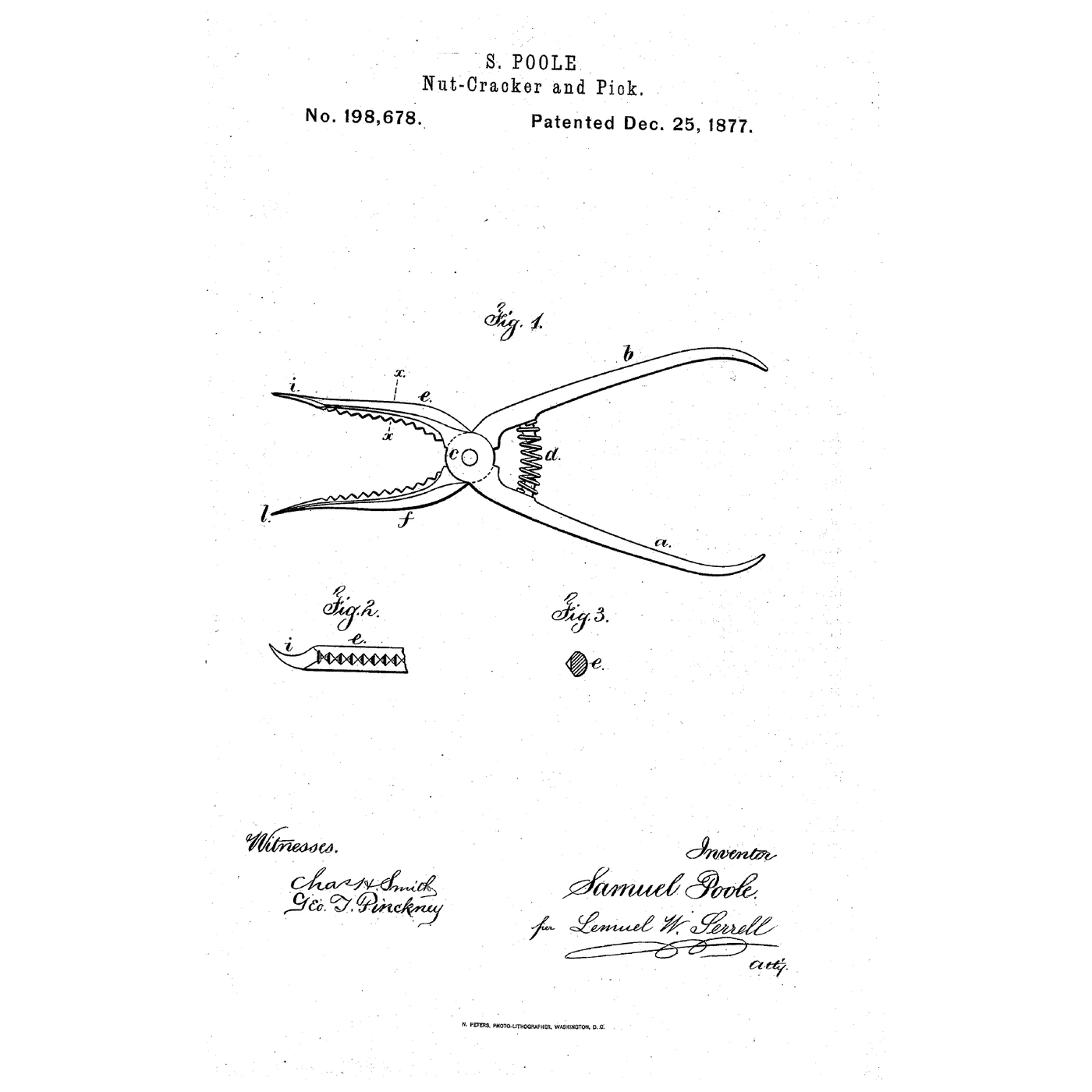

The Nut Cracker and Pick: Toothed Jaws That End in a Hook and a Scoop
Cracking a nut takes one tool, picking out the meat another and lifting it whole a third, and a big nut slips out of flat jaws.
Samuel Poole of Brooklyn received US 198,678, dated 25 December 1877, for a nut-cracker "similar in its general shape to a pair of pinchers" whose jaws curve outward so large nuts sit near the pivot, carry a single row of pointed teeth "adapted to penetrate the nut-shell, and not to slip on the same", and end in a hooked pick and a thin scoop that together make a pair of forceps, "thus combining the cracker, the pick, and the extractor in one implement."
This rung works out the leverage at three nut positions, then forges the cracker from flat bar and cracks walnuts and pecans near the pivot and near the tips.
Intermediário
About 4 hours
Instruções
1
1
Force on the shell by position
Force on the shell by position
A carregar o notebook Jupyter…
2
2
Two bars on a pivot
Two bars on a pivot
The embedded blueprint forges two jaws on a rivet. Poole's cracker is the same pair of levers, shaped for nuts.
3
3
Read US 198,678
Read US 198,678
"The jaws e f are curved outwardly, so that the broader space between them, when closed, is near the pivot or joint c, so as to have the necessary leverage for large nuts."
"The end of the jaw e is reduced in thickness, and formed with a hooked point, i, that is adapted to use as a nut-pick; and the end of the jaw f is also reduced in thickness, and may be used as a scoop or pick, l, and the two parts i l form together forceps, by which the meat can be grasped and pulled out of the shell of the nut".
4
4
Make the cracker and crack nuts
Make the cracker and crack nuts
**Bars.** Cut two 20 cm lengths of 20 × 5 mm mild steel flat bar. Drill a 6.5 mm hole 7 cm from one end of each for the pivot.
**Jaws.** Heat the short end of each bar with the torch and bend it outward in the vice, so that with the bars crossed at the holes the jaws leave a wider gap near the pivot than at the tips. Let them cool.
**Teeth and tips.** File a row of V-teeth down the middle of each jaw's inside face with the triangular file. File one tip thin and bend it into a small hook; file the other thin and flat into a scoop. Round every edge.
**Pivot and spring.** Bolt the bars together with an M6 bolt and two nuts locked against each other. Seat a compression spring between the handles just behind the pivot so they spring open.
**Test.** Crack five walnuts and five pecans with each nut close to the pivot, and five of each near the tips; note which crack and how hard it was. Lift the meat out with the hook and scoop and count the halves that come out whole. Compare with a bought nutcracker.
Materiais para este passo:
 Barra chata de aço macio0.4 metro
 Sortido de parafusos sextavados1 peça
 Porca sextavada2 peças
 Sortido de molas de compressão1 peça
 Noz10 peças
 Noz-pecã10 peças
Ferramentas necessárias:
 Serra de arco para metais
 Berbequim sem fios
 Jogo de brocas
 Maçarico a propano
 Torno de bancada
 Martelo
 Limas (lima de mão)
 Jogo de limas de agulha
 Chave inglesa
 Quebra-nozes
 Luvas de trabalho em couro
 Óculos de segurança transparentes
5
5
A cracker that slips, crushes or will not open
A cracker that slips, crushes or will not open
Nut cracker and pick troubleshooting.
Flow
Loading...
6
6
History and honest limits
History and honest limits
**Samuel Poole** of Brooklyn, New York, signed US 198,678 on 20 November 1877, filed it on 22 November and received it dated 25 December 1877. His claims cover the lever handles with curved, toothed jaws, the pick at one jaw's end, and jaws thinned at the ends to form forceps; a spring between the handles opened them.
**Honest limits.** Bent flat bar and an M6 bolt stand in for Poole's shaped jaws and pivot, and a compression spring for his. The notebook ignores the jaws' curve and friction; its squeeze and lengths are examples. Your cracking and whole-half counts are the result.
Materiais
6- 0.4 metroReferência
- Referência
- 2 peçasReferência
- Referência
- 10 peçasReferência
- 10 peçasReferência
Ferramentas necessárias
12- Referência
- 1 vendor sell this, none ship to you yetReferência
- Referência
- Referência
- Referência
- Referência
- Referência
- Referência
- Referência
- Referência
- Referência
- Referência
Blueprints relacionados
Estes blueprints compartilham conhecimento — técnicas, materiais ou princípios
Forging a Pair of Iron Tongs — The Blacksmith's Essential Gripping Tool
por Forge
Trabalho em Metal
26
0
0
0
1
0

The Law of the Lever — Archimedes' Balance of Weight and Distance
por Martin
Física
55
0
0
0
1
0
Processing Acorns for Food — Leaching Tannins from the Universal Tree Nut
por TheChef
Natureza Selvagem
68
0
0
0
0
0
CC0 Domínio Público
Este blueprint é liberado sob CC0. Você é livre para copiar, modificar, distribuir e usar este trabalho para qualquer finalidade, sem pedir permissão.
Apoie o Maker comprando produtos através do Blueprint, onde ele ganha uma Comissão Maker definida pelos vendedores, ou crie uma nova versão deste Blueprint e inclua-o como conexão no seu próprio Blueprint para compartilhar receita.