ARTE
BELEZA E BEM-ESTAR
ARTESANATO
CULTURA E HISTÓRIA
ENTRETENIMENTO
MEIO AMBIENTE
COMIDA E BEBIDAS
ENGENHARIA REVERSA
CIÊNCIAS
ESPORTES
TECNOLOGIA
TECNOLOGIA VESTÍVEL
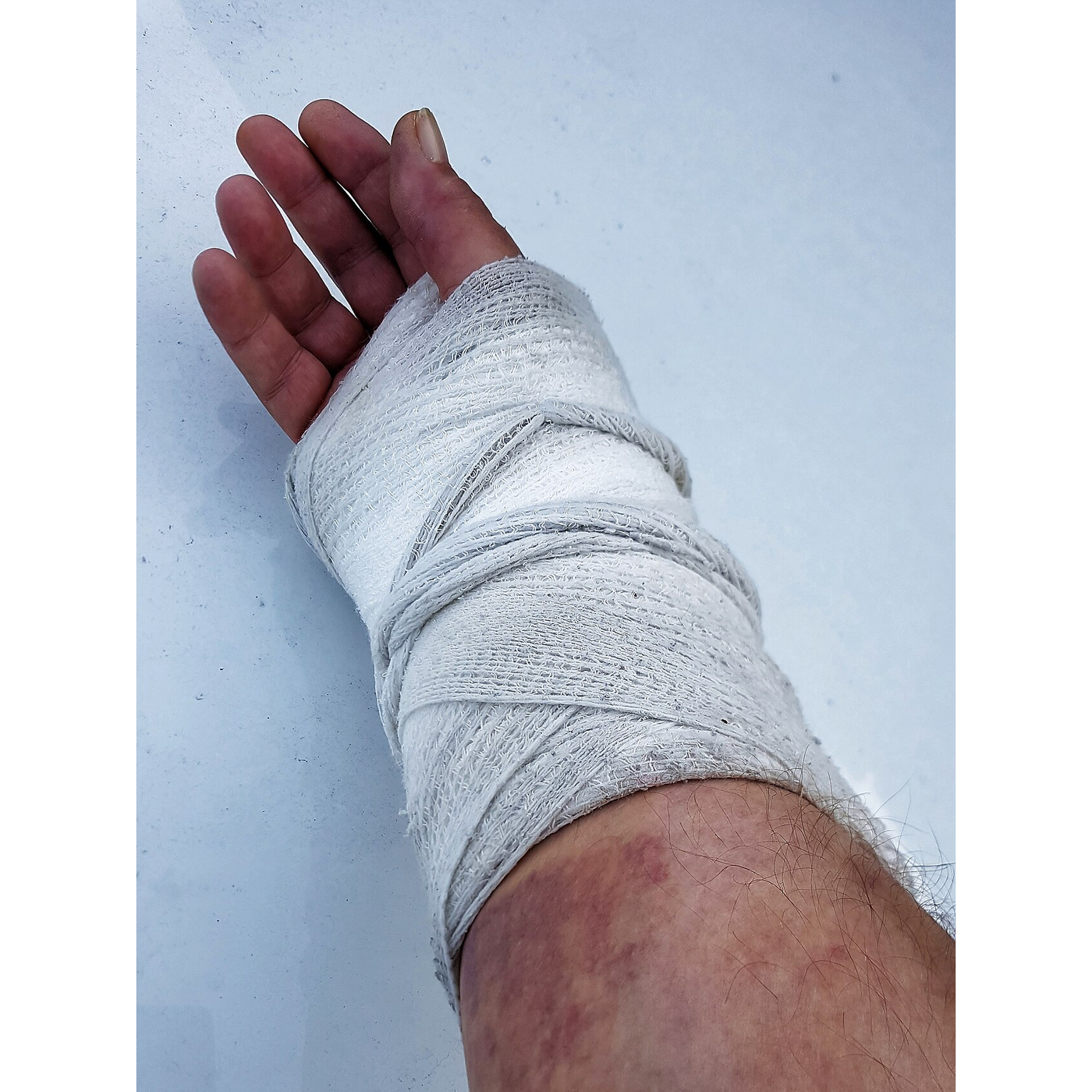


The Plaster Cast: Gypsum That Sets Round a Broken Limb
A broken bone heals only if its ends are held still in line for weeks. Splints of wood and bandages stiffened with starch or egg white took hours or days to harden. Antonius Mathijsen, a Dutch army surgeon at the military hospital in Haarlem, rubbed plaster of Paris into coarse cotton bandages in 1851: soaked in water and wrapped round the limb, they could be moulded to it and set hard within minutes. He published the method in February 1852, and armies adopted it because it could be applied on the battlefield.
The chemistry is simple: the hemihydrate takes up water and crystallises as gypsum. But the reaction gives off heat, and the water the mix needs to be workable is far more than the reaction uses.
This rung works out the heat and the water, models a setting cast's temperature, and makes a cast round a bottle, measuring its temperature as it sets.
Iniciante
About 3 hours
Instruções
1
1
Hydration chemistry, water ratio and heat
Hydration chemistry, water ratio and heat
A carregar o notebook Jupyter…
2
2
The older plaster it follows
The older plaster it follows
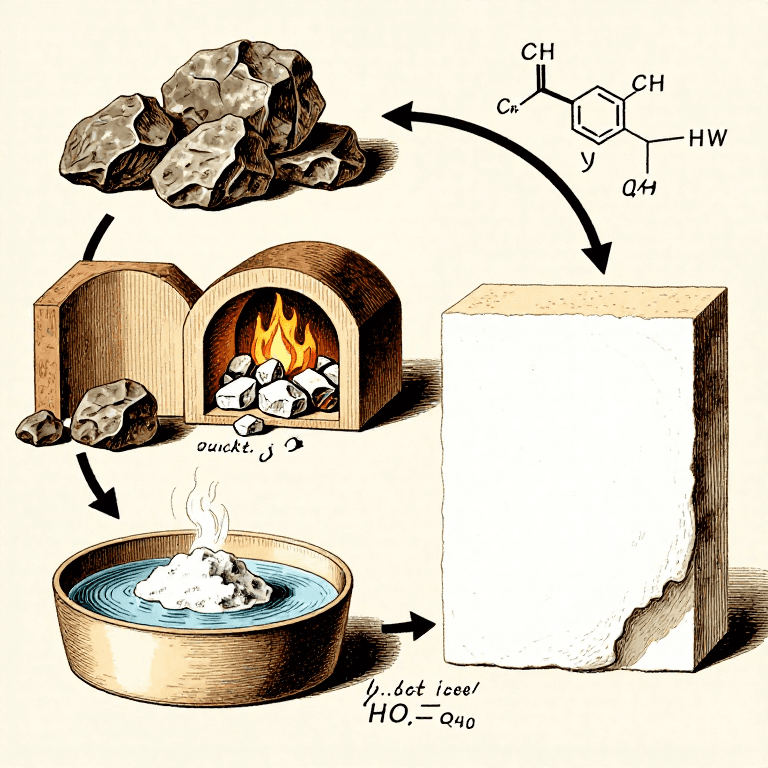
Lime plaster sets by taking up carbon dioxide over days; gypsum plaster sets by taking up water in minutes. The embedded blueprint makes the older one.
3
3
Measure the heat of setting
Measure the heat of setting
Weigh 100 g of plaster of Paris into a paper cup and 60 g of water at room temperature into another. Stir the plaster into the water, push a thermocouple probe into the middle, and read the temperature every minute for 40 minutes.
Repeat with a thin disc — 100 g spread 5 mm thick on a plastic sheet with the probe under it — and with a deep cup of 300 g. Plot the three curves: the thick lump gets far hotter than the thin disc, as the notebook's model shows. Never repeat the deep test with warm water near skin.
Materiais para este passo:
 Gesso de estuque1 kilogram
 Copos3 peças
 Água1 litro
Ferramentas necessárias:
 Balança digital de cozinha
 Termopar com mostrador
 Cronómetro
 Luvas de trabalho em couro
 Óculos de segurança transparentes
4
4
Wrap a cast round a bottle
Wrap a cast round a bottle
Use a plastic bottle as the limb. Smear it with petroleum jelly so the cast releases, and wrap one layer of cotton gauze as padding.
Cut plaster bandage into lengths. Dip each in cool water for a few seconds until the bubbles stop, squeeze it gently, and wrap it round with each turn overlapping the last by half, smoothing it with a wet palm so the layers bond. Build four to six layers, thicker where a real cast takes the load. Mould it with flat palms, never fingertips, which leave dents that press on skin.
It is firm in minutes and sets fully over hours as it dries. Next day, cut it off with a saw down one side and weigh it wet and dry.
Materiais para este passo:
 Rolos de ligadura gessada para máscaras1 peça
 Gaze de algodão1 peça
 Vaselina1 peça
 Garrafa de PET (bebida gaseificada)1 peçaÁgua2 litros
Ferramentas necessárias:
 BaldeLuvas de trabalho em couroBalança digital de cozinha
 Serra de arco para metais
5
5
A cast that is not right
A cast that is not right
Warning signs with a plaster cast. On a real patient, any of them means seeing a clinician.
Flow
Loading...
6
6
History and honest limits
History and honest limits
**Antonius Mathijsen** (1805–1878) first used plaster of Paris bandages in 1851 at the military hospital in Haarlem, and published the method in the Dutch journal *Repertorium* in February 1852; he took out no patent. Fibreglass and resin casts now often replace plaster because they are lighter and tolerate water, but plaster is still used where it must be moulded closely.
**Honest limits.** The temperature model is a simple lumped estimate, not a clinical figure. Applying a cast to a person is a clinical skill: this rung casts a bottle. The enthalpy figures are standard tabulated values; real plasters differ slightly by type.
Materiais
7- 1 kilogramReferência
- 3 peçasReferência
- 3 litrosReferência
- Referência
- 1 peçaReferência
- 1 peçaReferência
- Referência
Ferramentas necessárias
7- Referência
- Referência
- Referência
- Referência
- Referência
- Referência
- Referência
Blueprints relacionados
Estes blueprints compartilham conhecimento — técnicas, materiais ou princípios


CC0 Domínio Público
Este blueprint é liberado sob CC0. Você é livre para copiar, modificar, distribuir e usar este trabalho para qualquer finalidade, sem pedir permissão.
Apoie o Maker comprando produtos através do Blueprint, onde ele ganha uma Comissão Maker definida pelos vendedores, ou crie uma nova versão deste Blueprint e inclua-o como conexão no seu próprio Blueprint para compartilhar receita.