ARTE
BELEZA E BEM-ESTAR
ARTESANATO
CULTURA E HISTÓRIA
ENTRETENIMENTO
MEIO AMBIENTE
COMIDA E BEBIDAS
ENGENHARIA REVERSA
CIÊNCIAS
ESPORTES
TECNOLOGIA
TECNOLOGIA VESTÍVEL



The Porcelain-Lined Lemon Squeezer: Cast-Iron Handles, Porcelain Where the Juice Runs
Wooden lemon squeezers soak up stale juice, and bare iron ones are eaten by the acid and stain the juice.
Thomas C. Smith of New York received US 76,539, dated 7 April 1868, for "having the body of the device of cast iron or other cast metal, and in the manner of applying the porcelain parts to the same". A cast-iron cup on one handle holds a porcelain concave perforated with holes, resting on a ring of india-rubber and held by lips; a plate on the other handle carries a porcelain compress screwed to it. Only porcelain touches the lemon.
This rung works out how much iron the juice could take, then makes the porcelain concave and compress, fires them, fits them to flat-bar handles with a rubber ring, and compares juice left on iron and on porcelain.
Avançado
About 2 days, with drying and firing
Instruções
1
1
The acid and the iron
The acid and the iron
A carregar o notebook Jupyter…
2
2
A metal squeezer before it
A metal squeezer before it
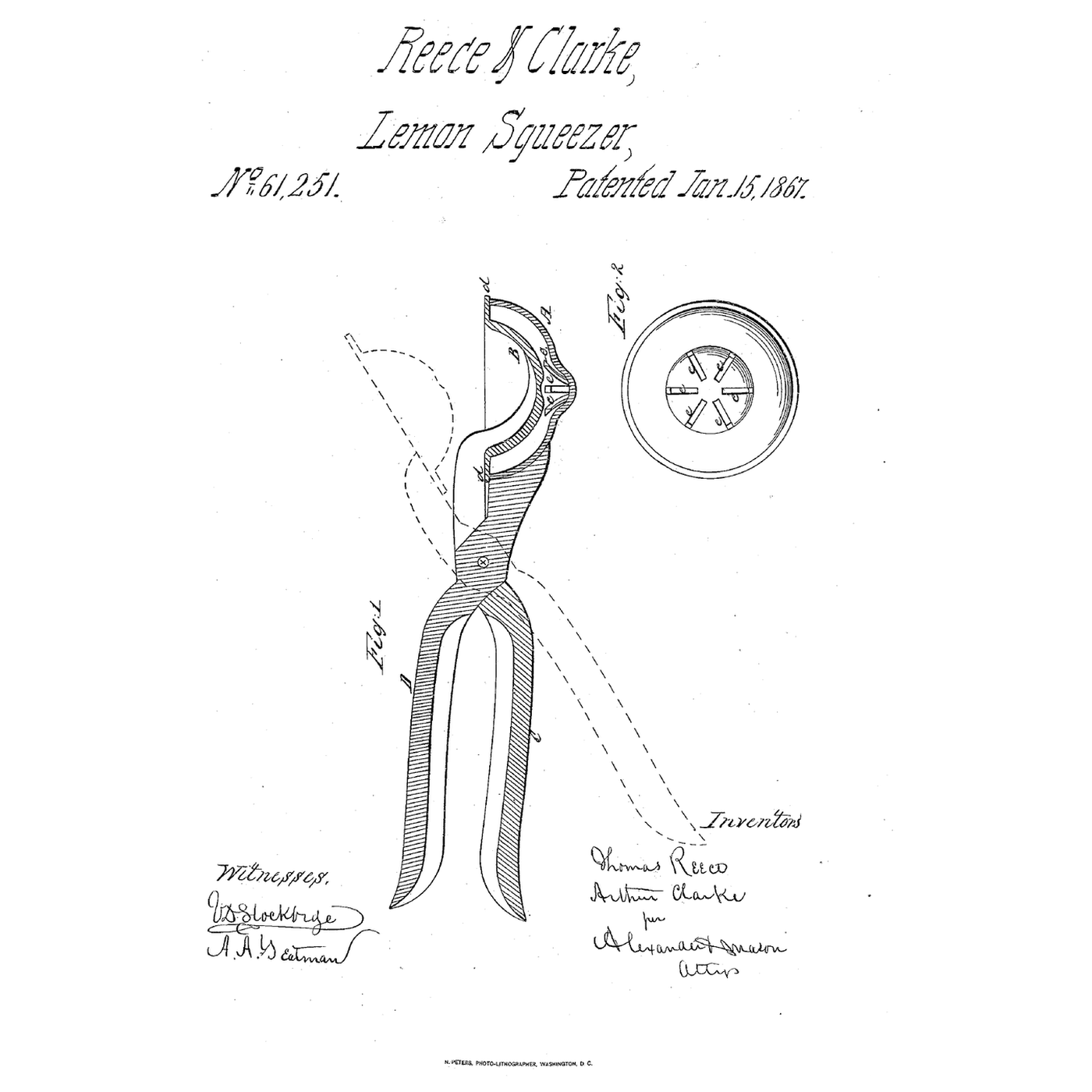
The embedded blueprint tins or galvanizes its cups against the acid. Smith lines his cast-iron squeezer with porcelain wherever the juice runs.
3
3
Read US 76,539
Read US 76,539
"G is a concave, which is the half of a hollow sphere, made also of porcelain, with a series of holes, d′, in its bottom or lower part, and having a flange, e, projecting horizontally from it all around its upper edge. This flange, e, rests or bears upon an annular piece of India rubber, f, which is placed on the shoulder a, in the interior of the cup B."
"The India-rubber ring f serves as a packing for the concave, holding it firmly in position without danger of breakage, and effectually prevents the acid juice of the lemons finding its way down between the concave and cup, as will be understood by referring to fig. 2."
4
4
Make the porcelain parts and fit them
Make the porcelain parts and fit them
**Concave.** Press porcelain clay into the inside of a small bowl to make a half-sphere about 7 cm across with a flat flange round its rim, and pierce its bottom with a ring of small holes.
**Compress.** Press a solid half-sphere of clay a few millimetres smaller, with a flat top for fixing.
**Fire.** Dry both slowly, bisque-fire them in the kiln, glaze them with clear glaze, and glaze-fire them at the clay's stated temperature.
**Frame.** Cut the bottom 4 cm off a tin can wider than the concave, cut a hole in its base, and rivet it to a flat-bar handle. Seat the concave in it on a rubber O-ring and bend three tabs of the can's rim over its flange as the lips g g. Epoxy the compress to a disc riveted on the second handle, and pivot the handles so the compress closes into the concave.
**Test.** Squeeze lemons over a glass. Then leave a spoonful of lemon juice on a pad of steel wool and another in the porcelain concave for an hour, and compare their colour and their pH with test strips.
Materiais para este passo:
 Pasta de porcelana1 kg
 Vidrado transparente1 peça
 Lata1 peça
 Barra chata de aço macio0.5 metro
 Rebites cegos6 peças
 Sortido de parafusos sextavados1 peça
 Porca sextavada1 peça
 Sortido de anéis de vedação1 peça
 Epóxi de dois componentes1 peça
 Limão3 peças
 Palha de aço1 peça
 Tiras de teste de pH1 peça
Ferramentas necessárias:
 Conjunto de ferramentas de oleiro
 Forno cerâmico
 Serra de arco para metais
 Berbequim sem fios
 Jogo de brocas
 Tesoura de chapa
 Kit de rebitadora
 Alicate de bico chato
 Faca de cozinha
 Copo
Copo Luvas de trabalho em couro
5
5
Porcelain that cracks, leaks or rattles
Porcelain that cracks, leaks or rattles
Porcelain-lined lemon squeezer troubleshooting.
Flow
Loading...
6
6
History and honest limits
History and honest limits
**Thomas C. Smith** of New York, New York, received US 76,539, dated 7 April 1868. His lower handle A was cast with the cup B, the upper A′ with a plate E holding the porcelain compress F by a screw e and nut d; the concave's flange had a notch h to pass it down past one of the lips g g before turning. He thought porcelain, glazed earthenware or other vitreous material suitable, and the metal parts japanned or silver-plated. His claims cover the shoulder, rubber ring, lips and notched flange, and the cast-metal handles with the porcelain compress and concave.
**Honest limits.** Pressed and glazed porcelain on flat-bar handles and a tin cup stand in for his cast iron and made porcelain. The notebook's iron is a ceiling, not a prediction; its volumes and acid content are examples. Your comparison is the result.
Materiais
12- Referência
- 1 peçaReferência
- 1 peçaReferência
- 0.5 metroReferência
- 6 peçasReferência
- Referência
- 1 peçaReferência
- Referência
- Referência
- 3 peçasReferência
- 1 peçaReferência
- 1 peçaReferência
Ferramentas necessárias
11- Referência
- Referência
- Referência
- 1 vendor sell this, none ship to you yetReferência
- Referência
- Referência
- Referência
- Referência
- Referência
- Referência
- Referência
Blueprints relacionados
Estes blueprints compartilham conhecimento — técnicas, materiais ou princípios



CC0 Domínio Público
Este blueprint é liberado sob CC0. Você é livre para copiar, modificar, distribuir e usar este trabalho para qualquer finalidade, sem pedir permissão.
Apoie o Maker comprando produtos através do Blueprint, onde ele ganha uma Comissão Maker definida pelos vendedores, ou crie uma nova versão deste Blueprint e inclua-o como conexão no seu próprio Blueprint para compartilhar receita.