ARTE
BELEZA E BEM-ESTAR
ARTESANATO
CULTURA E HISTÓRIA
ENTRETENIMENTO
MEIO AMBIENTE
COMIDA E BEBIDAS
ENGENHARIA REVERSA
CIÊNCIAS
ESPORTES
TECNOLOGIA
TECNOLOGIA VESTÍVEL


The Twisted-Rod Push Corkscrew: Press the Handle and a Twisted Stem Spins the Screw In
Turning a corkscrew into the cork by the handle, turn after turn, is slow.
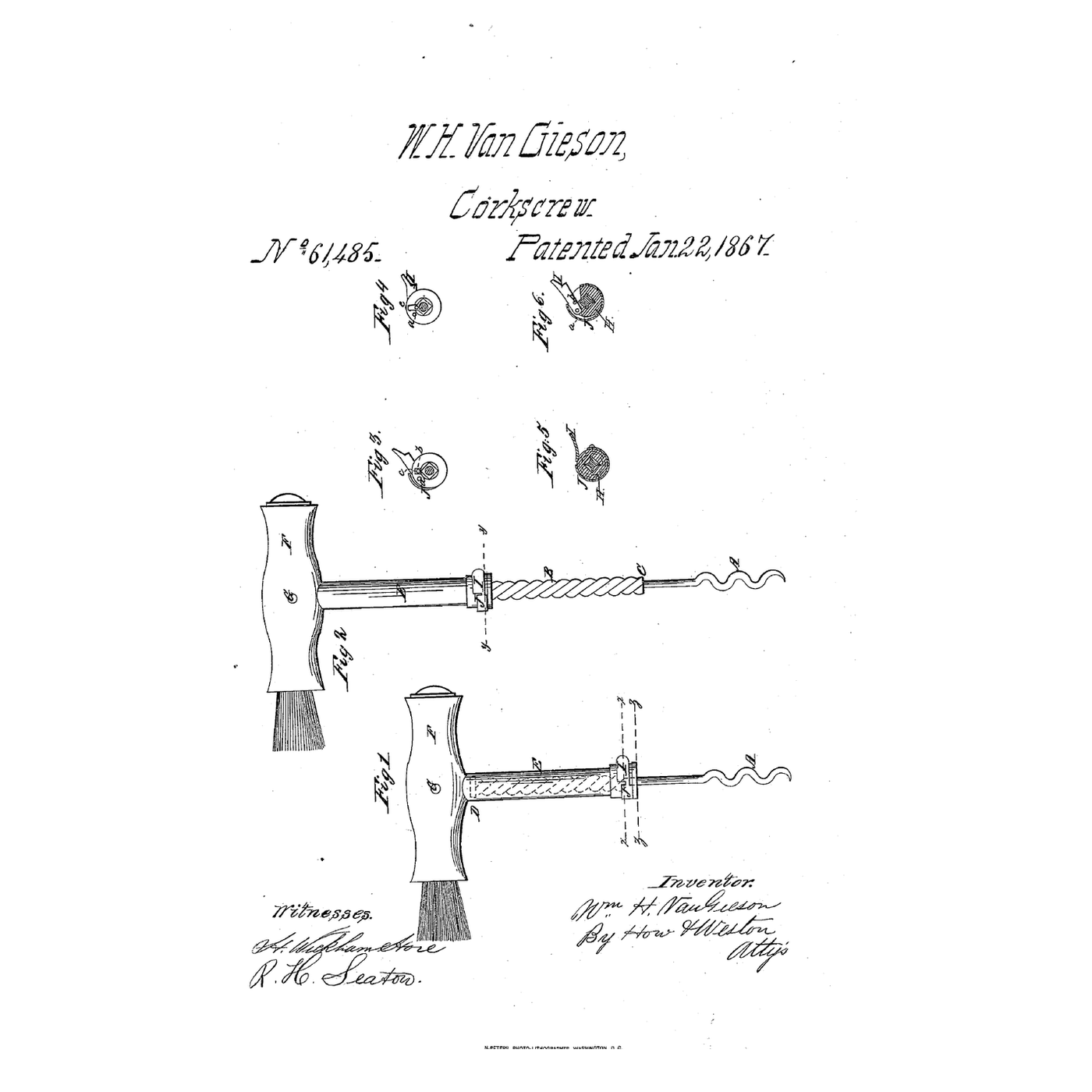
William H. Van Gieson of Passaic, New Jersey, received US 61,485, dated 22 January 1867, for a corkscrew "rapid and simple in its operation, as well as strong and durable, and not too bulky to be convenient in handling." The stem is twice its usual length: its upper part is a square rod twisted about one turn to the inch, the opposite way to the spiral, and it slides through a plate with a matching hole at the foot of a tube fixed in the handle. Pressing the handle drives the rod up the tube, turning it, and the spiral turns into the cork; a spring catch then hooks under a shoulder on the stem so the cork can be drawn.
This rung works out the torque a push gives, with a work check, then twists a square rod, files the plate, and presses corkscrews into corks.
Avançado
About 6 hours
Instruções
1
1
Push into torque
Push into torque
A carregar o notebook Jupyter…
2
2
A push-driven corkscrew before it
A push-driven corkscrew before it
The embedded blueprint lets a steep screw turn itself in under a push. Van Gieson keeps an ordinary spiral and turns it with a twisted rod running through a plate in the handle.
3
3
Read US 61,485
Read US 61,485
"To accomplish this object, I attach to the middle of the handle a metallic tube, in the position usually occupied by the shank of the instrument, and extend the shank of the screw or spiral to about double its usual length, making the upper part in the form of a regularly twisted square, or other prism-shaped rod, having about one twist to the inch, and turned in the opposite direction from that of the screw or spiral itself, and make this twisted square portion to run up into the said tube through a plate at its lower extremity."
"In using my cork-screw, the stem is first thrown out, which can easily be done by pressing back the spring-catch I, and the point of the screw A being placed against the centre of the cork, the handle is pressed down, thereby turning the twisted part B and spiral A, and forcing the said spiral into the cork. So soon as the shoulder C passes above the spring-catch I, the said spring-catch hooks under the said shoulder, and gives a bearing against which the stem is supported while the cork is being pulled."
4
4
Make the corkscrew and press it into corks
Make the corkscrew and press it into corks
**Twisted rod.** Cut 18 cm of 6 mm mild steel square bar. Heat 10 cm of it red with the torch and, with one end in the vise, twist it with an adjustable wrench about four turns, so it has about one twist to the inch, the opposite way to the spiral you will wind.
**Spiral and shoulder.** Wind 2 mm steel wire into an open helix round a 6 mm rod, file a point, and silver-solder it to the square bar's plain end. Silver-solder a washer round the bar where the twist ends, as the shoulder C.
**Plate and tube.** Drill and file a square hole in a small piece of mild steel plate so the twisted rod slides through it and turns as it goes. Silver-solder the plate across the end of a 12 cm length of tube that the rod turns freely in.
**Handle and catch.** Drill a hardwood handle across its middle and fix the tube's other end in it with a rivet. Rivet a strip of spring steel beside the plate so its bent end springs under the shoulder when the rod is pushed fully in.
**Test.** Cork several bottles of water with the corking kit. Press the spring catch back, draw the stem out, set the point on a cork's centre and press the handle down. When the catch clicks under the shoulder, draw the cork.
Materiais para este passo:
 Barra quadrada de aço macio0.18 metro
 Arame de aço0.4 metro
 Anilha plana1 peça
 Conjunto de solda de prata (fraca/média/forte)1 peça
 Fundente1 peça
 Chapa grossa de aço macio1 peça
 Tubo de alumínio0.12 metro
 Barrote de madeira dura para cabos1 peça
 Rebites cegos3 peças
 Fita de aço-mola0.08 metro
 Garrafa de vidro (transparente)3 peças
 Rolhas3 peças
 Água2 litros
Ferramentas necessárias:
 Serra de arco para metais
 Maçarico a propano
 Torno de bancada
 Chave inglesa
 Limas (lima de mão)
 Jogo de limas de agulha
 Berbequim sem fios
 Jogo de brocas
 Kit de rebitadora
 Alicate de bicos redondos
 Kit de rolhamento de garrafas de vinho
 Óculos de segurança transparentes
 Luvas de trabalho em couro
5
5
A push corkscrew that jams, slips or will not hold
A push corkscrew that jams, slips or will not hold
Twisted-rod push corkscrew troubleshooting.
Flow
Loading...
6
6
History and honest limits
History and honest limits
**William H. Van Gieson** of Passaic, Passaic County, New Jersey, received US 61,485, dated 22 January 1867. A head or button D on the twisted part stopped it leaving the tube, the tube E was fixed in the handle F by a pin G, and the spring catch I was held by a circular spring J in a slot in the tube, with a pin b to limit its throw. His claims cover the stem's upper part twisted opposite to the spiral, and its combination with the tube, plate, catch and handle.
**Honest limits.** A twisted square bar, a filed plate and aluminium tube stand in for his parts; the head D and circular spring J are simplified. The notebook ignores friction; its forces, spiral lead and stroke are examples. Your pressed-in corks are the result.
Materiais
13- 0.18 metroReferência
- 0.4 metroReferência
- 1 peçaReferência
- Referência
- 1 peçaReferência
- Referência
- 0.12 metroReferência
- Referência
- 3 peçasReferência
- 0.08 metroReferência
- Referência
- 3 peçasReferência
- 2 litrosReferência
Ferramentas necessárias
13- Referência
- Referência
- Referência
- Referência
- Referência
- Referência
- 1 vendor sell this, none ship to you yetReferência
- Referência
- Referência
- Referência
- Referência
- Referência
- Referência
Blueprints relacionados
Estes blueprints compartilham conhecimento — técnicas, materiais ou princípios


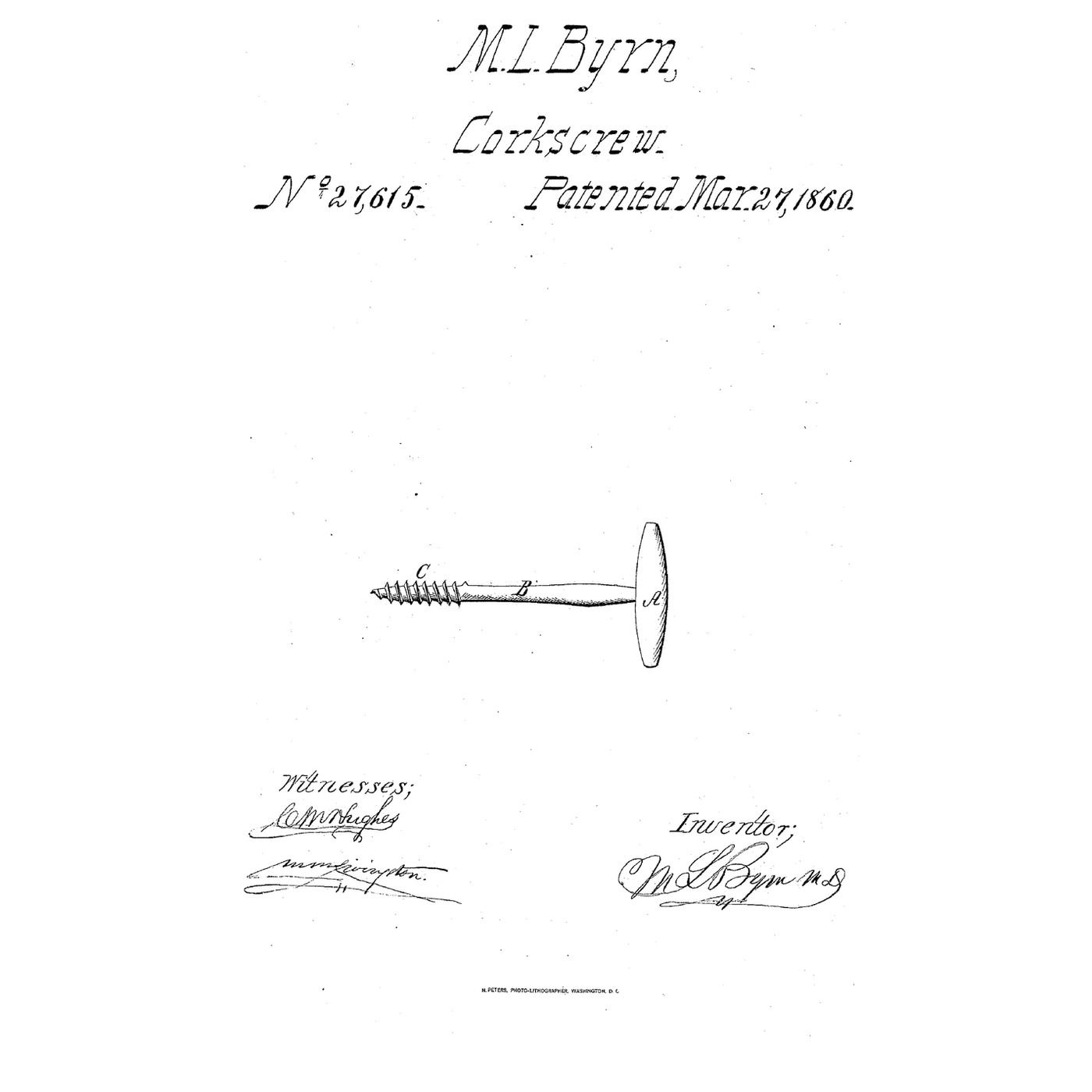
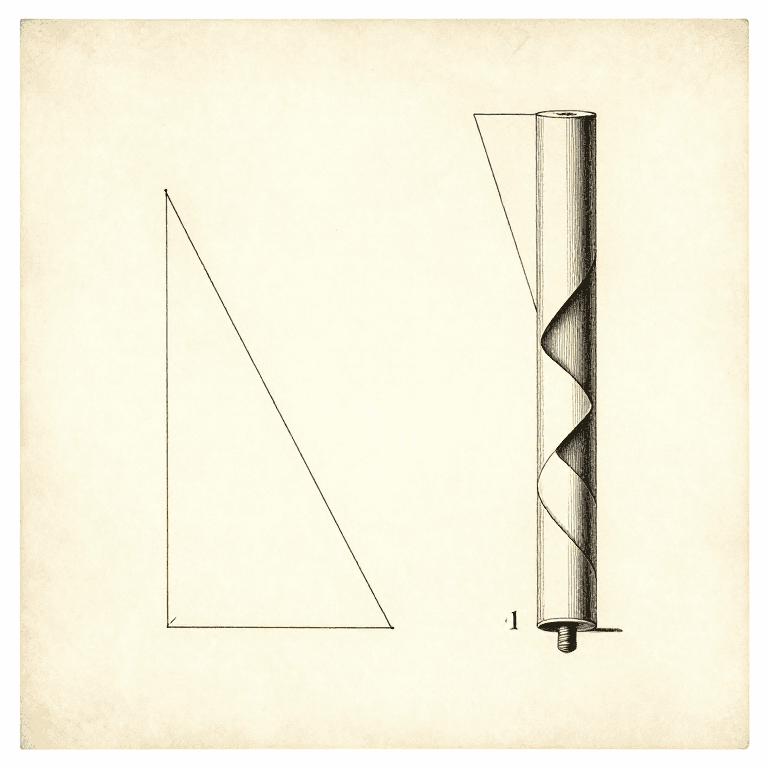
CC0 Domínio Público
Este blueprint é liberado sob CC0. Você é livre para copiar, modificar, distribuir e usar este trabalho para qualquer finalidade, sem pedir permissão.
Apoie o Maker comprando produtos através do Blueprint, onde ele ganha uma Comissão Maker definida pelos vendedores, ou crie uma nova versão deste Blueprint e inclua-o como conexão no seu próprio Blueprint para compartilhar receita.