ARTE
BELEZA E BEM-ESTAR
ARTESANATO
CULTURA E HISTÓRIA
ENTRETENIMENTO
MEIO AMBIENTE
COMIDA E BEBIDAS
ENGENHARIA REVERSA
CIÊNCIAS
ESPORTES
TECNOLOGIA
TECNOLOGIA VESTÍVEL
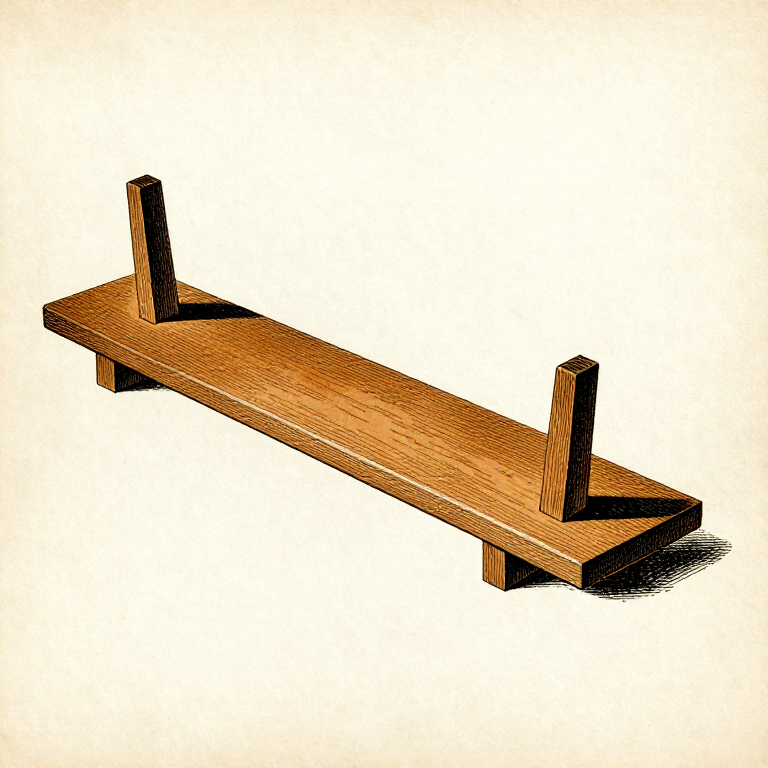


Twist, Cup and Bow: Winding Sticks Make the Invisible Obvious
A board can be out of true in three separate ways, and they need three different tests. BOW is a curve along its length, CUP is a curve across its width, and TWIST — wind — is the two ends being in different planes.
Twist is the one that matters most and the one you cannot see. A board can look perfectly flat, sit on the bench without rocking, and still be twisted enough to make a door that will not close.
Winding sticks solve it with no measurement at all: two straight battens and your eye, amplifying a fraction of a millimetre into something unmistakable.
Intermediário
3 hours
Instruções
1
1
Bow and cup: a straightedge finds both
Bow and cup: a straightedge finds both
Lay a straightedge along the length of the board and look for light under it: that is BOW. Lay it across the width and do the same: that is CUP.
Check in several places along and across, because a board is rarely uniform. Cup usually goes the same way on a flat-sawn board — away from the heart of the tree — which is why boards are often alternated in a glued panel.
Both are straightforward to see and straightforward to plane out, and both cost thickness. Take the measurement before deciding the finished thickness, or you will find the board is thinner than the design needs after truing it.
Materiais para este passo:
 Tábua de madeira de lei1 peça
Ferramentas necessárias:
 Régua de traçar
 Régua
Régua Plaina manual
2
2
Winding sticks: how the trick actually works
Winding sticks: how the trick actually works
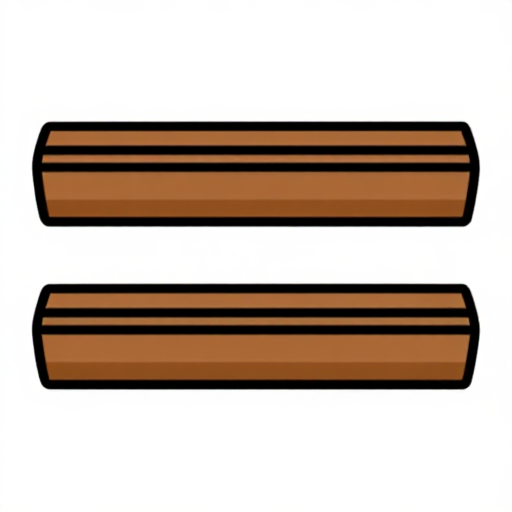
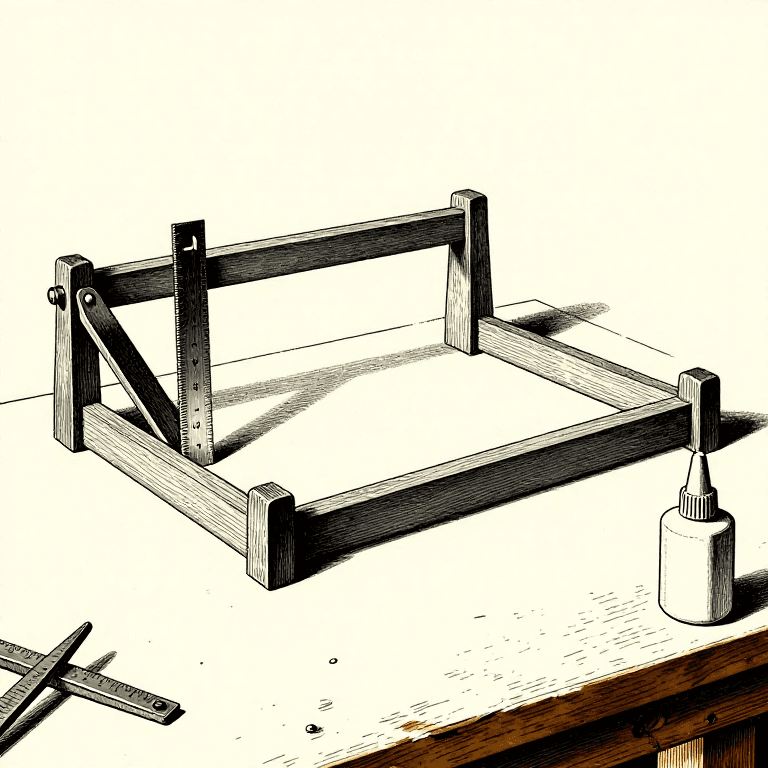
Stand one stick across the board at each end and sight across their top edges from a low angle. If the board is flat, the two top edges line up as a single line. If it is twisted, one stick appears tilted relative to the other.
The sticks amplify. They are much wider than the board is thick, so an end-to-end twist of a fraction of a millimetre becomes a visible several-millimetre offset between the two far corners — a difference you can see easily and could never feel.
Make them from any straight stable stock, in a matched pair, dead parallel along their length. A dark inlay or a painted stripe along the top edge of one makes the sighting much easier, which is why traditional pairs have contrasting inlays.
Materiais para este passo:
Tábua de madeira de lei2 peçasFerramentas necessárias:
 Réguas de verificação de empenoRégua de traçar
3
3
How much a small twist actually costs
How much a small twist actually costs
A carregar o notebook Jupyter…
Ferramentas necessárias:
Réguas de verificação de empeno Calculadora
4
4
Take the high corners down, and re-check constantly
Take the high corners down, and re-check constantly
Twist is removed by planing the two diagonally opposite HIGH corners down until the sticks read parallel. Mark the high corners in pencil while the sticks are still in place so you know which they are once you pick up the plane.
Work diagonally across the board rather than along it — the high corners are on a diagonal, so that is the direction the shavings need to come from. Check again every few strokes. It is easy to overshoot and put a twist the other way in.
Then re-check with the straightedge for bow and cup, because removing twist changes them. True the face completely before touching the edge; a face that goes out of true afterwards takes the edge's squareness with it.
Materiais para este passo:
Tábua de madeira de lei1 peçaFerramentas necessárias:
Réguas de verificação de empenoPlaina manualRégua de traçarBlueprints relacionados
Estes blueprints compartilham conhecimento — técnicas, materiais ou princípios

CC0 Domínio Público
Este blueprint é liberado sob CC0. Você é livre para copiar, modificar, distribuir e usar este trabalho para qualquer finalidade, sem pedir permissão.
Apoie o Maker comprando produtos através do Blueprint, onde ele ganha uma Comissão Maker definida pelos vendedores, ou crie uma nova versão deste Blueprint e inclua-o como conexão no seu próprio Blueprint para compartilhar receita.