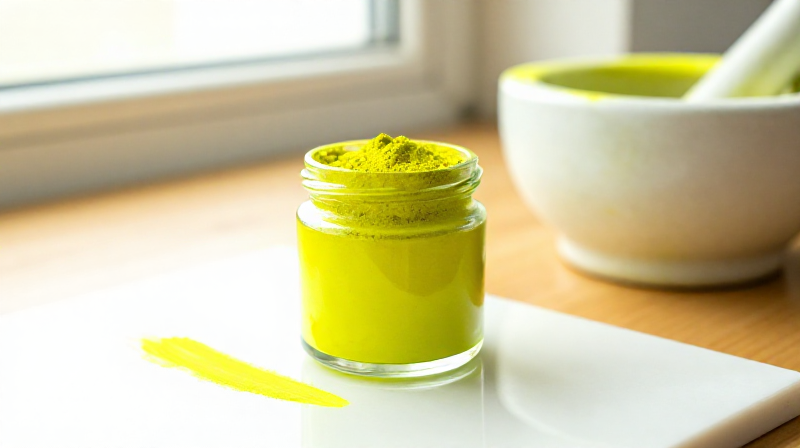


Making Isoindoline Yellow — The High-Performance Pigment That Outlasts Cadmium
Isoindoline Yellow (Pigment Yellow 109, CI 56284) is a synthetic organic pigment developed in the 1960s by Ciba-Geigy in Switzerland. It belongs to a class of pigments built from the isoindoline ring system — a five-membered nitrogen-containing ring fused to a benzene ring. These pigments offer a combination of brilliant colour, excellent lightfastness (ASTM I–II), and good heat stability that no earlier yellow pigment could match without using toxic heavy metals.
The synthesis involves two stages. First, phthalonitrile (1,2-dicyanobenzene) is reacted with ammonia to form 1,3-diiminoisoindoline — a reactive intermediate where both nitrile groups have been converted to imino groups, with one incorporated into a five-membered ring. Second, two molecules of this diiminoisoindoline are condensed with one molecule of barbituric acid. The active methylene group of barbituric acid (position 5) bridges the two isoindoline units, creating an extended conjugated system that absorbs blue-violet light and appears bright yellow.
The closely related PY110 (CI 56280) uses tetrachlorophthalonitrile as the starting material instead, giving a warmer, more reddish yellow with even greater weather resistance — preferred for automotive paints. Together, these isoindoline yellows replaced cadmium yellow and chrome yellow for applications demanding permanence without toxicity.
SAFETY WARNING: Phthalonitrile is a skin and respiratory irritant. Ammonia solution causes chemical burns and produces choking fumes. Barbituric acid is harmful if ingested (it is the parent compound of barbiturate drugs, though it has no sedative activity itself). Work under ventilation with full PPE.
Instructions
Don protective equipment and set up ventilation
Don protective equipment and set up ventilation
Put on chemical splash goggles, nitrile gloves, a lab coat, and a respirator with acid gas and ammonia cartridges. The ammonia step produces choking fumes even with aqueous solution — a fume hood or strong cross-ventilation is essential. Phthalonitrile dust is irritating to the lungs. Have a water wash station accessible for skin contact.
Tools needed:
 P100/FFP3 Respirator with Acid Gas Cartridge
 Chemical Splash Goggles
 Nitrile Rubber Gloves (Thick)
 Lab Coat
Dissolve phthalonitrile in methanol
Dissolve phthalonitrile in methanol
Weigh 8 g of phthalonitrile (1,2-dicyanobenzene) — a white crystalline solid with a faint almond-like odour. Dissolve in 60 ml of methanol in a round-bottom flask fitted with a reflux condenser. Warm gently to 40 °C with stirring to dissolve completely. Phthalonitrile contains two adjacent nitrile (–C≡N) groups on a benzene ring — both will react with ammonia in the next step to form the isoindoline ring system.
Materials for this step:
 Phthalonitrile8 g
 Methanol (Lab Grade, 500ml)60 ml
Tools needed:
 Digital Precision Scale
 Thermometer (Lab)
Add ammonia solution to form 1,3-diiminoisoindoline
Add ammonia solution to form 1,3-diiminoisoindoline
Add 40 ml of concentrated ammonia solution (25–28%) to the phthalonitrile solution and heat to 50–60 °C with stirring for 3 hours under the reflux condenser. Ammonia attacks both nitrile groups: one nitrile cyclises with the nitrogen to form the five-membered isoindoline ring, while the other converts to an imino group (=NH). The product — 1,3-diiminoisoindoline — begins to precipitate as a pale yellow crystalline solid as the reaction proceeds.
Materials for this step:
 Ammonia Solution (25-28%)40 ml
Tools needed:
 Glass Stirring Rod (25cm)
Filter and wash 1,3-diiminoisoindoline
Filter and wash 1,3-diiminoisoindoline
Cool the reaction mixture to room temperature. The 1,3-diiminoisoindoline has largely precipitated as pale yellow crystals. Filter through filter paper, wash with 100 ml of cold methanol to remove unreacted phthalonitrile and residual ammonia, then with 100 ml of cold distilled water. Press dry on the filter. The product should be a pale yellow to off-white crystalline powder. This is the reactive intermediate that will be coupled with barbituric acid.
Materials for this step:
Methanol (Lab Grade, 500ml)100 ml Distilled Water (1 Liter)100 ml
Tools needed:
 Filter Paper (fine pore)
 Glass Funnel (Stemmed)
Dissolve barbituric acid
Dissolve barbituric acid
In a separate beaker, dissolve 4 g of barbituric acid in 80 ml of glacial acetic acid at 50 °C. Barbituric acid (pyrimidine-2,4,6-trione) is a white crystalline solid — the parent compound of all barbiturate drugs, though it has no pharmacological activity itself. Its importance here is the active methylene group at position 5, which sits between two electron-withdrawing carbonyl groups. This highly activated C–H bond will react with the imino groups of the diiminoisoindoline.
Materials for this step:
 Barbituric Acid4 g
 Acetic Acid (Glacial, 500ml)80 ml
Tools needed:
 Glass Beaker (Borosilicate, 500ml)
Add diiminoisoindoline to barbituric acid solution
Add diiminoisoindoline to barbituric acid solution
Add the dried 1,3-diiminoisoindoline in small portions to the warm barbituric acid solution with vigorous stirring. A bright yellow colour develops immediately as the condensation begins — the imino nitrogen of the diiminoisoindoline attacks the activated methylene of barbituric acid, displacing water and forming a new carbon–nitrogen double bond. Two molecules of diiminoisoindoline react with each barbituric acid, one on each side of the central C–H.
Tools needed:
Glass Stirring Rod (25cm)Heat for condensation at 80 °C
Heat for condensation at 80 °C
Heat the mixture to 80 °C and maintain for 2 hours with constant stirring. The slurry becomes thick with bright yellow pigment as the condensation completes. Both sides of the barbituric acid methylene have now been substituted, creating an extended conjugated bridge between the two isoindoline units. Two molecules of ammonia are released as byproducts and escape through the condenser. The resulting chromophore absorbs blue-violet light, producing a vivid greenish yellow.
Tools needed:
Thermometer (Lab)Cool and filter crude pigment
Cool and filter crude pigment
Allow the mixture to cool to room temperature. The bright yellow pigment has precipitated as a thick slurry in the acetic acid. Filter through filter paper. The vivid yellow pigment collects on the filter while the acetic acid filtrate passes through as a pale yellow solution. Rinse the beaker with 50 ml of warm acetic acid and pour through the filter to capture all pigment.
Tools needed:
Filter Paper (fine pore)Glass Funnel (Stemmed)Acid wash to remove unreacted amines
Acid wash to remove unreacted amines
Return the filter cake to a beaker and boil in 200 ml of dilute hydrochloric acid (10%) for 20 minutes. This dissolves any unreacted diiminoisoindoline (as its hydrochloride salt) and other basic impurities. The isoindoline yellow pigment is completely insoluble in dilute acids — it remains as a bright yellow solid. Filter hot.
Materials for this step:
 Dilute Hydrochloric Acid (10% HCl)200 ml
Alkali wash and final water wash
Alkali wash and final water wash
Boil the filter cake in 200 ml of dilute sodium hydroxide (5%) for 20 minutes to remove any unreacted barbituric acid and acidic byproducts. Filter hot, then wash with 500 ml of hot distilled water in three portions until the filtrate is colourless and neutral. The pigment is resistant to both acids and alkalis — these harsh washes remove all impurities while leaving the chromophore intact.
Materials for this step:
 Sodium Hydroxide (Lab Grade, 500g)10 gDistilled Water (1 Liter)700 ml
Tools needed:
Filter Paper (fine pore)Dry the purified pigment
Dry the purified pigment
Spread the washed pigment on a clean glass plate and dry at 80 °C for 4–6 hours. Isoindoline yellow is thermally stable to above 250 °C — a significant improvement over Hansa Yellow (which darkens above 120 °C) and one of the reasons it displaced earlier organic yellows for demanding applications. The dried pigment should be a uniform, vivid greenish-yellow powder.
Grind to final pigment fineness
Grind to final pigment fineness
Grind the dried pigment in a porcelain mortar. The colour intensifies as particle size decreases — a well-ground isoindoline yellow is startlingly bright, with a clean, pure yellow hue that has none of the greenish cast of some Hansa Yellows or the orange undertone of cadmium yellow. Tinting strength is high — a small amount produces a vivid yellow tint in white paint. Pass through a 120-mesh sieve.
Tools needed:
 Mortar and Pestle (Porcelain)
 120-Mesh Sieve
Store finished isoindoline yellow
Store finished isoindoline yellow
Transfer the sieved pigment to a glass jar with a tight-fitting lid. Label with the pigment name (Isoindoline Yellow, PY109, CI 56284), date, and properties: lightfastness ASTM I–II (excellent), heat stability above 250 °C, resistant to acids and alkalis. Expected yield from 8 g phthalonitrile and 4 g barbituric acid: approximately 7–9 g of finished pigment. Isoindoline yellows represent the final step in the century-long search for a bright, permanent, non-toxic yellow — everything chrome yellow and cadmium yellow promised, without the lead or cadmium.
Tools needed:
 Glass Storage Jar with Lid
Materials
8- Placeholder
- Placeholder
- Placeholder
- Placeholder
- Placeholder
- Placeholder
- Placeholder
- Placeholder
Tools Required
13- Placeholder
- Placeholder
- Placeholder
- Placeholder
- Placeholder
- Placeholder
- Placeholder
- Placeholder
- Placeholder
- Placeholder
- Placeholder
- Placeholder
Connected Blueprint Materials
Related Blueprints
These blueprints share knowledge with this one — techniques, materials, or principles that connect them in the learning graph.
Related blueprints
Other builds that share materials, tools, or techniques with this one.
CC0 Public Domain
This blueprint is released under CC0. You are free to copy, modify, distribute, and use this work for any purpose, without asking permission.
Support the Maker by purchasing products through their Blueprint where they earn a Maker Commission set by Vendors, or create a new iteration of this Blueprint and include it as a connection in your own Blueprint to share revenue.