合作
艺术
美容与健康
工艺
文化与历史
娱乐
环境
食品与饮料
逆向工程
科学
体育
技术
可穿戴设备
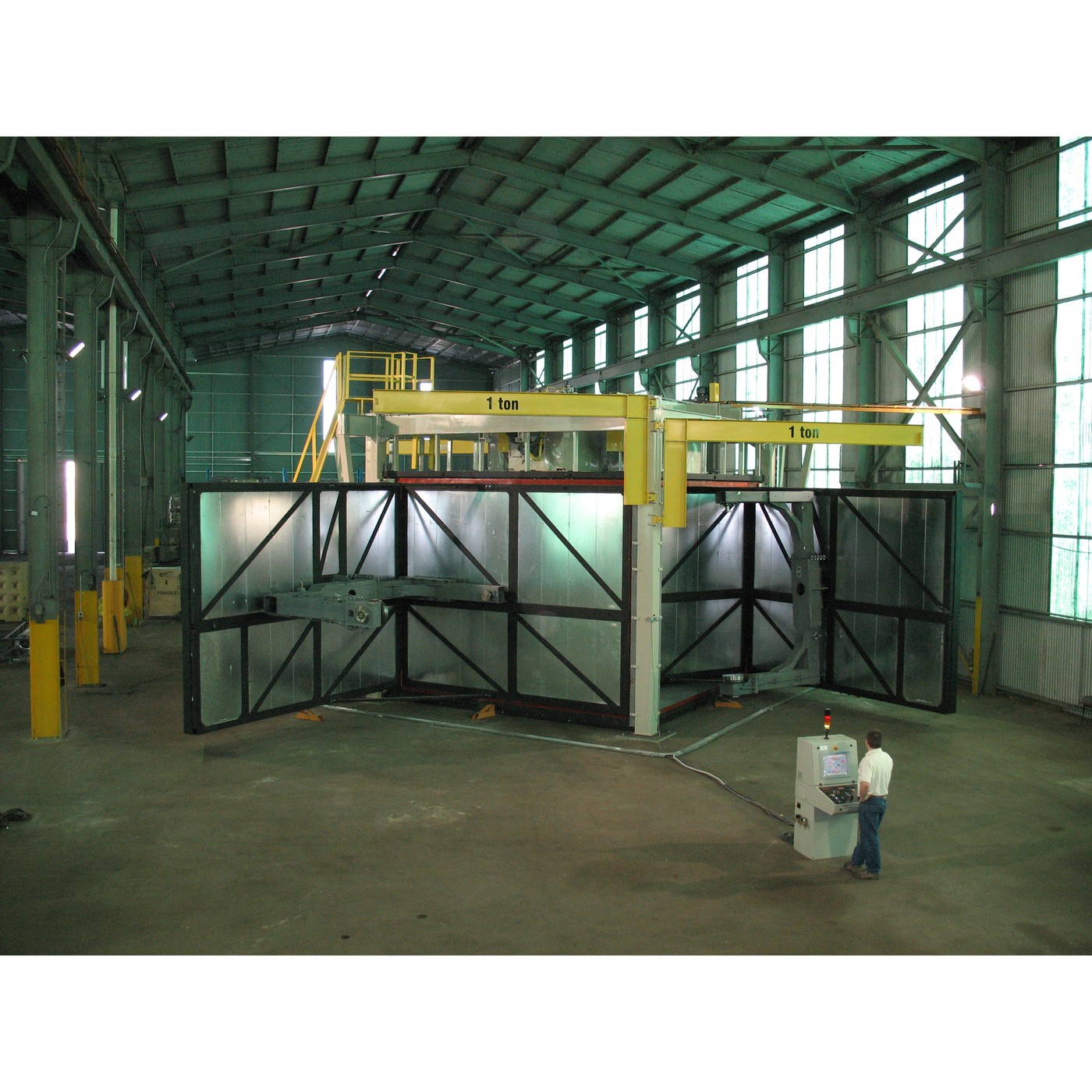


Rotational Moulding: No Pressure At All
Every other process in this batch pushes polymer somewhere: a screw rams it, air inflates it, a haul-off drags it. Rotational moulding pushes nothing. Powder is weighed into a cold mould, the mould is closed and tumbled about two axes inside an oven, and the powder melts and sticks to the inside surface wherever it touches.
Because there is no pressure, there is no clamping force, no core, no ejection system and no injection unit — so the tool can be cast aluminium or fabricated sheet and costs a small fraction of an injection mould. Water tanks, kayaks, road barriers, playground equipment and fuel tanks are made this way, seamless and stress-free.
The price is time. This rung works out both sides of that bargain, and makes a small part with an oven and a hand-turned frame.
中级
About 3 hours
说明
1
1
Find the signature of a rotomoulded part
Find the signature of a rotomoulded part
Rotomoulded parts announce themselves once you know what to look for. Find a water butt, a kayak, a wheelie bin, a road barrier or a large planter and examine it.
- **No parting line worth the name** across the body, and **no gate**. There is a mould split, but nothing was injected anywhere.
- **Generous radii everywhere.** Powder will not flow into a sharp internal corner; it bridges. A rotomoulded part has no sharp corners at all, and a designer who draws one gets a thin spot.
- **The wall is thicker at the corners**, which is the exact opposite of rung 3's blow moulding. Nothing was stretched, so powder simply collected where it had more surface to sit against.
- **A slightly textured or matt inside surface**, and often a faint pebbling, because the last powder to melt never fully levelled.
- **No internal stress.** Squeeze it, cut it, drill it — it does not spring or craze the way an injection moulding does, because nothing was forced anywhere.
Cut a sample if you can, and measure the wall at a flat, a corner and a boss. Write the three numbers down; step 4's arithmetic predicts the flat one from the charge weight.
所需工具:
 6 英寸数显卡尺
 千分尺
 手工刀
 数码显微镜
 直尺
 安全眼镜
 实验记录本(带复写页)
2
2
Rotomould something small
Rotomould something small
The process scales down honestly, and a small oven plus a hand-turned frame is enough to make a real part.
**The mould.** Two aluminium halves that clamp together — a simple sphere or a rounded box, 60–100 mm across — with a small vent hole so the air inside can expand and escape. Every rotomould has a vent; without one the pressure inside pushes the melt away from the wall and the part comes out thin and bubbled.
**The charge.** Weigh polyethylene powder into the mould. Step 4 gives the arithmetic; for a 80 mm sphere aiming at a 2 mm wall you want roughly 40 g. Use **powder**, not pellets: pellets do not melt evenly at these temperatures and leave a lumpy, porous wall. If you only have pellets, grind them cold.
**The rotation.** Two axes, slowly, at different speeds — a common ratio is about 4:1 between the major and minor axes, which is what stops the powder tracing the same path twice. A simple hand frame with two cranks is perfectly adequate for a small part, and turning it by hand for twenty minutes teaches you more about the process than any description.
**The heat.** Oven at about 250–280 °C for polyethylene, and the number that matters is the **internal air temperature** rather than the oven setting. Keep turning throughout. You are done when the inside surface has gone glossy — in a production machine an air probe reports this; on the bench, judge by time and then by the result.
**The cool.** Keep turning while it cools or the melt slumps to the bottom. Cool slowly with air; quenching a rotomoulded part warps it badly, because the wall is thick and the polymer is semi-crystalline.
An oven at 280 °C and a hot metal mould that must be handled while turning. Leather gloves rated for heat, a face shield, a stable frame, and ventilation — polyethylene above about 300 °C degrades and the fumes are genuinely harmful. Do not exceed the temperature and do not leave it unattended.
此步骤所需材料:
 滚塑用聚乙烯粉料1 个
所需工具:
 烤箱
 红外测温仪
 K 型热电偶配 MAX6675 模块
 精密数字天平
 台虎钳
 台钻
 锉刀(手用锉)
 皮革工作手套
 面屏安全眼镜
 通风柜(带排风管)
 灭火器
 秒表实验记录本(带复写页)
 铝板(6061-T6)
3
3
Make the three classic faults happen
Make the three classic faults happen
Three faults account for most of what goes wrong, and each has an unmistakable appearance. Produce all three deliberately and keep the samples.
**Bubbles (under-cooked).** Take the part out early. The wall is full of trapped air between partly-fused powder grains, and it looks like frozen foam in section. This is the commonest real fault: the powder melted and stuck but never coalesced. The fix is more time at temperature, not more temperature.
**Degradation (over-cooked).** Leave one in too long. The inside surface goes yellow or brown and the part becomes brittle; it may smell. Polyethylene oxidises from the inside surface outward because that is where the hot air is. Note that the outside can look perfect.
**Warping (cooled wrong).** Quench one in cold water. It will distort, and it will keep distorting for hours as stresses relax. Compare with one air-cooled slowly on the frame.
Section all three plus a good one, and look at the wall under the microscope. The good part has a uniform, dense, slightly glossy inner face. The under-cooked one is porous. The over-cooked one is discoloured at the inner face specifically.
Then break each one. Under-cooked parts fail at a fraction of the load because every bubble is a void, and this is the reason rotomoulding is judged on internal air temperature rather than on the clock.
此步骤所需材料:
滚塑用聚乙烯粉料1 个所需工具:
烤箱红外测温仪K 型热电偶配 MAX6675 模块数码显微镜手工刀 测力计(弹簧秤)秒表皮革工作手套面屏安全眼镜通风柜(带排风管)实验记录本(带复写页)
4
4
Charge weight, wall thickness and where the energy goes
Charge weight, wall thickness and where the energy goes
正在加载 Jupyter 笔记本…
所需工具:
精密数字天平5
5
History and context
History and context
**Attribution, stated honestly.** No patent is asserted here. Rotational moulding of hollow objects is very old — rotating a mould containing a liquid to coat its inside is how chocolate shells and hollow metal castings were already being made in the nineteenth century, and the catalogue's slip casting rung is the same idea in ceramics. The plastics version arrives with **polyethylene powder** in the 1950s, and the process was developed across the industry rather than by a single filing.
**What it is actually for.** Not speed, and not precision. Rotomoulding wins on three things nothing else offers together: **very low tool cost**, so short runs and large parts are affordable; **seamless, stress-free hollow parts** with no weld line and no ejection marks; and **uniform corners**, because powder collects rather than stretches. A 1,000 litre water tank is a rotomoulding because no other process could make one at all without joining pieces.
**The comparison worth holding.** Injection moulding puts the cost in the tool and almost none in the cycle. Rotational moulding puts almost none in the tool and all of it in the cycle. Step 4's energy split is why: most of the heat goes into the mould, and it all has to come out again before the part can be removed.
**Honest limits.** Cycle times of twenty minutes to an hour, so labour and energy per part are high. Tolerances are poor — plus or minus several per cent on wall — and wall thickness cannot be varied deliberately except by adding insulation to the mould. No sharp corners, no fine detail, no threads worth having. The polymer choice is narrow because the powder must sinter and flow at oven temperature without degrading, which in practice means polyethylene for the overwhelming majority of parts. And the process is genuinely hot and genuinely slow, which is why step 2 is written with as much space given to the gloves as to the powder.
相关蓝图
这些蓝图共享知识——技术、材料或原理


CC0 公共领域
此蓝图以 CC0 协议发布。你可以自由复制、修改、分发和使用此作品,无需征得许可。
通过购买蓝图中的产品支持创客,他们将获得 创客佣金 (由供应商设定),或创建此蓝图的新版本并将其作为连接包含在你自己的蓝图中以分享收入。