艺术
美容与健康
工艺
文化与历史
娱乐
环境
食品与饮料
逆向工程
科学
体育
技术
可穿戴设备



The Story Stick: Carry the Dimension Instead of the Number
A story stick is a plain batten with the actual dimensions of a job marked on it. Not written — MARKED, as physical positions you transfer directly to the work.
It removes reading a scale, rounding a number, writing it down and reading it back — four separate opportunities for error, each of which has ruined a piece at some point. The stick carries the real distance and hands it over unchanged.
It is also how you fit something to an opening that is not quite square or not quite the size it should be, which is most real openings in most real buildings.
初学者
2 hours
说明
1
1
Make one from the job, not from the drawing
Make one from the job, not from the drawing
Take a straight offcut a little longer than the largest dimension, hold it in the actual opening or against the actual assembly, and mark the real positions directly onto it.
The drawing says the alcove is 800 mm. The alcove is 797 at the bottom and 803 at the top, and the stick knows that while the drawing does not. Working from the stick makes the piece fit the opening it is actually going into.
Mark clearly and label what each mark is. An unlabelled story stick is useless a week later, and labelling it takes as long as making the marks.
此步骤所需材料:
 干燥软木板1 个
所需工具:
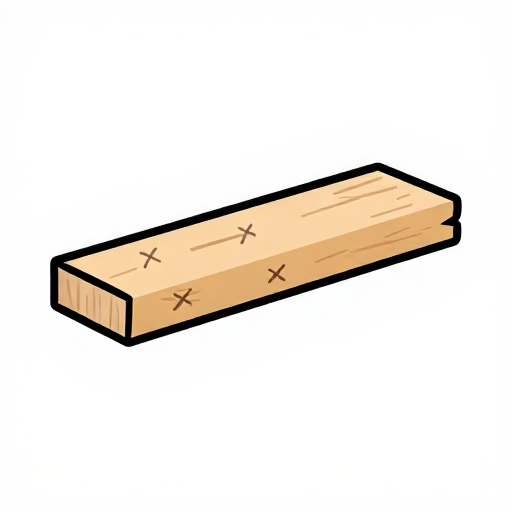 尺寸记录木条
 划线刀
划线刀2
2
Transfer, never measure
Transfer, never measure
Lay the stick on the work with a known end registered against the end of the piece, and transfer each mark straight across with a knife or a square.
Never read a number off the stick. The whole value is that no number exists: the distance goes from opening to stick to workpiece without ever becoming a quantity, so there is nothing to round and nothing to mistype.
Always register the same end of the stick against the same end of the work. That is the face-side principle again — one reference for everything — and getting it backwards on one piece of a set produces a mirror-image part that looks correct until it is offered up.
此步骤所需材料:
 硬木板4 个
所需工具:
尺寸记录木条划线刀 固定角尺
固定角尺3
3
One stick per job, and keep it until the job is finished
One stick per job, and keep it until the job is finished
Use one stick for one job and write the job on it. A stick reused for the next job with new marks over old ones is worse than no stick — you will read the wrong set at exactly the wrong moment.
Keep it until the piece is installed and accepted. Replacement parts, later adjustments and the matching piece next year are all easier with the stick than without, and it costs nothing to keep an offcut on a nail.
For a kitchen, a row of cabinets or a set of doors, the stick becomes the authoritative record of the job. If the stick and the drawing disagree, the stick is right — it was made from the building.
此步骤所需材料:
干燥软木板1 个所需工具:
尺寸记录木条4
4
The same trick on a small scale: pinch rods and gauge blocks
The same trick on a small scale: pinch rods and gauge blocks
Two sticks overlapped and clamped, extended until they just touch both sides of an opening, give an exact internal measurement with no reading at all. That is a PINCH ROD, and it measures a diagonal or an alcove far more accurately than a tape pushed into a corner.
Use two of them to check whether an opening is square: set one to each diagonal and compare the rods against each other. Equal means square, and you never learn or need either number.
The same idea, smaller again, is simply holding the part against the hole. The principle running through this whole rung is that a comparison is more accurate than a measurement, and it is available far more often than people use it.
此步骤所需材料:
干燥软木板2 个所需工具:
尺寸记录木条 直尺规固定角尺
相关蓝图
这些蓝图共享知识——技术、材料或原理

CC0 公共领域
此蓝图以 CC0 协议发布。你可以自由复制、修改、分发和使用此作品,无需征得许可。
通过购买蓝图中的产品支持创客,他们将获得 创客佣金 (由供应商设定),或创建此蓝图的新版本并将其作为连接包含在你自己的蓝图中以分享收入。