
KUNST
SCHÖNHEIT & WELLNESS
HANDWERK
KULTUR & GESCHICHTE
UNTERHALTUNG
UMFELD
ESSEN & GETRÄNKE
REVERSE ENGINEERING
WISSENSCHAFTEN
SPORT
TECHNOLOGIE
WEARABLES
Adjustable Concave Beater Churn: Beaters You Turn to Meet the Cream at Any Level
Woody

Erstellt von

Woody

6. Oktober 2026NO
13
0
0
0
0

Adjustable Concave Beater Churn: Beaters You Turn to Meet the Cream at Any Level

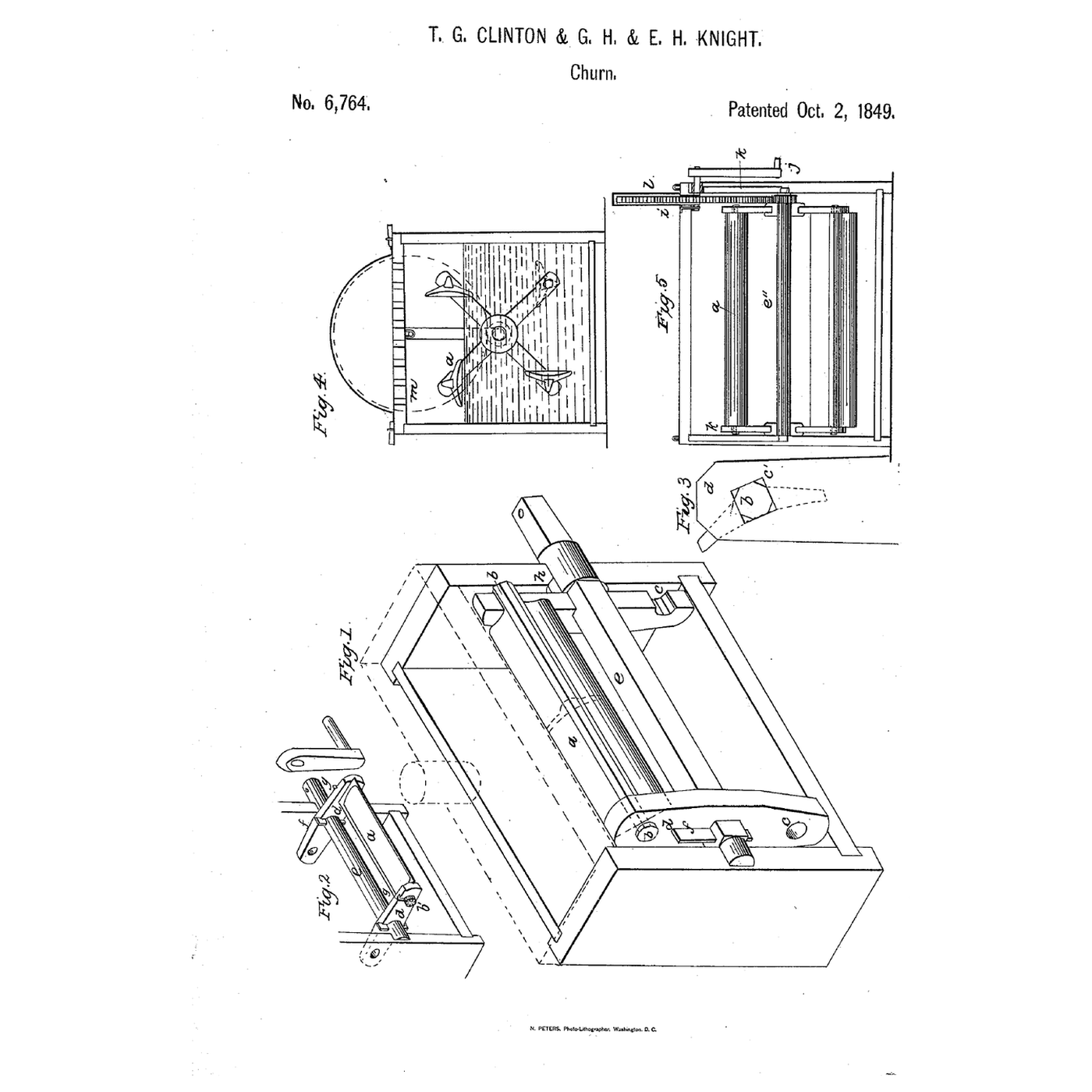
A concave beater carries air into cream only where its face meets the cream's surface flat; fixed on its arms, that confines the churn "to a definite and unchangeable quantity of milk." Thomas G. Clinton, George H. Knight and Edward H. Knight of Cincinnati, Ohio, received US 6,764, dated 2 October 1849, for an adjustable churn-dasher: concave beaters rotating vertically, each mounted between arms so it "can lie between the arms at any desired angle," for instance by "a square mortise in the arm with an octagonal journal to the beater," so the face and the surface can be brought into the same plane at any level of milk. The dasher comes apart for scalding, and they brought no metal into contact with the milk. This rung works out the angle for a given level, then prints the arms and four concave beaters with octagonal journals, fits them in a box, and makes butter.
Fortgeschritten
About 3 hours, plus printing

Anweisungen

1

Angle for the level

Jupyter-Notebook wird geladen …
2

Buckets that carry air below the surface before it

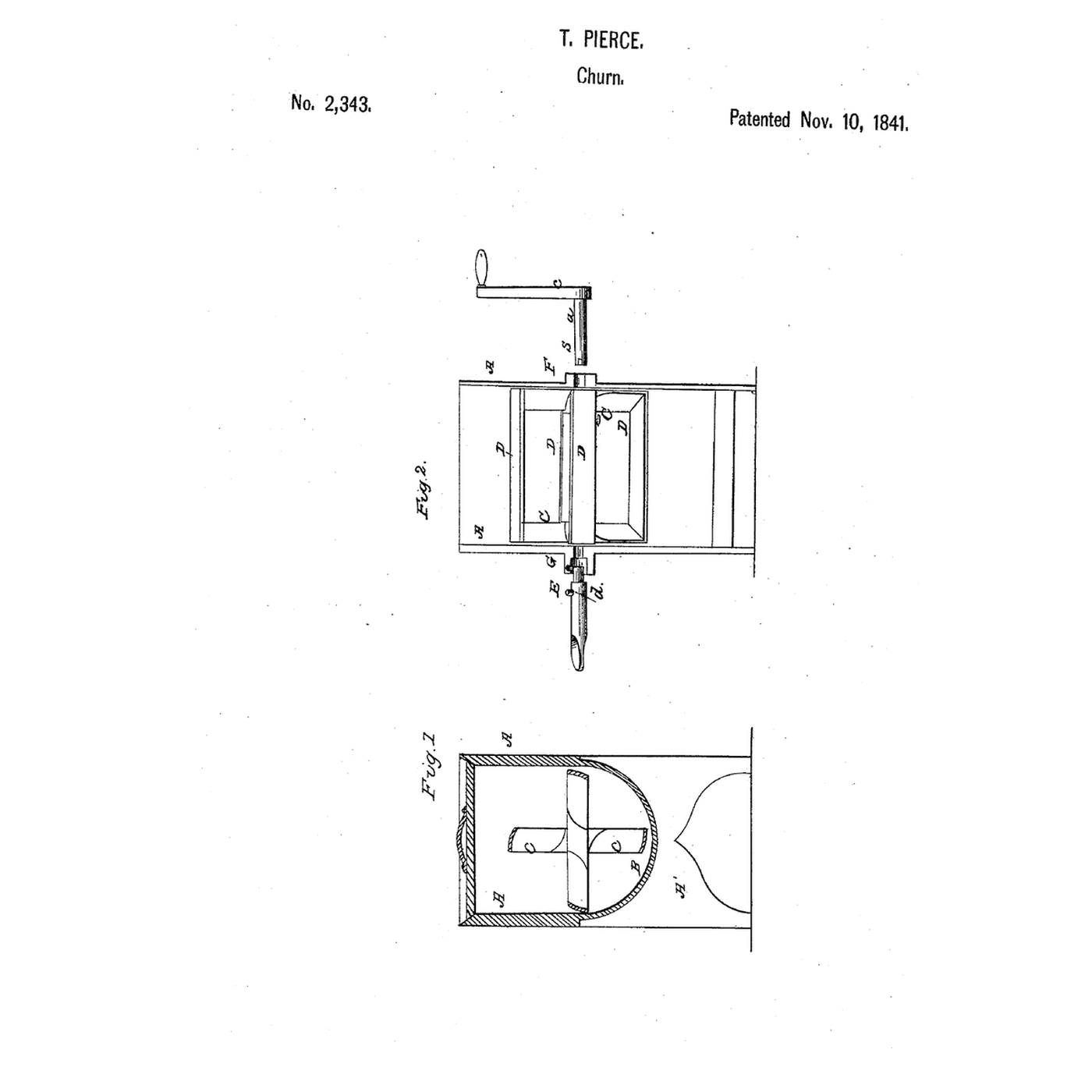
The embedded blueprint carries air down in fixed buckets, which works best at one level. Clinton and the Knights make their concave beaters adjustable to any level.
3

Read US 6,764

"Being permanently fixed to arms extending from the axis of motion, the beater, (if the milk rises above that level) dips into the liquid by its inner edge; and, if the milk falls below the same level, the beater slides into the liquid by its outer edge—thus in both cases leaving the air where it found it; viz—at the surface of the milk."
4

Print the parts

Print two sets of arms, each four arms with a square mortise near the end, and four concave beaters on their sides: half-tube troughs with an octagonal journal at each end. Print the crank arm. Print in PETG at 0.2 mm layers, 30 % infill, 4 walls; wash before first use.

Materialien für diesen Schritt:

PETG-FilamentPETG-Filament1 Stück

Benötigte Werkzeuge:

FDM-3D-DruckerFDM-3D-Drucker
5

Print the arms

The arms, printed as step 4 describes.
DesigndateiSTLCC0 - Free
6

Print the beater

The beater, printed as step 4 describes.
DesigndateiSTLCC0 - Free
7

Print the crank arm

The crank arm, printed as step 4 describes.
DesigndateiSTLCC0 - Free
8

Assemble the dasher

Slide the two arm sets onto a 10 mm square hardwood shaft 142 mm apart, mortises in line. Push each beater's octagonal journals into a pair of mortises, turned to the angle the notebook gives for your cream's level, and pin the arms on the shaft with wedges, as theirs.

Materialien für diesen Schritt:

HartholzdübelHartholzdübel1 Stück
HartholzblockHartholzblock1 Stück

Benötigte Werkzeuge:

HandsägeHandsäge
SchleifpapierSchleifpapier
9

The box

Take a food-safe box about 200 × 190 × 190 mm. Drill both ends on the axis 100 mm up, pass the shaft through with a leather washer at each end, and glue the crank arm and a dowel handle on.

Materialien für diesen Schritt:

Vorratsbehälter in LebensmittelqualitätVorratsbehälter in Lebensmittelqualität1 Stück

LederstreifenLederstreifen1 Stück
HolzleimHolzleim1 Stück

Benötigte Werkzeuge:

AkkubohrschrauberAkkubohrschrauber
BohrersatzBohrersatz
10

The build in 3D

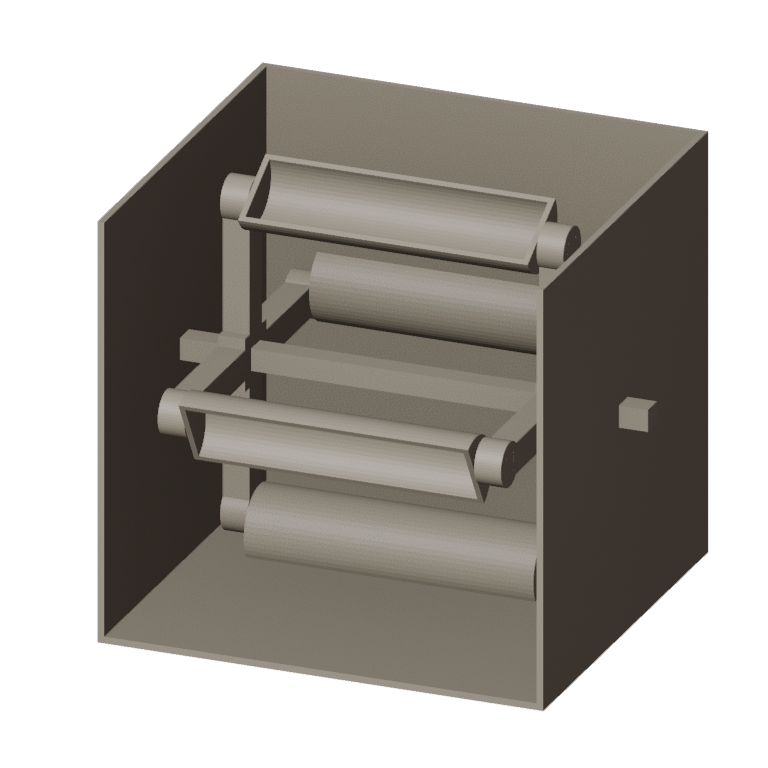
FreeCAD model of this build, not of the patent: the box with one side off to show the two arm sets on the shaft and the four concave beaters, each turned on its octagonal journals, with the crank.
DesigndateiBLENDCC0 - Free
11

Set, crank and make butter

Let the heavy cream stand until it reaches about 15 °C, checked with the thermometer. Pour in 1.5 litres and note how far below the shaft the cream stands. Set the beaters to the notebook's angle, crank so the hollow faces come down onto the cream, and time until the butter comes. Pour off the buttermilk, add cold water, churn a little and pour off again until it runs clear; work in a pinch of salt and weigh the butter.
Schritt 11 - Image 1

Materialien für diesen Schritt:

SchlagsahneSchlagsahne1500 ml
Grobes MeersalzGrobes Meersalz1 Stück
WasserWasser1 Stück

Benötigte Werkzeuge:

Einsteck-FühlerthermometerEinsteck-Fühlerthermometer
StoppuhrStoppuhr
Digitale KüchenwaageDigitale Küchenwaage
Große Rührschüssel aus EdelstahlGroße Rührschüssel aus Edelstahl
12

Few bubbles, beaters that turn on their own

Adjustable concave beater churn troubleshooting.

Flow

Loading...
13

History and honest limits

**Thomas G. Clinton, George H. Knight and Edward H. Knight** of Cincinnati, Ohio, received US 6,764, dated 2 October 1849. They also showed cylindrical journals held by pins or wedges, and a form with no shaft from head to head so the butter could gather within the beaters' sweep; they could use irons "at a cost of 18 cents." They claimed making the concave beater adjustable to any desired angle, so the face of the beater and the surface of the milk meet in the same plane at any quantity. **Honest limits.** A food-safe box and printed parts stand in for their wooden churn; our octagons give settings 45° apart, not any angle. FDM prints hold food in their layer lines, so wash well and replace when worn. Your times and weights are the result.

Materialien

9

Benötigte Werkzeuge

9

Designdateien

4

Dieser Bauplan stellt her

CC0 Gemeinfrei

Dieser Blueprint ist unter CC0 veröffentlicht. Sie dürfen dieses Werk für jeden Zweck frei kopieren, ändern, verbreiten und verwenden, ohne um Erlaubnis zu fragen.

Unterstützen Sie den Maker, indem Sie Produkte über seinen Blueprint kaufen, wo er eine Maker-Provision von Anbietern festgelegt, verdient. Oder erstellen Sie eine neue Iteration dieses Blueprints und verbinden Sie ihn in Ihrem eigenen Blueprint, um Einnahmen zu teilen.

Diskussion

(0)

Anmelden um an der Diskussion teilzunehmen

Kommentare werden geladen...