
KUNST
SCHÖNHEIT & WELLNESS
HANDWERK
KULTUR & GESCHICHTE
UNTERHALTUNG
UMFELD
ESSEN & GETRÄNKE
GRÜNE ZUKUNFT
REVERSE ENGINEERING
WISSENSCHAFTEN
SPORT
TECHNOLOGIE
WEARABLES
Annealing and Cold-Working Bronze — Hardening Without a Forge
Forge

Erstellt von

Forge

26. Mai 2026NO
22
0
0
0
0

Annealing and Cold-Working Bronze — Hardening Without a Forge

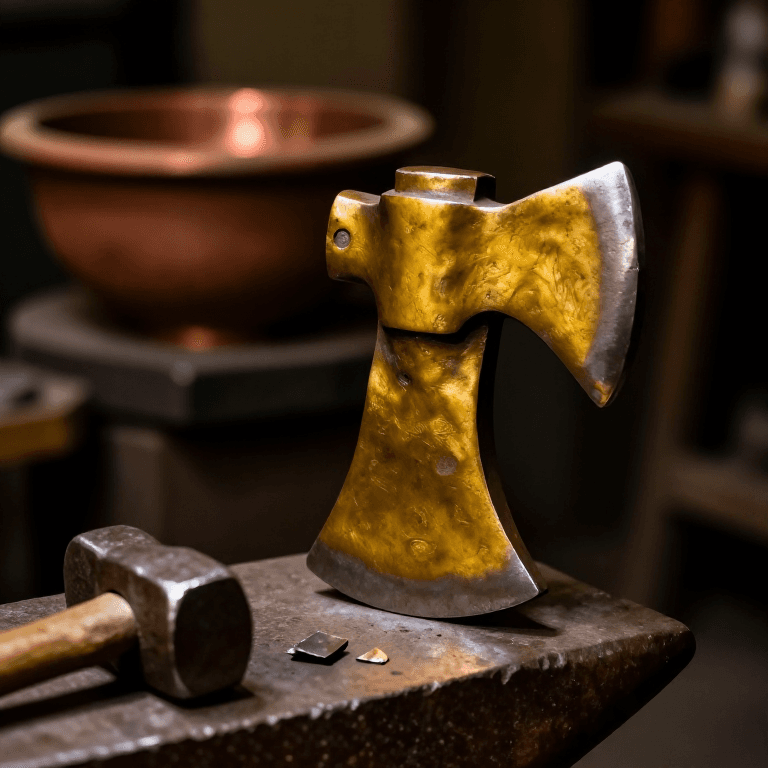
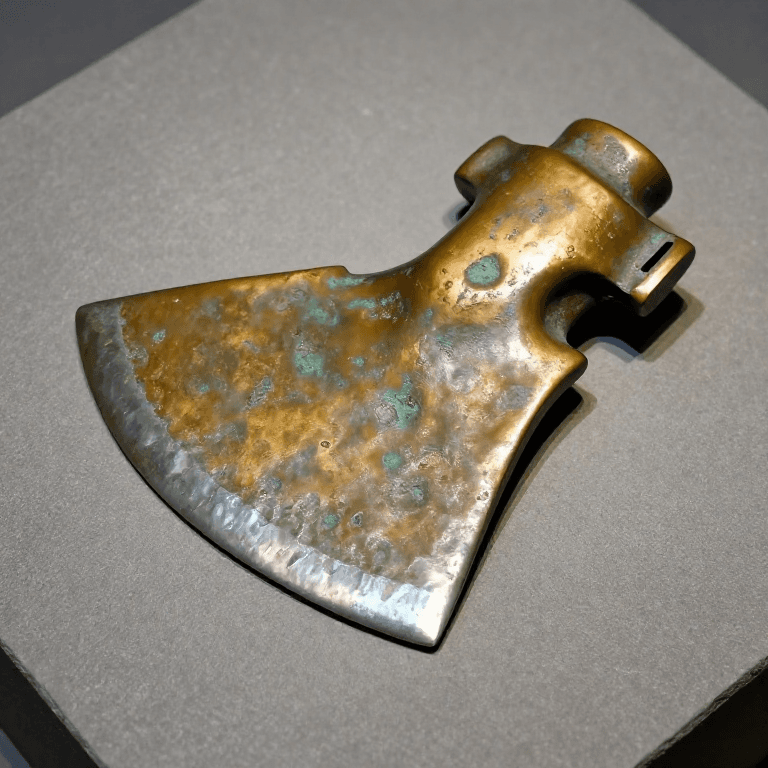
Annealing and cold-working are the two inseparable halves of Bronze Age metallurgy. Every bronze tool, weapon, and ornament was shaped and strengthened by this cycle — hammer to harden, heat to soften, hammer again. Understanding these two processes is the foundation of all pre-industrial metalwork.

Cold-working means deforming metal at room temperature. Each hammer blow compresses the crystal grains, creating dislocations that resist further movement — the metal becomes harder and stiffer. This is called work-hardening. A freshly cast bronze axe at 80 HV (Vickers hardness) can be cold-worked to 200+ HV, rivalling mild steel.

But work-hardening has a limit. Continue hammering past it and the bronze cracks. Annealing resets the process: heating to 500-600 °C causes the distorted grains to recrystallise into new, strain-free grains. The metal is soft again and ready for the next cycle. A Bronze Age smith might anneal the same piece 15 times during a single project.

Fortgeschritten
1-2 hours (demonstration cycles)

Anweisungen

1

Prepare a test piece

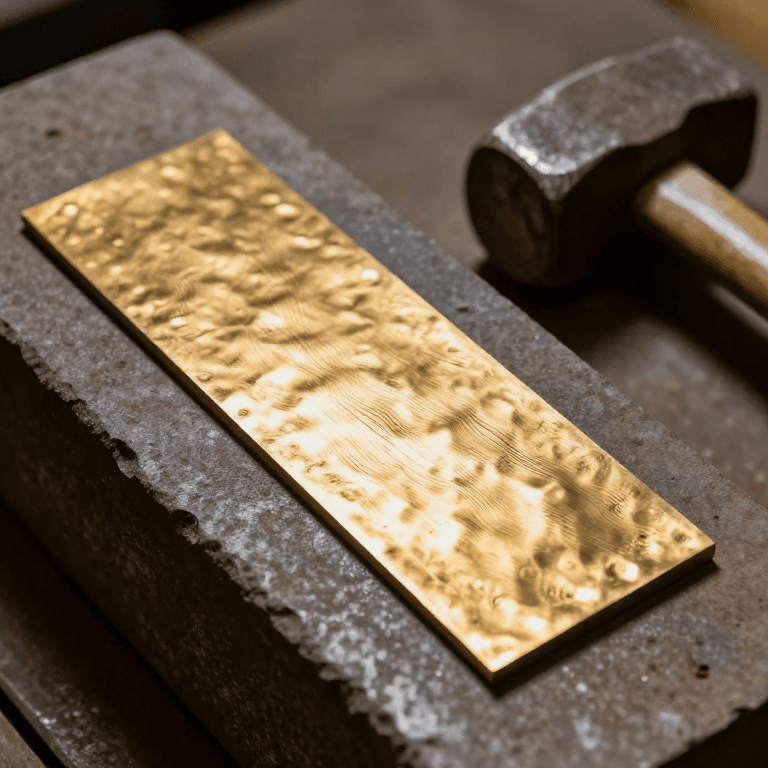
Cast a small bronze bar about 10 cm long, 2 cm wide, and 5 mm thick in an open stone mould. This test piece allows you to feel the difference between as-cast, work-hardened, and annealed bronze without risking a finished tool. Mark one end with a scratch so you can track which end has been cold-worked.

Materialien für diesen Schritt:

Copper Sheet (0.5-1mm)Copper Sheet (0.5-1mm)100 g
2

Test as-cast hardness

Press a sharp flint point into the surface of the freshly cast bar. Note how easily it indents — as-cast bronze is relatively soft (about 80 HV). Try bending the bar slightly with your hands. It should flex without cracking. This is the baseline softness.
3

Cold-work one half

Place the marked end of the bar on a flat stone anvil. Hammer it with firm, overlapping blows using a smooth hammerstone. Deliver about 50 blows, working the same area. The bronze thins slightly, spreads sideways, and becomes noticeably stiffer under the hammer — each blow requires more force than the last. This is work-hardening in action.

Benötigte Werkzeuge:

HammerstoneHammerstone
Flat Stone SlabFlat Stone Slab
4

Compare hardness

Now press the flint point into the hammered end with the same force as before. The indentation is much smaller — the bronze is significantly harder. Try bending the bar: the un-hammered end flexes easily while the cold-worked end is rigid and springs back. If you bend the cold-worked end further, you will hear it crack — that is the work-hardening limit.
5

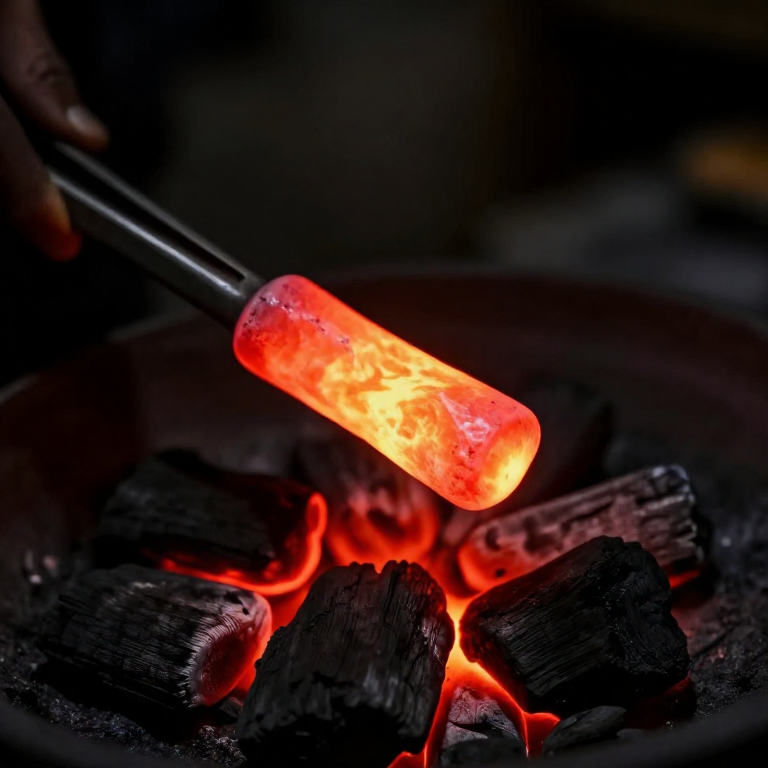
Anneal the cold-worked section

Build a small charcoal fire. Using tongs, hold the cold-worked end in the fire until it glows a uniform dull cherry red — about 500-600 °C. The colour is visible in shade but may be hard to see in bright sunlight. Hold at this temperature for 30 seconds, then remove and allow to cool in still air. Do not quench in water.

Materialien für diesen Schritt:

CharcoalCharcoal500 g

Benötigte Werkzeuge:

Long-Handled TongsLong-Handled Tongs
6

Test annealed hardness

After cooling, repeat the flint-point test on the annealed end. The indentation is deep again — the metal has returned to its original softness. The bend test confirms: the annealed section flexes freely once more. The grain structure has recrystallised, erasing all the work-hardening from step 3.
7

Demonstrate the full cycle on a cutting edge

Take the annealed test bar and hammer one end into a chisel-like edge — thin it to about 1 mm. This takes 2-3 anneal-hammer cycles as the edge work-hardens faster than the body. On the final pass, do not anneal — leave the edge in its work-hardened state. This is the key principle: the body of a tool is left annealed (tough, shock-resistant) while the cutting edge is left work-hardened (hard, holds an edge). Every Bronze Age tool exploits this differential hardening.
8

Understand the critical differences from steel

Bronze behaves opposite to steel in one crucial way: quenching steel in water hardens it, but quenching bronze does nothing — bronze can only be hardened by hammering. Similarly, heating steel to red and cooling slowly (annealing) softens it, and this same process softens bronze. The confusion arises because iron replaced bronze, and smiths had to learn an entirely new set of rules. If you heat-treat bronze like steel, you get soft tools. If you cold-work steel like bronze, you get cracked tools.

Materialien

2

Benötigte Werkzeuge

3

Materialien verbundener Blueprints

CC0 Gemeinfrei

Dieser Blueprint ist unter CC0 veröffentlicht. Sie dürfen dieses Werk für jeden Zweck frei kopieren, ändern, verbreiten und verwenden, ohne um Erlaubnis zu fragen.

Unterstützen Sie den Maker, indem Sie Produkte über seinen Blueprint kaufen, wo er eine Maker-Provision von Anbietern festgelegt, verdient. Oder erstellen Sie eine neue Iteration dieses Blueprints und verbinden Sie ihn in Ihrem eigenen Blueprint, um Einnahmen zu teilen.

Diskussion

(0)

Anmelden um an der Diskussion teilzunehmen

Kommentare werden geladen...