


Forging an Iron Chisel — The Cutting Tool That Shapes Stone, Wood, and Metal
The chisel is perhaps the most versatile tool ever forged. A blacksmith's cold chisel cuts iron on the anvil. A mason's point chisel dresses stone blocks. A carpenter's firmer chisel shapes timber joints. In every case, the principle is the same: a hardened steel or iron edge driven by a hammer blow concentrates force onto a line, splitting the material along that line.
An iron chisel is forged from a single bar of wrought iron: one end is drawn to a flat wedge for the cutting edge, the other end is left square as the striking head. The critical technique is case-carburising the cutting end — packing it in charcoal and heating it to absorb carbon, converting the surface layer from soft wrought iron into hardenable steel. This steel edge is then quench-hardened and tempered, giving the chisel a hard cutting face backed by a tough, shock-absorbing body.
Anweisungen
Select and cut the bar stock
Select and cut the bar stock
Forge the cutting end to a wedge
Forge the cutting end to a wedge
Materialien für diesen Schritt:
 Holzkohle3 kg
Benötigte Werkzeuge:
 Schmiedehammer
 Schmiedezange
 Herd (Schmiedefeuer)
Form the striking head
Form the striking head
Straighten and true
Straighten and true
Case-carburise the cutting end
Case-carburise the cutting end
Quench-harden the edge
Quench-harden the edge
Materialien für diesen Schritt:
 Wasser5 l
Temper the hardened edge
Temper the hardened edge
Benötigte Werkzeuge:
 Sandstein (Schleifmittel)
Grind the final edge
Grind the final edge
Benötigte Werkzeuge:
 Wetzstein
Benötigte Werkzeuge
5- Platzhalter
- Platzhalter
- Platzhalter
- Platzhalter
- Platzhalter
Materialien verbundener Blueprints

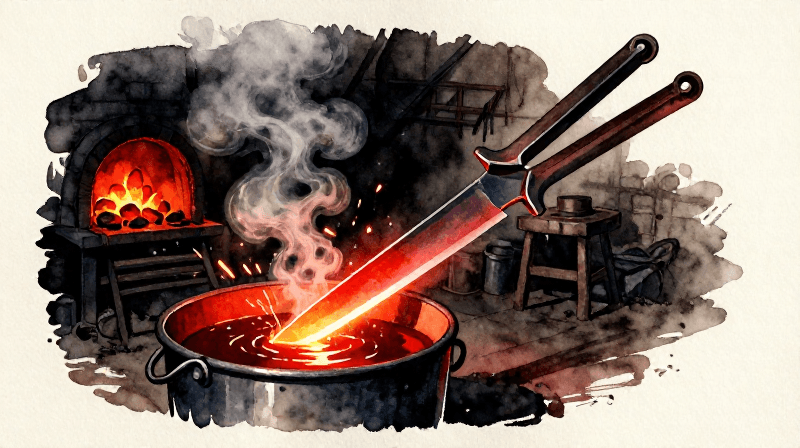
Dieser Bauplan stellt her
Verwandte Blueprints
Diese Blueprints teilen Wissen — Techniken, Materialien oder Prinzipien

CC0 Gemeinfrei
Dieser Blueprint ist unter CC0 veröffentlicht. Sie dürfen dieses Werk für jeden Zweck frei kopieren, ändern, verbreiten und verwenden, ohne um Erlaubnis zu fragen.
Unterstützen Sie den Maker, indem Sie Produkte über seinen Blueprint kaufen, wo er eine Maker-Provision von Anbietern festgelegt, verdient. Oder erstellen Sie eine neue Iteration dieses Blueprints und verbinden Sie ihn in Ihrem eigenen Blueprint, um Einnahmen zu teilen.