KUNST
SCHÖNHEIT & WELLNESS
HANDWERK
KULTUR & GESCHICHTE
UNTERHALTUNG
UMFELD
ESSEN & GETRÄNKE
REVERSE ENGINEERING
WISSENSCHAFTEN
SPORT
TECHNOLOGIE
WEARABLES
Oscillating Paddle Churn: Oblique Paddles Swung to and Fro by a Strap
Martin

Erstellt von

Martin

6. Oktober 2026NO
33
0
0
0
0

Oscillating Paddle Churn: Oblique Paddles Swung to and Fro by a Strap

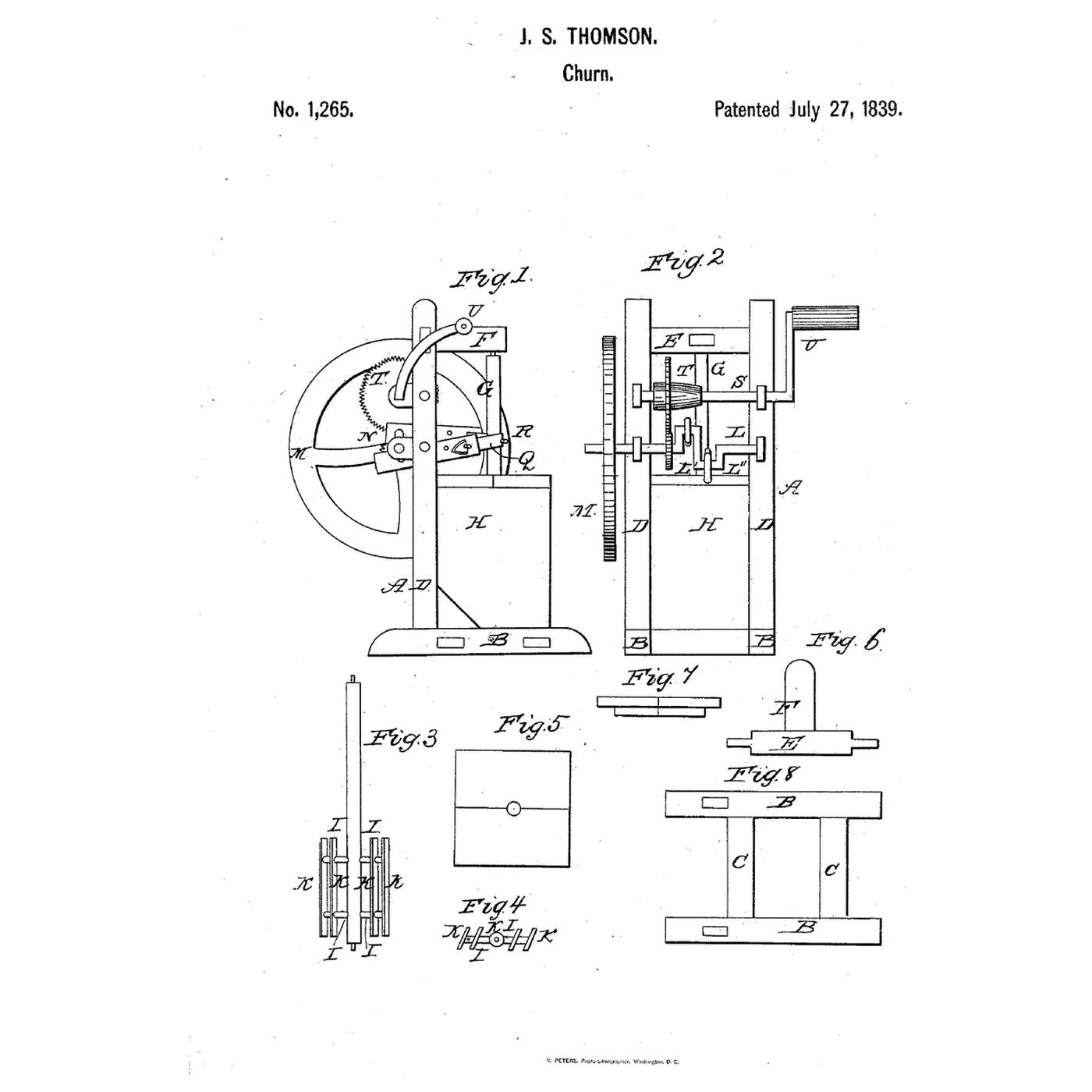
A rotary dasher carries the cream round the churn; Thomson wanted it thrown in and out as well. John S. Thomson of Luzerne County, Pennsylvania, received US 1,265, dated 27 July 1839, for a churn whose upright dasher carries four vertical paddles set obliquely on horizontal parallel arms, "so that they shall force the cream when moving in one direction from the center to the circumference of the churn and when turned in an opposite direction or returning throw it back toward the center." A double crank works two pitmen joined by a leather strap round the dasher shaft, and a nail through the strap gives "the vibratory motion of the dasher." This rung sizes the crank for a half turn, then prints the dasher, strap drum and double crank, builds the frame, and makes butter.
Erfahren
About 6 hours, plus printing

Anweisungen

1

Crank throw and paddle push

Jupyter-Notebook wird geladen …
2

Oblique paddles before them

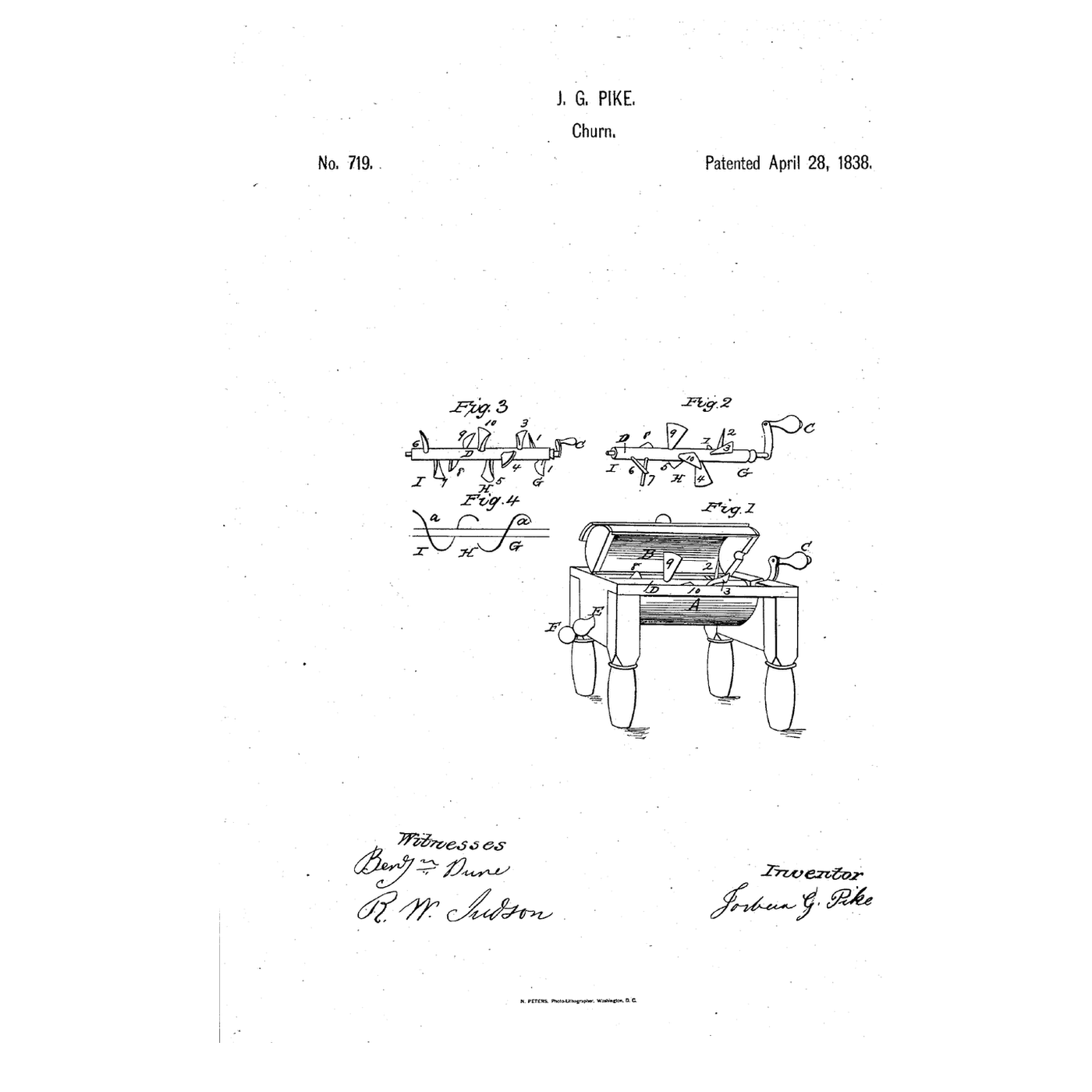
The embedded blueprint sets paddles obliquely on a turning shaft to move the cream along a cylinder. Thomson sets them obliquely on arms of an upright dasher and swings it back and forth.
3

Read US 1,265

"The dasher consists of an upright shaft with two or three arms I placed above each other as the size of the churn may require, passing horizontally through it in the same direction and low enough to be within the churn, to which horizontal parallel arms I I are fastened four vertical parallel boards or paddles K, two on one side of the shaft G and two on the opposite side. They are fastened to the arms obliquely at any required angle suitable for producing the intended effect."
4

Print the parts

Print the dasher standing on its lower arm (/uploads/blueprints/oscillating-paddle-churn-dasher.stl): four paddles at 45° to the arms. Print the strap drum (/uploads/blueprints/oscillating-paddle-churn-drum.stl), the double crank with its two opposite pins (/uploads/blueprints/oscillating-paddle-churn-double-crank.stl), the pivot cup (/uploads/blueprints/oscillating-paddle-churn-pivot-cup.stl) and the crank arm (/uploads/blueprints/oscillating-paddle-churn-crank-arm.stl). Print in PETG at 0.2 mm layers, 30 % infill, 4 walls; wash before first use.

Materialien für diesen Schritt:

PETG-FilamentPETG-Filament1 Stück

Benötigte Werkzeuge:

FDM-3D-DruckerFDM-3D-Drucker
5

Build the frame

Join two pine sills with two cross pieces and stand two posts 330 mm tall at one end, joined at the top by a rail. Fix an arm from the middle of the rail reaching over the churn's centre. Drill both posts for a 12 mm dowel crankshaft 70 mm above the churn's top.

Materialien für diesen Schritt:

KiefernbrettKiefernbrett1 Stück
Holzschraube #8 x 1"Holzschraube #8 x 1"1 Stück
HolzleimHolzleim1 Stück

Benötigte Werkzeuge:

HandsägeHandsäge
AkkubohrschrauberAkkubohrschrauber
BohrersatzBohrersatz
Schraubendreher-SatzSchraubendreher-Satz
SchraubzwingenSchraubzwingen
Bandmaß (Rollmeter)Bandmaß (Rollmeter)
6

Dasher, strap and pitmen

Set a food-safe box about 150 mm square under the arm and screw the pivot cup to its floor. Slide the dasher and the drum onto a 10 mm square hardwood shaft, drive a nail into each end as pivots, and stand it in the cup and the arm's hole through the lid. Glue the double crank and the crank arm on the dowel crankshaft. Cut two pine pitmen to reach from the crank pins to the drum. Pass a leather strip once round the drum, nail it through to the drum, and fasten one end to each pitman.

Materialien für diesen Schritt:

Vorratsbehälter in LebensmittelqualitätVorratsbehälter in Lebensmittelqualität1 Stück

HartholzdübelHartholzdübel1 Stück
KiefernbrettKiefernbrett1 Stück
LederstreifenLederstreifen1 Stück
NägelNägel1 Stück
HolzleimHolzleim1 Stück
Holzschraube #8 x 1"Holzschraube #8 x 1"1 Stück

Benötigte Werkzeuge:

HandsägeHandsäge
AkkubohrschrauberAkkubohrschrauber
BohrersatzBohrersatz
HammerHammer
Lochsägen-SetLochsägen-Set
7

The patent drawing

US 1,265 drawing sheet, public domain (expired patent).
Schritt 7 - Image 1
8

Crank and make butter

Let the heavy cream stand until it reaches about 15 °C, checked with the thermometer. Pour in 500 ml and fit the lid. Turn the handle steadily: the dasher swings half a turn each way. Time until the butter comes. Pour off the buttermilk, add cold water, churn a little and pour off again until it runs clear; work in a pinch of salt and weigh the butter.

Materialien für diesen Schritt:

SchlagsahneSchlagsahne500 ml
Grobes MeersalzGrobes Meersalz1 Stück
WasserWasser1 Stück

Benötigte Werkzeuge:

Einsteck-FühlerthermometerEinsteck-Fühlerthermometer
StoppuhrStoppuhr
Digitale KüchenwaageDigitale Küchenwaage
Große Rührschüssel aus EdelstahlGroße Rührschüssel aus Edelstahl
9

A dasher that turns too far, a strap that slips

Oscillating paddle churn troubleshooting.

Flow

Loading...
10

History and honest limits

**John S. Thomson** of Luzerne County, Pennsylvania, received US 1,265, dated 27 July 1839. His frame was of timber about two inches square, with sills about eighteen inches long and posts about three feet high. A balance wheel about 2 feet across and about 16 pounds steadied the crankshaft. A 9-inch cog wheel with a crank and handle, on a shaft above, drove a 3-inch wheel on the crankshaft. "The size of this machine in all its parts may be varied and made larger or smaller as required, preserving, however, all the proportions." **Honest limits.** A food-safe box and printed parts stand in for his churn and dasher. Our handle turns the double crank directly, without his cog wheels or balance wheel. FDM prints hold food in their layer lines, so wash well and replace when worn. Your times and weights are the result.

Materialien

11

Benötigte Werkzeuge

13

Dieser Bauplan stellt her

CC0 Gemeinfrei

Dieser Blueprint ist unter CC0 veröffentlicht. Sie dürfen dieses Werk für jeden Zweck frei kopieren, ändern, verbreiten und verwenden, ohne um Erlaubnis zu fragen.

Unterstützen Sie den Maker, indem Sie Produkte über seinen Blueprint kaufen, wo er eine Maker-Provision von Anbietern festgelegt, verdient. Oder erstellen Sie eine neue Iteration dieses Blueprints und verbinden Sie ihn in Ihrem eigenen Blueprint, um Einnahmen zu teilen.

Diskussion

(0)

Anmelden um an der Diskussion teilzunehmen

Kommentare werden geladen...