ARTE
BELLEZA Y BIENESTAR
ARTESANÍA
CULTURA E HISTORIA
ENTRETENIMIENTO
MEDIO AMBIENTE
COMIDA Y BEBIDAS
INGENIERÍA INVERSA
CIENCIAS
DEPORTES
TECNOLOGÍA
TECNOLOGÍA VESTIBLE
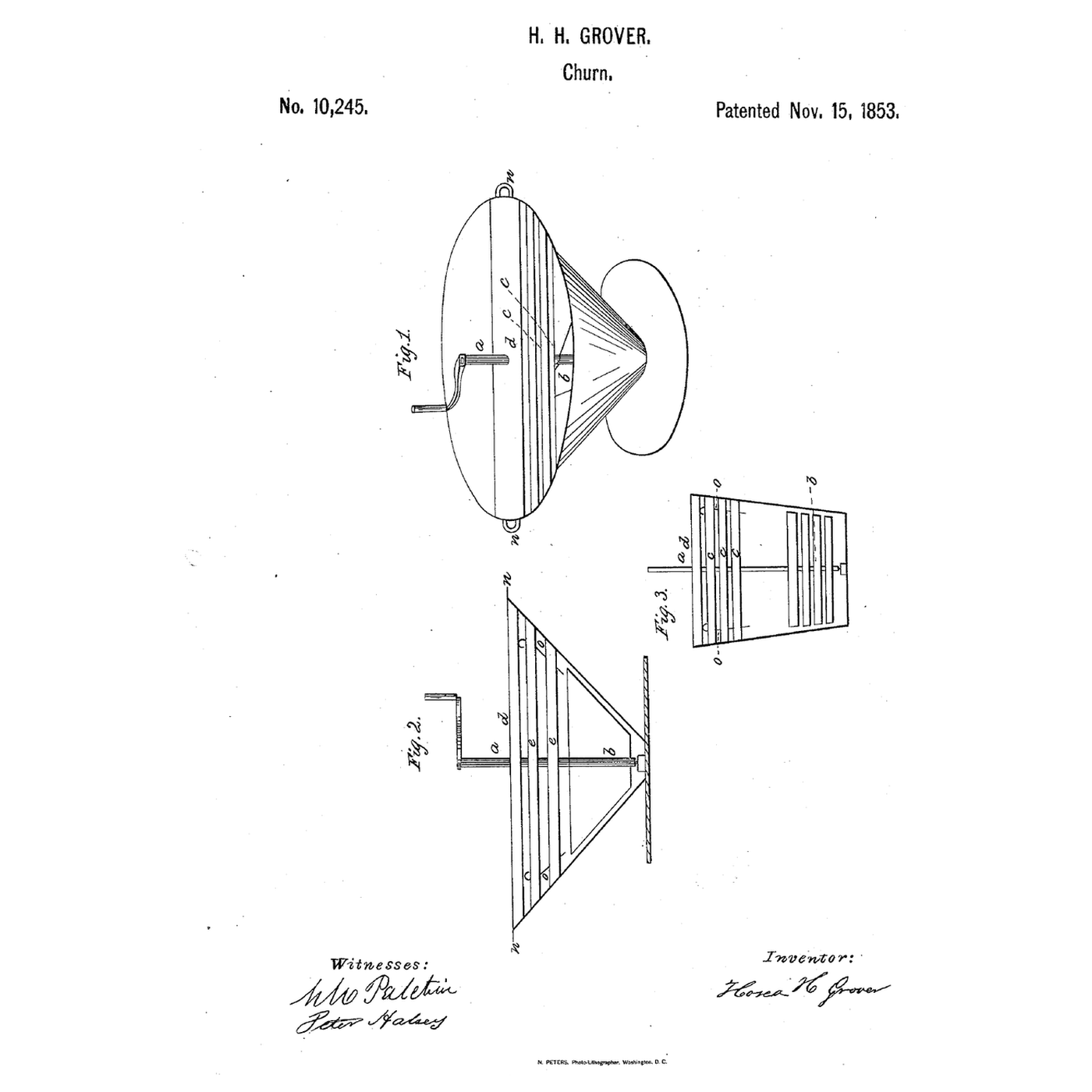

Flaring-Tub Slat-Reactor Churn: The Cream Climbs the Flare and Is Beaten Back by Slats
Grover let the shape of the tub do the work: spun cream climbs a flaring side.
Hosea H. Grover of North Cohocton, Steuben County, New York, received US 10,245, dated 15 November 1853, for a rotary churn: a crank and shaft with a transverse piece near the bottom, standing in a step at the tub's bottom, under slats across the top held by wires and a cross piece fastened with staples. Turning it "produces centrifugal motion in the milk and thereby causes it to rise up the flaring surface of the tub until it meets the reactor by which it is beat back upon the dash." The small churn is of tin; for larger quantities he made the tub of wood, less flaring, with a pinion and larger cog wheel to speed the dash.
This rung looks at how high spun cream could climb, then prints the dash bar, step, slat rails and bearing block, fits them in a flaring stainless bowl, and makes butter.
Principiante
About 3 hours, plus printing
Instrucciones
1
1
How high it could climb
How high it could climb
Cargando el cuaderno de Jupyter…
2
2
A reaction in the churn before it
A reaction in the churn before it
The embedded blueprint makes the cream react against oars pitched opposite ways. Grover throws it up a flaring side into fixed slats.
3
3
Read US 10,245
Read US 10,245
"These slats are designed to be placed in singly and then the wires passed through them so that the slats may be used in any required number to suit the quantity and quality (that is the thickness) of the milk or cream to be churned. Thus situated the slats constitute a reactor."
4
4
Print the parts
Print the parts
Print the dash bar b with its square socket, the step, two slat rails that hook over the rim like his staples and the bearing block for the cross piece. Print in PETG at 0.2 mm layers, 30 % infill, 4 walls; wash before first use.
Materiales para este paso:
 Filamento PETG1 pieza
Herramientas necesarias:
 Impresora 3D de filamento (FDM)
5
5
Print the dash bar
Print the dash bar
The dash bar, printed as step 4 describes.
6
6
Print the step
7
7
Print the slat rail
Print the slat rail
The slat rail, printed as step 4 describes.
8
8
Print the bearing block
Print the bearing block
The bearing block, printed as step 4 describes.
9
9
Dash and step
Dash and step
Stand the step in the middle of a large stainless mixing bowl with sloping sides, about 300 mm across. Cut a 10 mm square hardwood shaft to stand in it and reach 60 mm above the rim, push the dash bar onto it 15 mm above the step, and glue a pine crank arm and dowel handle on top.
Materiales para este paso:
 Bol grande de acero inoxidable1 pieza
 Espigas de madera dura1 pieza
 Tabla de pino1 pieza
 Cola de carpintero1 pieza
Herramientas necesarias:
 Serrucho
 Taladro inalámbrico
 Juego de brocas
 Papel de lija
10
10
Slats, wires and cross piece
Slats, wires and cross piece
Hook the two rails over the rim opposite each other. Cut hardwood laths 10 mm thick to span between the rails in their grooves, each with a 14 mm hole in its middle for the shaft, and slide in as many as the cream needs, one at a time. Push a 3 mm stainless rod down through each rail and the slat ends, as his wires. Lay a 24 by 12 mm lath across the rim through the bearing block, over the rails, as the cross piece d, the shaft through the block.
Materiales para este paso:
Espigas de madera dura1 pieza Redondo de acero dulce1 pieza
Herramientas necesarias:
SerruchoTaladro inalámbricoJuego de brocas Sierra para metales
11
11
The build in 3D
The build in 3D
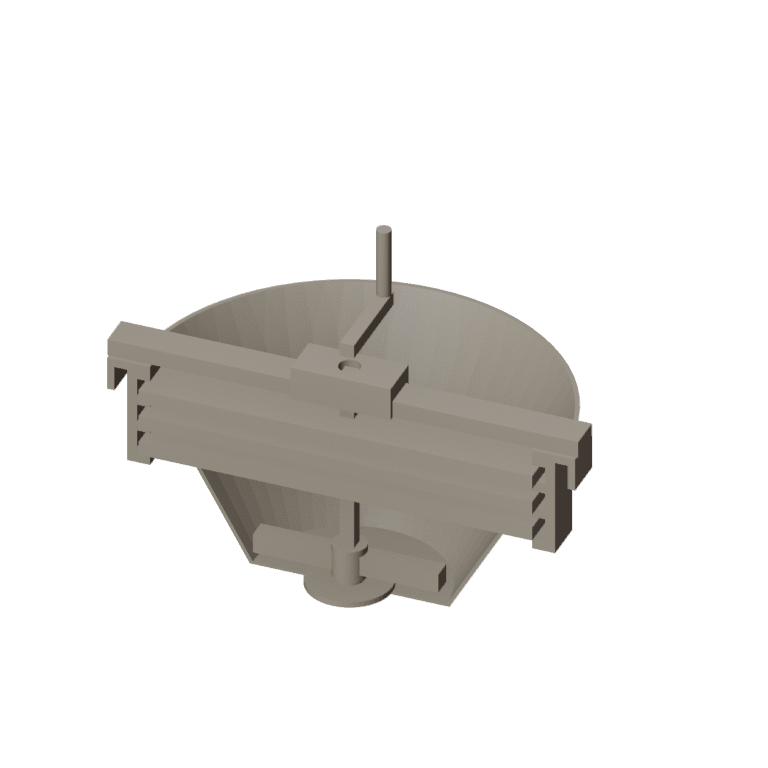
FreeCAD model of this build, not of the patent: the flaring tub cut away to show the step and the dash bar near the bottom, three slats across the top in the rails hooked over the rim, the wires, and the cross piece with its bearing block and the crank.
12
12
Spin and make butter
Spin and make butter
Let the heavy cream stand until it reaches about 15 °C, checked with the thermometer. Pour in 1.5 litres. Turn the crank briskly so the cream climbs the bowl's side into the slats; if it does not reach them, take out the top slat and lower the rest. Time until the butter comes. Pour off the buttermilk, add cold water, churn a little and pour off again until it runs clear; work in a pinch of salt and weigh the butter.
Materiales para este paso:
 Crema de leche espesa1500 ml
 Sal marina gruesa1 pieza
 Agua1 pieza
Herramientas necesarias:
 Termómetro de sonda permanente
 Cronómetro
 Báscula digital de cocinaBol grande de acero inoxidable
13
13
Cream that will not climb, a shaft that wanders
Cream that will not climb, a shaft that wanders
Flaring-tub slat-reactor churn troubleshooting.
Flow
Loading...
14
14
History and honest limits
History and honest limits
**Hosea H. Grover** of North Cohocton, Steuben County, New York, received US 10,245, dated 15 November 1853 (the drawing sheet reads "H. H. Grover"). He did not claim a conical tub with a revolving dasher, with or without breakers, as such churns had been used before; he claimed such a conical tub with a vertical revolving dasher at its bottom combined with breakers at the top.
**Honest limits.** A mixing bowl with curved sides, hardwood and printed parts stand in for his tin cone; the notebook's rise is an upper bound, not a measurement. FDM prints hold food in their layer lines, so wash well and replace when worn. Your times and weights are the result.
Materiales
9- 1 piezaMarcador de posición
- Marcador de posición
- 1 piezaMarcador de posición
- 1 piezaMarcador de posición
- 1 piezaMarcador de posición
- 1 piezaMarcador de posición
- 1500 mlMarcador de posición
- 1 piezaMarcador de posición
- 1 piezaMarcador de posición
Herramientas requeridas
10- Marcador de posición
- Marcador de posición
- 1 vendor sell this, none ship to you yetMarcador de posición
- Marcador de posición
- Marcador de posición
- Marcador de posición
- Marcador de posición
- Marcador de posición
- Marcador de posición
- Marcador de posición
Archivos de diseño
5Este plano hace
Blueprints relacionados
Estos blueprints comparten conocimiento — técnicas, materiales o principios
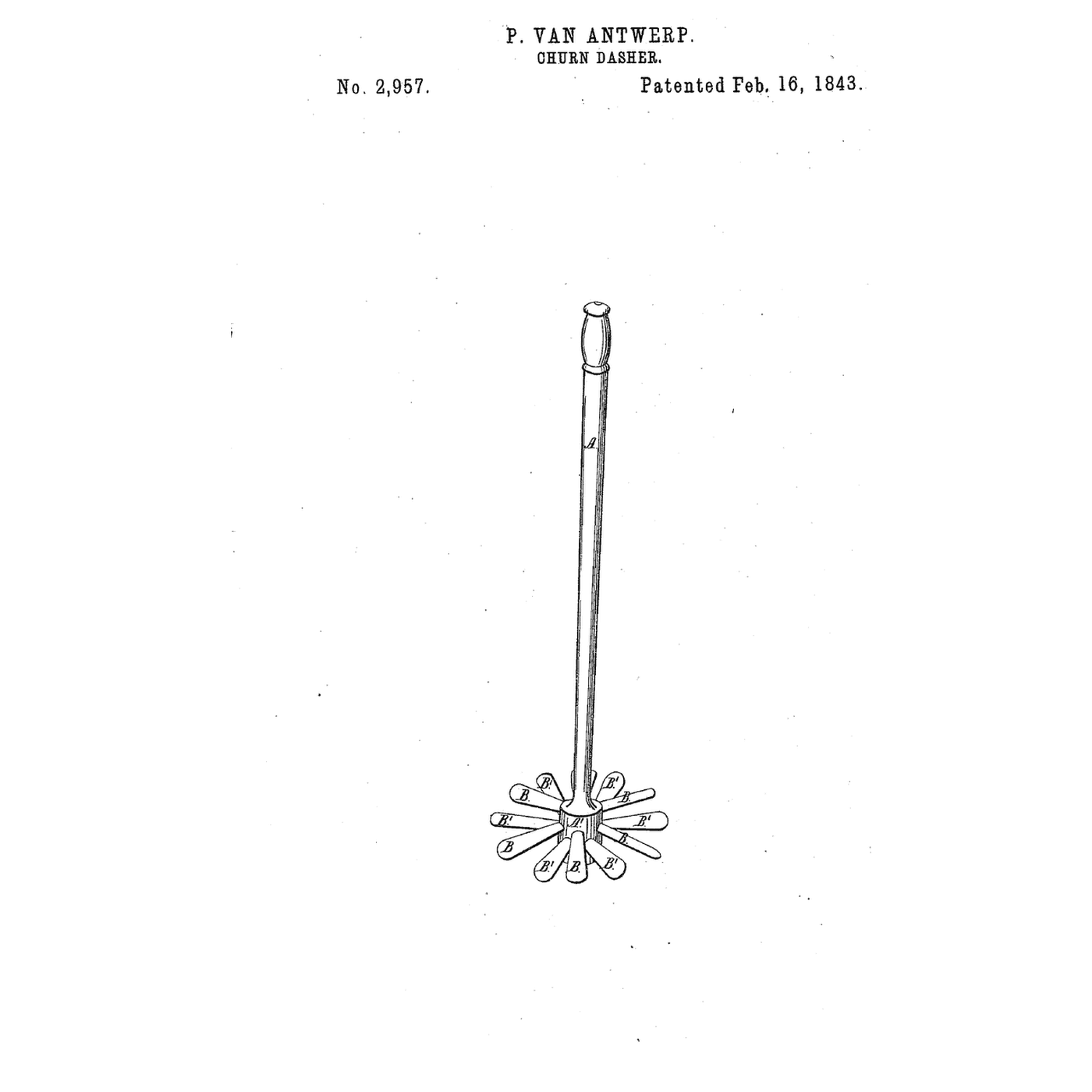
Reacting Churn Dasher: Two Rows of Oars Pitched Opposite Ways
por TheChef
COMIDA Y BEBIDAS
37
0
0
0
0
0
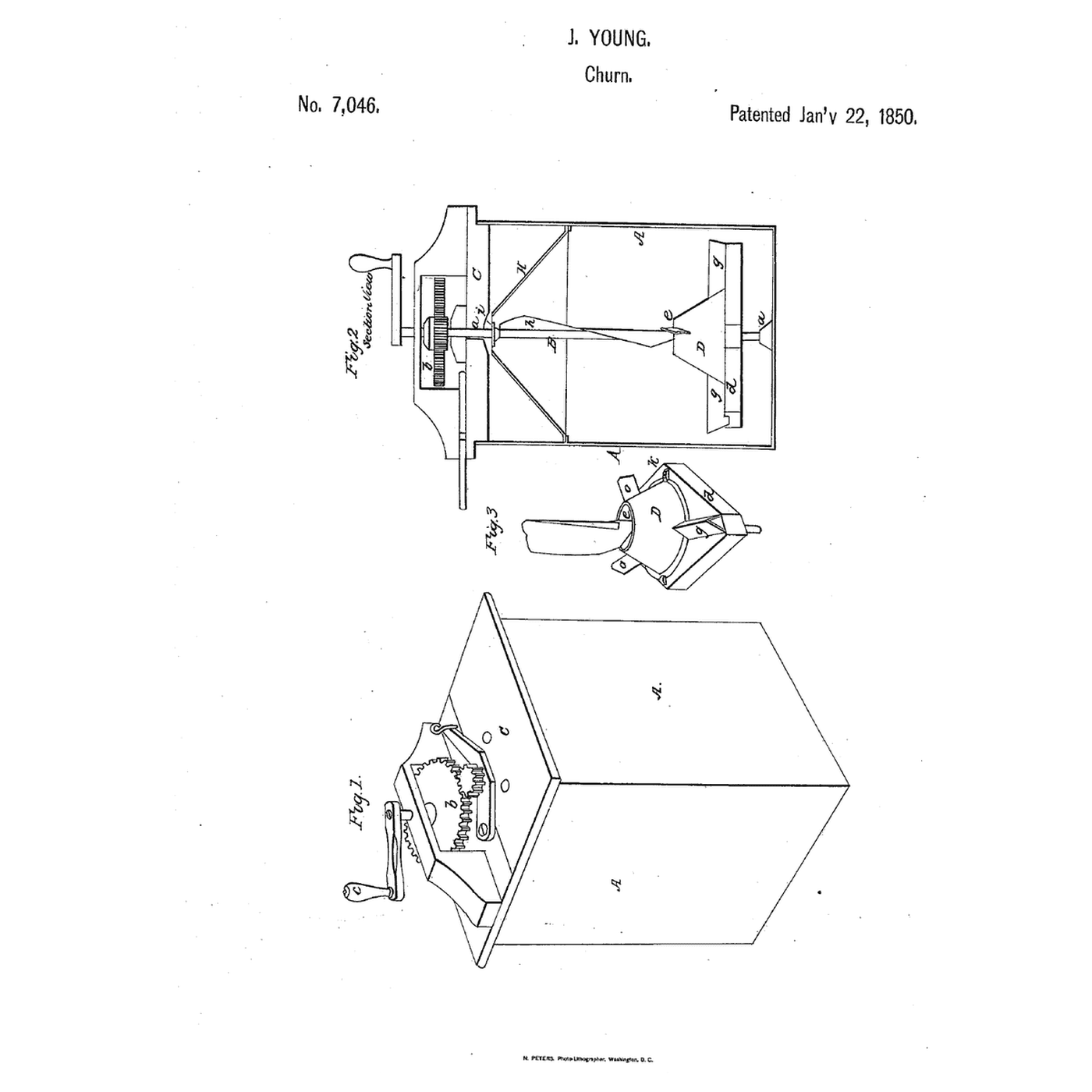
Whirl-Cone Splash-Guard Churn: A Whirl Feeds Air to a Cone, a Funnel Keeps the Cream In
por Karen
COMIDA Y BEBIDAS
36
0
0
0
0
0

Churning Butter from Cream — The 5,000-Year-Old Fat Separation
por TheChef
ARTESANÍA
54
0
0
0
0
0
CC0 Dominio público
Este Blueprint se publica bajo CC0. Eres libre de copiar, modificar, distribuir y usar este trabajo para cualquier propósito, sin pedir permiso.
Apoya al Maker comprando productos a través de su Blueprint, donde gana una Comisión del Maker establecida por los vendedores, o crea una nueva iteración de este Blueprint e inclúyela como conexión en tu propio Blueprint para compartir ingresos.