Colaboración
ARTE
BELLEZA Y BIENESTAR
ARTESANÍA
CULTURA E HISTORIA
ENTRETENIMIENTO
MEDIO AMBIENTE
COMIDA Y BEBIDAS
INGENIERÍA INVERSA
CIENCIAS
DEPORTES
TECNOLOGÍA
TECNOLOGÍA VESTIBLE
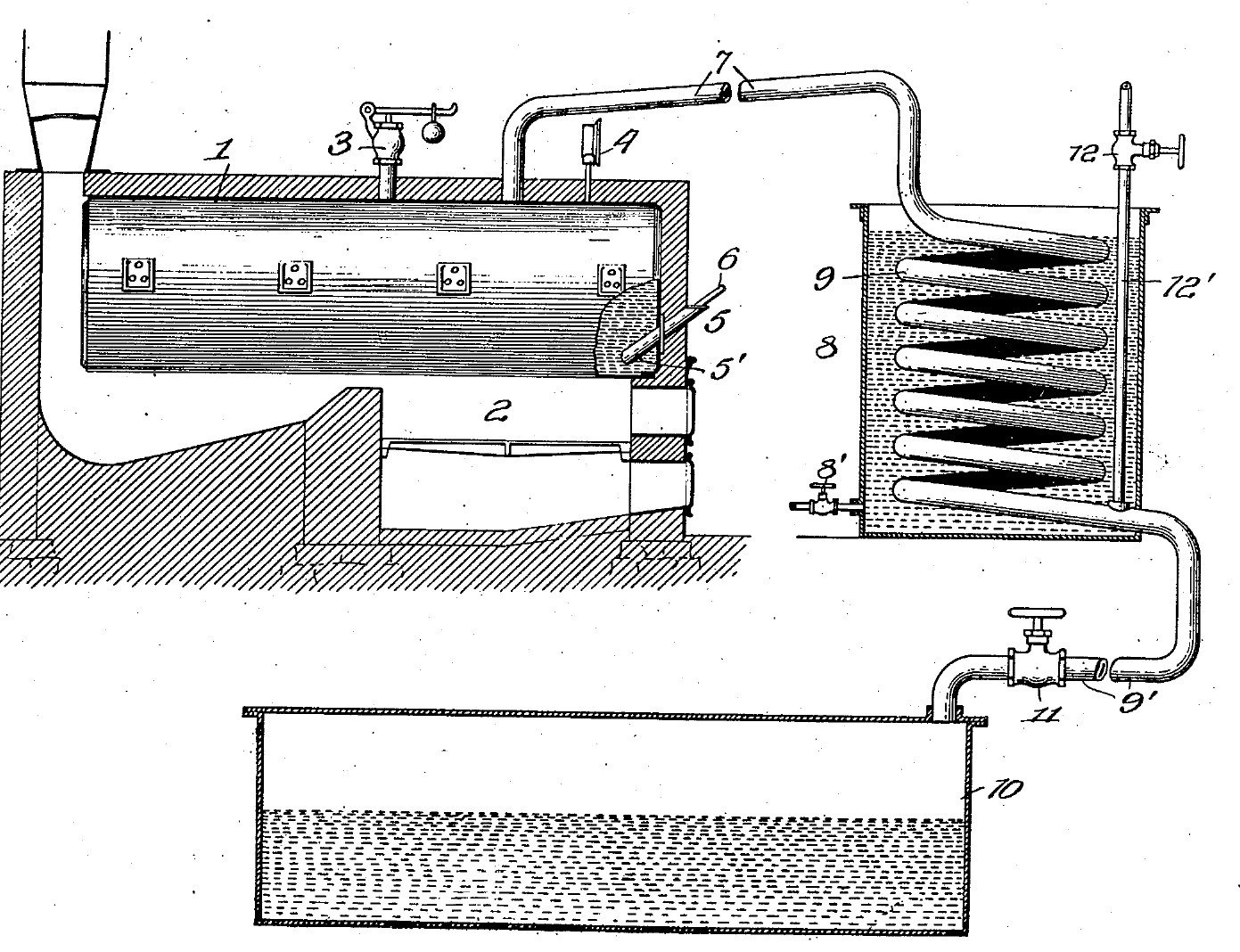


Gasoline by Pressure Cracking: Heavy Residue Distilled at 650-850 °F under 4-5 Atmospheres (Burton, US 1,049,667)
Straight distillation leaves most of a barrel of crude as heavy oil. Burton's 1913 patent turns that residue into gasoline: distil it hot while its own vapour is held at 4 to 5 atmospheres, all the way through the condenser. The heat and pressure break the heavy oil into light oil. Cracked gasoline is the first rung toward high-octane fuel.
Feed: the fuel-oil and gas-oil residue left after the light cuts, boiling at about 600 to 700 °F (claim: above 500 °F).
Source: W. M. Burton, US 1,049,667 (1913), assigned to Standard Oil (Indiana). Not given: charge size, run time, yield. Burton claims the gasoline stays in the paraffin series; that is his claim. A fired still under pressure needs a working safety valve. Picture: the patent drawing.
Experto
2 days
Instrucciones
1
1
Fill the pressure still with residue
Fill the pressure still with residue
The still is a closed, boiler-like holder over a fire chamber, with a safety valve, a pressure gauge, and a thermometer in an oil-filled tube slanting into it. Fill it with the heavy residue left after the gasoline and illuminating oils have been distilled off.
Materiales para este paso:
 Residuo de petróleo1 still charge
Herramientas necesarias:
 Alambique a presión
 Manómetro
 Termómetro
2
2
Close the outlet and fire it
Close the outlet and fire it
A pipe rises from the top of the still to a water-cooled condenser coil, then runs to a receiver tank. Keep the shut-off valve after the coil closed and fire the still. The vapours build up 4 to 5 atmospheres on the liquid, and its boiling point rises from 500-600 °F to 750-800 °F.
Herramientas necesarias:
Alambique a presión Serpentín condensador
 AguaManómetro
3
3
Distil at 650 to 850 °F under pressure
Distil at 650 to 850 °F under pressure
Distil at about 650 to 850 °F. Keep the pressure on the vapours the whole way, in the still and while they condense in the coil. The heat and pressure turn the heavy oil into low-boiling oil.
Herramientas necesarias:
Alambique a presiónTermómetroManómetro4
4
Draw off the gasoline from time to time
Draw off the gasoline from time to time
Open the shut-off valve now and then to run the condensed gasoline into the receiver. Do it often enough that the coil never fills with liquid.
Herramientas necesarias:
Serpentín condensador Tanque de petróleo
5
5
Let off the gas
Let off the gas
Gas that will not condense collects in the coil and blocks it. Release it from time to time through the relief valve on the pipe rising from the lower end of the coil. Burton does not say what becomes of it. Ours: collect it under pressure if it is to be used.
Herramientas necesarias:
Serpentín condensador Bombona de gas a presión
Materiales
1- 1 still chargeMarcador de posición
Este plano hace
Blueprints relacionados
Estos blueprints comparten conocimiento — técnicas, materiales o principios
CC0 Dominio público
Este Blueprint se publica bajo CC0. Eres libre de copiar, modificar, distribuir y usar este trabajo para cualquier propósito, sin pedir permiso.
Apoya al Maker comprando productos a través de su Blueprint, donde gana una Comisión del Maker establecida por los vendedores, o crea una nueva iteración de este Blueprint e inclúyela como conexión en tu propio Blueprint para compartir ingresos.