ARTE
BELLEZA Y BIENESTAR
ARTESANÍA
CULTURA E HISTORIA
ENTRETENIMIENTO
MEDIO AMBIENTE
COMIDA Y BEBIDAS
INGENIERÍA INVERSA
CIENCIAS
DEPORTES
TECNOLOGÍA
TECNOLOGÍA VESTIBLE
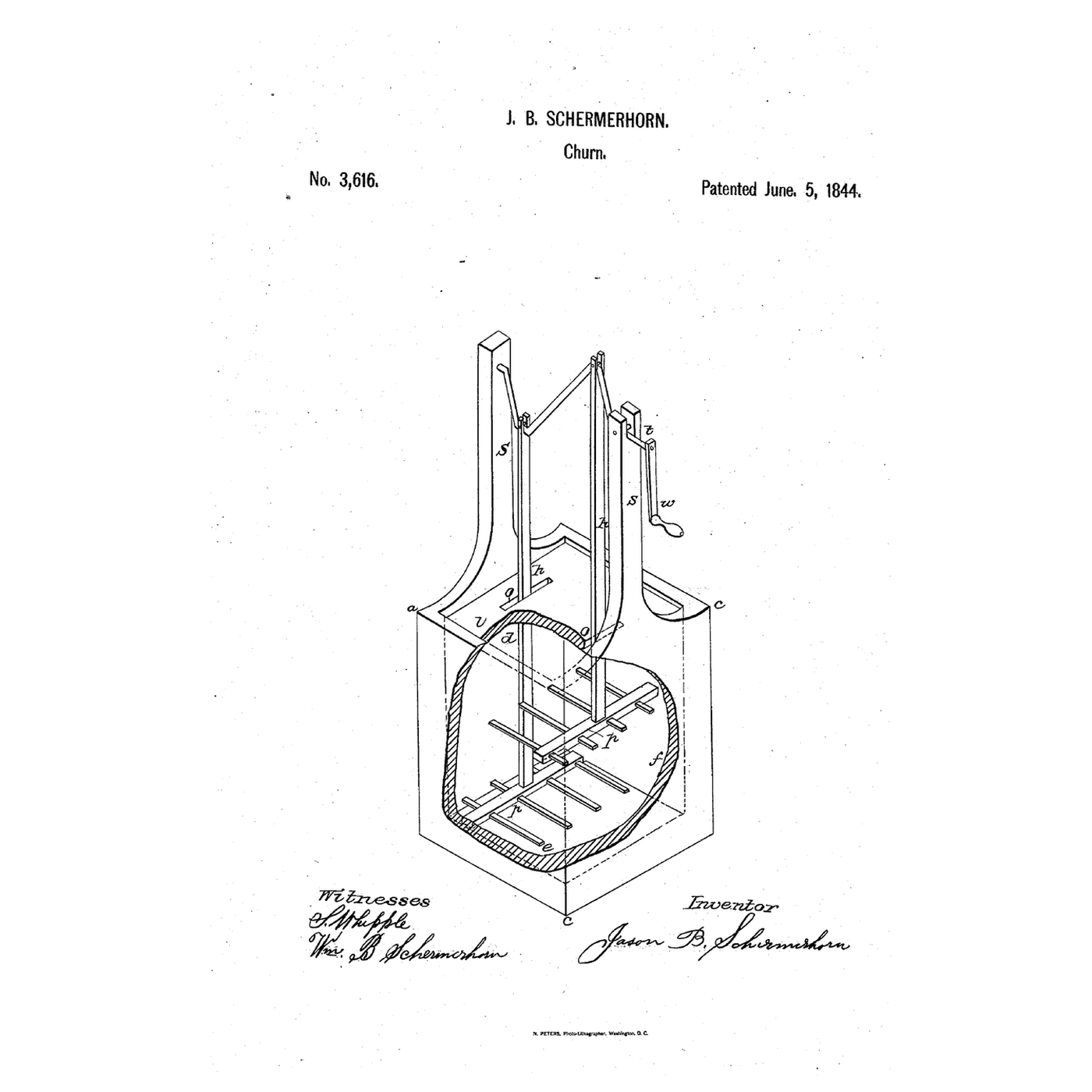


Interraking Plunger Churn: Two Rakes Worked Oppositely by a Double Crank
Schermerhorn did not claim churning with plungers, "either by hand, or by crank motion"; he claimed two of them shaped like rakes.
Jason B. Schermerhorn of Deerfield, New York, received US 3,616, dated 5 June 1844, for a dairy churn with "two rake-formed plungers with teeth interraking, and with oppositely reciprocating motions communicated to them by a cranked shaft." Standards on two sides of a square box carry the crank shaft; the teeth of one plunger pass between those of the other, "the one ascending while the other is descending," which "will produce a violent commotion in the cream."
This rung checks his proportions, then prints the rake heads, crank discs and yokes, builds the standards on a box, and makes butter.
Intermedio
About 5 hours, plus printing
Instrucciones
1
1
His proportions
His proportions
Cargando el cuaderno de Jupyter…
2
2
A double crank before it
A double crank before it
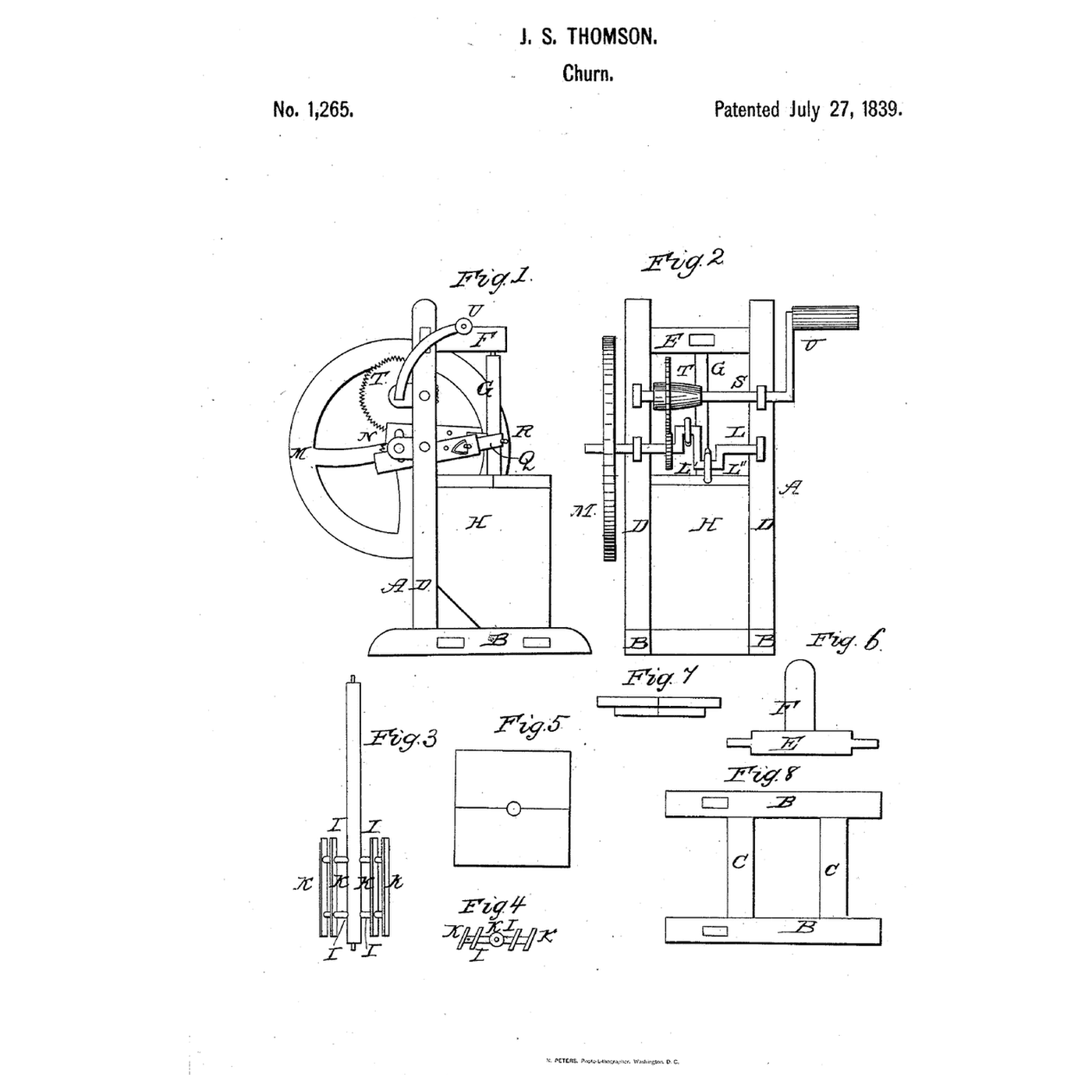
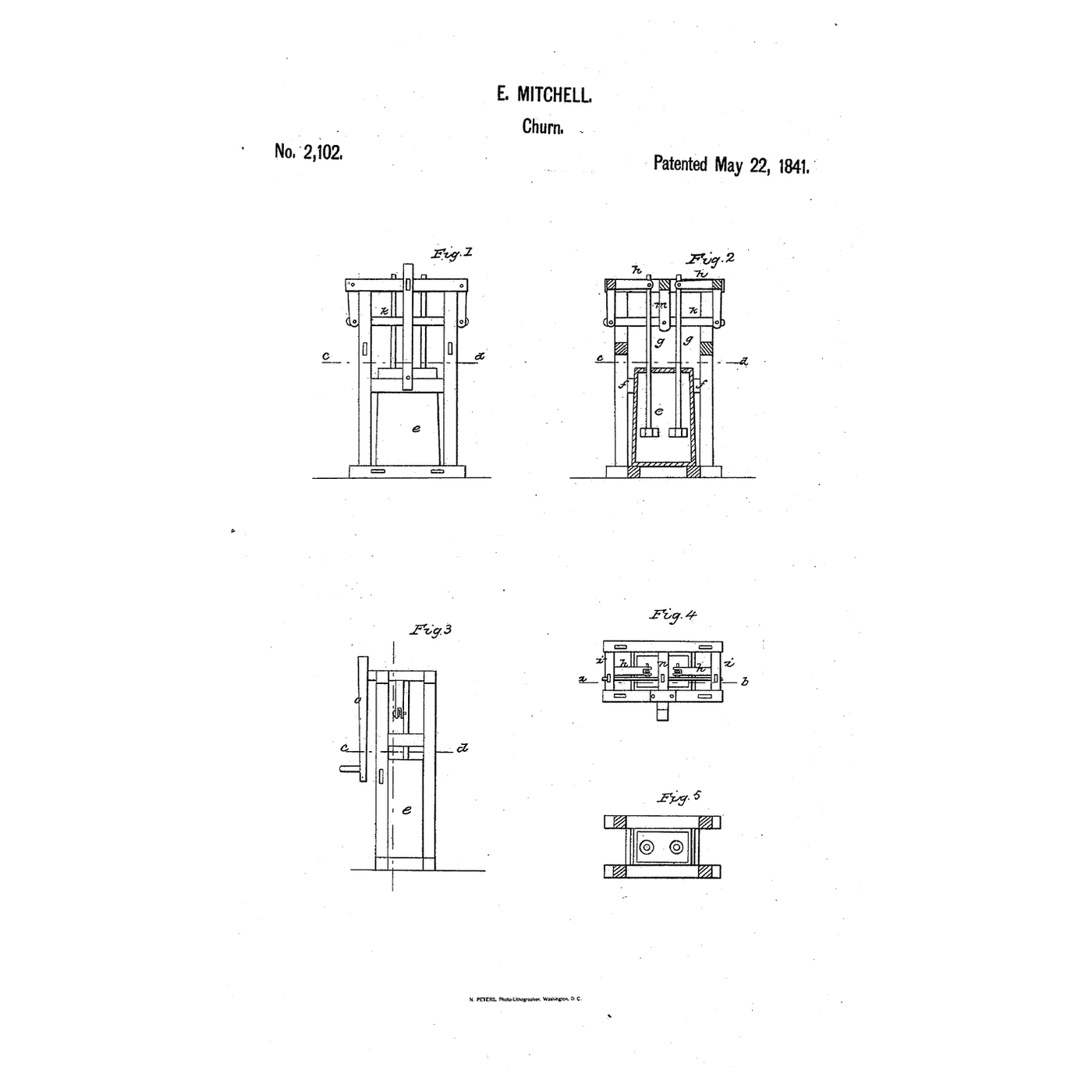
The embedded blueprint uses a double crank to pull two pitmen. Schermerhorn's double crank works two plungers up and down oppositely.
3
3
Read US 3,616
Read US 3,616
"The teeth of the plunger pass through the head piece horizontally, and at right angles therewith, projecting on both sides of the head-piece, but unequally; the projection on the side next the center of the churn being twice or thrice as great as on the other side. The length of the pieces forming the teeth should be equal to about two thirds of the width of the box."
4
4
Print the parts
Print the parts
Print two identical rake heads: their teeth are set off-centre, so one turned round passes between the other's. Print two crank discs and two yokes. Print in PETG at 0.2 mm layers, 30 % infill, 4 walls; wash before first use.
Materiales para este paso:
 Filamento PETG1 pieza
Herramientas necesarias:
 Impresora 3D de filamento (FDM)
5
5
Print the rake head
Print the rake head
The rake head, printed as step 4 describes.
6
6
Print the crank disc
Print the crank disc
The crank disc, printed as step 4 describes.
7
7
Print the yoke
8
8
Box and standards
Box and standards
Take a food-safe box about 150 mm square and 200 mm deep. Screw a pine standard to each of two opposite sides, rising about 200 mm above the top, and drill both for a 10 mm square hardwood crank shaft. Cut two oblong openings in the lid for the plunger rods.
Materiales para este paso:
 Recipiente de almacenaje de grado alimentario1 pieza
 Tabla de pino1 pieza
 Tornillo para madera n.º 8 x 1"1 pieza
Herramientas necesarias:
 Serrucho
 Taladro inalámbrico
 Juego de brocas
 Segueta (sierra de marquetería)
 Juego de destornilladores
9
9
Crank and plungers
Crank and plungers
Slide the crank discs onto the shaft with their pins on opposite sides, half a turn apart, and glue them 60 mm apart. Glue a rake head on each of two 12 mm dowel rods, long sides of the teeth toward the centre, and a yoke on each rod's top. Pass the rods through the lid, hang the yokes on the crank pins, and glue the crank arm and a dowel handle on the shaft's end.
Materiales para este paso:
 Espigas de madera dura1 pieza
 Cola de carpintero1 pieza
Herramientas necesarias:
Serrucho Papel de lija
10
10
The build in 3D
The build in 3D
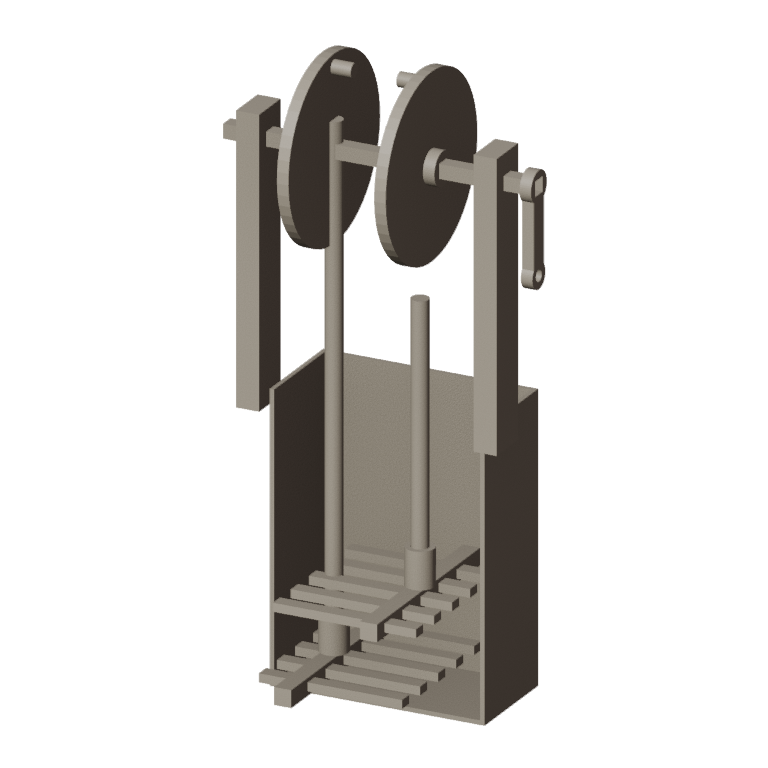
FreeCAD model of this build, not of the patent: the box cut away to show the two rake heads with their teeth interleaving, one at the bottom and one rising, their rods up to the two crank discs on the shaft between the standards, and the crank.
11
11
Crank and make butter
Crank and make butter
Let the heavy cream stand until it reaches about 15 °C, checked with the thermometer. Pour in 1 litre, fit the lid, and crank steadily; time until the butter comes. Pour off the buttermilk, add cold water, churn a little and pour off again until it runs clear; work in a pinch of salt and weigh the butter.
Materiales para este paso:
 Crema de leche espesa1000 ml
 Sal marina gruesa1 pieza
 Agua1 pieza
Herramientas necesarias:
 Termómetro de sonda permanente
 Cronómetro
 Báscula digital de cocina
 Bol grande de acero inoxidable
12
12
Teeth that clash, rods that bind
Teeth that clash, rods that bind
Interraking plunger churn troubleshooting.
Flow
Loading...
13
13
History and honest limits
History and honest limits
**Jason B. Schermerhorn** of Deerfield, Oneida County, New York, received US 3,616, dated 5 June 1844. His crank was a round iron rod "from one half to five-eighths of an inch in diameter" bent into a double crank "somewhat like a fulling mill crank"; the handles were forked over the cranks and pinned, so the plungers could be withdrawn; the tooth pieces might be one inch wide by half an inch.
**Honest limits.** Printed crank discs on a wooden shaft stand in for his bent iron crank, and a food-safe box for his wooden one. FDM prints hold food in their layer lines, so wash well and replace when worn. Your times and weights are the result.
Materiales
9- 1 piezaMarcador de posición
- Marcador de posición
- 1 piezaMarcador de posición
- Marcador de posición
- 1 piezaMarcador de posición
- 1 piezaMarcador de posición
- 1000 mlMarcador de posición
- 1 piezaMarcador de posición
- 1 piezaMarcador de posición
Herramientas requeridas
11- Marcador de posición
- Marcador de posición
- 1 vendor sell this, none ship to you yetMarcador de posición
- Marcador de posición
- Marcador de posición
- Marcador de posición
- Marcador de posición
- Marcador de posición
- Marcador de posición
- Marcador de posición
- Marcador de posición
Archivos de diseño
4Este plano hace
Blueprints relacionados
Estos blueprints comparten conocimiento — técnicas, materiales o principios


CC0 Dominio público
Este Blueprint se publica bajo CC0. Eres libre de copiar, modificar, distribuir y usar este trabajo para cualquier propósito, sin pedir permiso.
Apoya al Maker comprando productos a través de su Blueprint, donde gana una Comisión del Maker establecida por los vendedores, o crea una nueva iteración de este Blueprint e inclúyela como conexión en tu propio Blueprint para compartir ingresos.