ARTE
BELLEZA Y BIENESTAR
ARTESANÍA
CULTURA E HISTORIA
ENTRETENIMIENTO
MEDIO AMBIENTE
COMIDA Y BEBIDAS
INGENIERÍA INVERSA
CIENCIAS
DEPORTES
TECNOLOGÍA
TECNOLOGÍA VESTIBLE



The Float Inkstand: A Cork That Keeps the Ink From the Air
Ink left open in a well thickens, dries and settles, so the writer dips into sludge.
Walter Hunt of New York, assignor to Augustus T. Arrowsmith, received US 4,062, dated 29 May 1845, for an inkstand with "a float upon the surface of, or submerged in the ink, which float, I make of cork". The float, a truncated cone, rises against the bottom of the ink tube and covers the ink "wholly protecting it from the atmosphere until it is exhausted by use"; each dip of the pen pushes it down "as a loose plunger" and stirs the sediment back into the ink.
This rung works out how much ink surface the float hides, then fits a cork float and a tube to a glass jar and weighs its ink against an open jar for a week.
Principiante
About 1 hour, then a week of weighing
Instrucciones
1
1
Open surface and float push
Open surface and float push
Cargando el cuaderno de Jupyter…
2
2
The ink it protects
The ink it protects
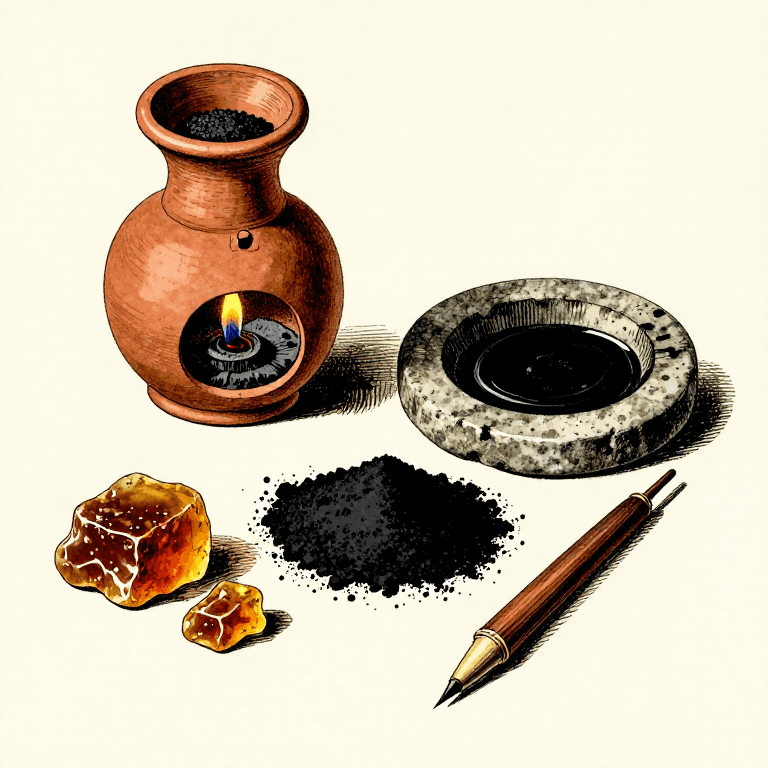
The embedded blueprint makes iron gall ink, which darkens and thickens in air and leaves sediment. Hunt's float keeps the air off it and stirs the sediment back in.
3
3
Read US 4,062
Read US 4,062
"It will be seen that the said float will retain its position and operate as a stopper to the ink-tube, until the ink is reduced below the conical part of the float, to the upper line of its base at I, at which elevation the float covers the whole surface of the ink, wholly protecting it from the atmosphere until it is exhausted by use."
"One other important advantage of this arrangement is, that at each introduction of the pen, the float is forced down and operates as a loose plunger in removing the sediment, which is ordinarily deposited in the bottom of the stand, and forces it upward and remingles it with the fluid".
4
4
Make the inkstand and weigh it for a week
Make the inkstand and weigh it for a week
**Tube.** Take a glass jar about 45 mm across inside with a metal lid. Drill an 8 mm hole in the centre of the lid and push 25 mm of clear vinyl tubing through it so 20 mm hangs inside. Seal round it with silicone sealant and let it cure.
**Float.** Cut two discs from cork sheet, 2 mm smaller than the jar's inside, and stick them together with silicone. Pare the top edge with the craft knife and sand it into a truncated cone whose flat top is wider than the tube.
**Fill.** Pour in ink until the float, floating, presses up against the bottom of the tube, and screw the lid on. Dip the pen: it should push the float down and meet ink.
**Test.** Fill a second jar to the same level with no float and no lid. Weigh both on the kitchen scale every day for a week and compare the ink each loses with the notebook's area ratio.
Materiales para este paso:
 Tarros de vidrio con tapa2 piezas
 Tubo de vinilo transparente0.03 metro
 Plancha de corcho1 pieza
 Sellador de silicona5 ml
 Tinta de escribir100 ml
Herramientas necesarias:
 Taladro inalámbrico
 Juego de brocas
 Cúter de precisión
 Papel de lija
 Calibre digital de 6 pulgadas
 Regla
 Báscula digital de cocina
 Juego de plumillas de caligrafía
5
5
An inkstand that leaks, dries or will not let the pen in
An inkstand that leaks, dries or will not let the pen in
Float inkstand troubleshooting.
Flow
Loading...
6
6
History and honest limits
History and honest limits
**Walter Hunt** of New York, assignor to Augustus T. Arrowsmith, signed US 4,062 on 12 July 1844; it is dated 29 May 1845. He chose cork "in consequence of its lightness, cleanliness and durability", made the reservoir a glass cup under a metal cap holding two pen sockets and the ink tube, and offered an elastic arch of sheet india rubber on the float as an alternative. Hunt later patented the safety pin (US 6,281, 1849).
**Honest limits.** A glass jar, vinyl tube and sheet cork stand in for his cup, cap and turned cork. Evaporation only roughly follows exposed area. Cork density is a range and the sizes are examples. Your week of weighings is the result.
Materiales
5- 2 piezasMarcador de posición
- 0.03 metroMarcador de posición
- 1 piezaMarcador de posición
- Marcador de posición
- 100 mlMarcador de posición
Herramientas requeridas
8- 1 vendor sell this, none ship to you yetMarcador de posición
- Marcador de posición
- Marcador de posición
- Marcador de posición
- Marcador de posición
- Marcador de posición
- Marcador de posición
- Marcador de posición
Blueprints relacionados
Estos blueprints comparten conocimiento — técnicas, materiales o principios


CC0 Dominio público
Este Blueprint se publica bajo CC0. Eres libre de copiar, modificar, distribuir y usar este trabajo para cualquier propósito, sin pedir permiso.
Apoya al Maker comprando productos a través de su Blueprint, donde gana una Comisión del Maker establecida por los vendedores, o crea una nueva iteración de este Blueprint e inclúyela como conexión en tu propio Blueprint para compartir ingresos.