ARTE
BELLEZA Y BIENESTAR
ARTESANÍA
CULTURA E HISTORIA
ENTRETENIMIENTO
MEDIO AMBIENTE
COMIDA Y BEBIDAS
INGENIERÍA INVERSA
CIENCIAS
DEPORTES
TECNOLOGÍA
TECNOLOGÍA VESTIBLE


The Plunger-Filled Fountain Pen: A Measured Dose of Ink per Stroke
Carrying ink meant carrying an inkstand, and early reservoir pens either flooded or ran dry.
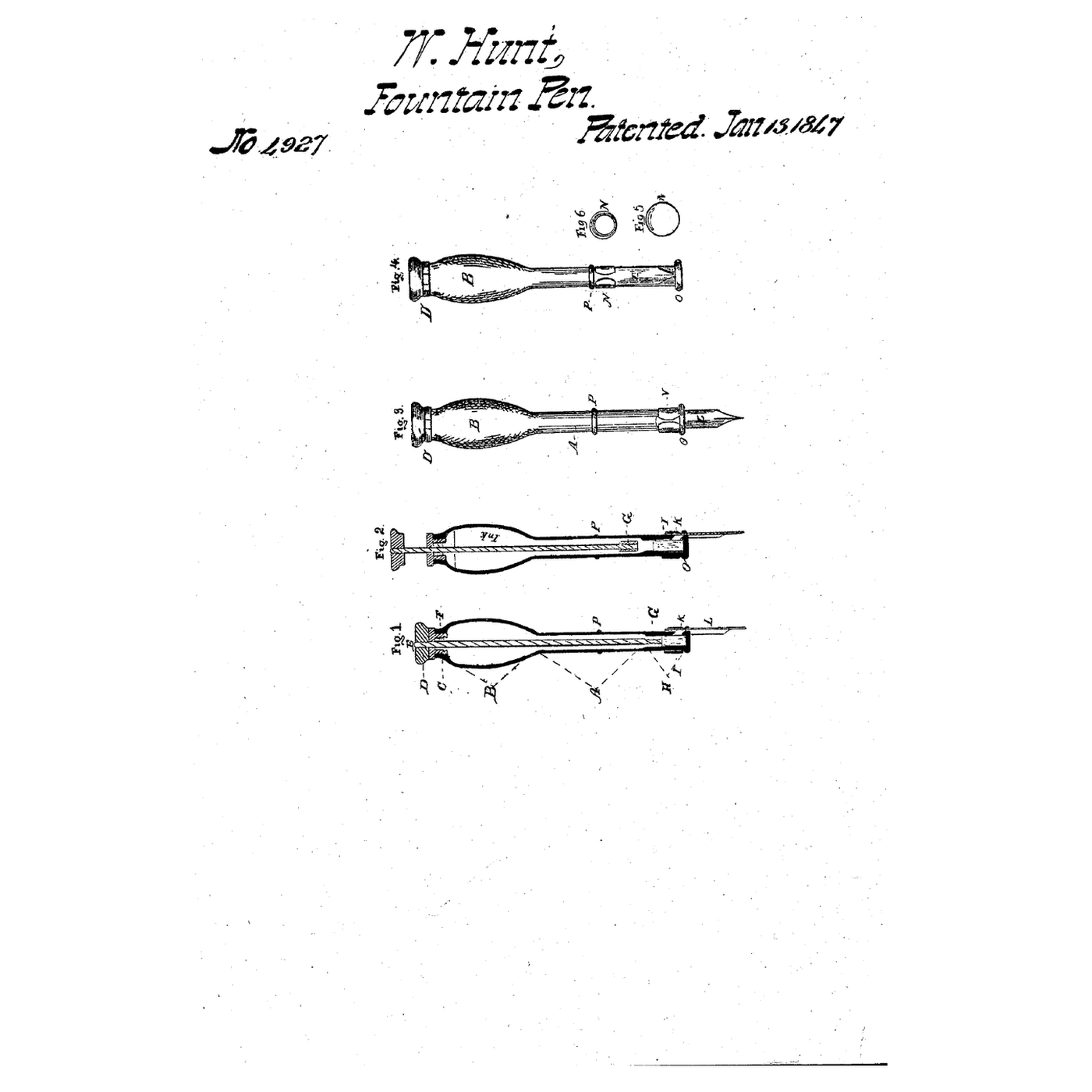
Walter Hunt of New York received US 4,927, dated 13 January 1847, for a fountain pen that is "the combination of all in one of inkstand, pen, shaft, and pen holder, so arranged as to be convenient for the pocket, and adapted to the common steel pen". A rubber plunger drawn back lets ink fall from the reservoir into a small filling tube; returned suddenly, it "forces the ink in said tube into the barrel of the pen" through a sponge stopper, so each stroke gives the same dose. "It never dries up, nor leaks, and is certain to throw out the requisite quantity of ink".
This rung works out the dose and the number of fillings from Hunt's sizes, then builds a fixed-dose filler from a syringe and an acrylic reservoir and weighs its strokes.
Intermedio
About 3 hours
Instrucciones
1
1
Dose and fillings
Dose and fillings
Cargando el cuaderno de Jupyter…
2
2
The pen that had to be dipped
The pen that had to be dipped
The embedded blueprint cuts a quill that must be dipped every few words. Hunt carries the ink with the pen and feeds a fixed dose to a common steel nib.
3
3
Read US 4,927
Read US 4,927
"The manner of filling and using, is as follows: when the pen is to be filled, the plunger is drawn back by the thumb and finger, hold of the nut D, which allows the ink to fall from the reservoir B, into the filling tube H. The plunger is then suddenly returned, which forces the ink in said tube into the barrel of the pen, through the aperture K, said plunger forming a perfect stopper in said tube which prevents the escape of the ink until another supply for the pen is required."
"Felting, or woolen cloth, will probably answer in the room of sponge, for the purpose of the stopper, as its office is to check the flow of the ink through the aperture K, except under the pressure of the piston as before stated."
4
4
Build the filler and weigh its doses
Build the filler and weigh its doses
**Reservoir.** Cut 5 cm of clear acrylic tube as the reservoir and seal a disc of rubber sheet across its lower end with a hole in the middle.
**Filling tube and plunger.** Take a Luer syringe: its barrel is the filling tube, its plunger the piston. Cut a side port in the barrel near its top with the craft knife, below where the plunger sits when drawn back, and seal the reservoir's hole over that port with epoxy, so ink falls in when the plunger is drawn back.
**Stopper and nib.** Push a plug of sponge into the syringe's nozzle and fit a dip-pen nib against it.
**Test.** Fill the reservoir with ink. Draw the plunger back past the port, wait a moment, and push it home once. Weigh the assembly before and after with the kitchen scale; 1 g of ink is about 1 ml. Do ten strokes and compare the spread with a free squeeze of a syringe. Then write with the nib until it runs dry, and count the words.
Materiales para este paso:
 Tubo acrílico (transparente)0.05 metro
 Jeringa - Luer1 pieza
 Plancha de caucho1 pieza
 Esponja1 pieza
 Resina epoxi5 ml
 Tinta de escribir30 ml
Herramientas necesarias:
 Sierra para metales
 Cúter de precisión
 Taladro inalámbrico
 Juego de brocas
 Báscula digital de cocina
 Juego de plumillas de caligrafía
5
5
A filler that floods, runs dry or gives uneven doses
A filler that floods, runs dry or gives uneven doses
Plunger-filled fountain pen troubleshooting.
Flow
Loading...
6
6
History and honest limits
History and honest limits
**Walter Hunt** of New York signed US 4,927 on 12 September 1845; it is dated 13 January 1847. His plunger was india rubber, or leather saturated with india-rubber paste, on a wire piston rod through a stuffing box; a band with a crescent opening held the pen, and a sliding holder let the pen be drawn back and shielded for the pocket. His claim is the filling tube of graduated capacity combined with the fountain pen. The same Walter Hunt patented the float inkstand in 1845 and later the safety pin.
**Honest limits.** A Luer syringe and an acrylic tube stand in for his shaft, reservoir and plunger. The notebook uses his printed sizes, taking the bulb as a cylinder. Your dose weighings are the result.
Materiales
6- 0.05 metroMarcador de posición
- 1 piezaMarcador de posición
- 1 piezaMarcador de posición
- 1 piezaMarcador de posición
- 5 mlMarcador de posición
- 30 mlMarcador de posición
Herramientas requeridas
6- Marcador de posición
- Marcador de posición
- 1 vendor sell this, none ship to you yetMarcador de posición
- Marcador de posición
- Marcador de posición
- Marcador de posición
Este plano hace
Blueprints relacionados
Estos blueprints comparten conocimiento — técnicas, materiales o principios



CC0 Dominio público
Este Blueprint se publica bajo CC0. Eres libre de copiar, modificar, distribuir y usar este trabajo para cualquier propósito, sin pedir permiso.
Apoya al Maker comprando productos a través de su Blueprint, donde gana una Comisión del Maker establecida por los vendedores, o crea una nueva iteración de este Blueprint e inclúyela como conexión en tu propio Blueprint para compartir ingresos.