Colaboración
ARTE
BELLEZA Y BIENESTAR
ARTESANÍA
CULTURA E HISTORIA
ENTRETENIMIENTO
MEDIO AMBIENTE
COMIDA Y BEBIDAS
INGENIERÍA INVERSA
CIENCIAS
DEPORTES
TECNOLOGÍA
TECNOLOGÍA VESTIBLE
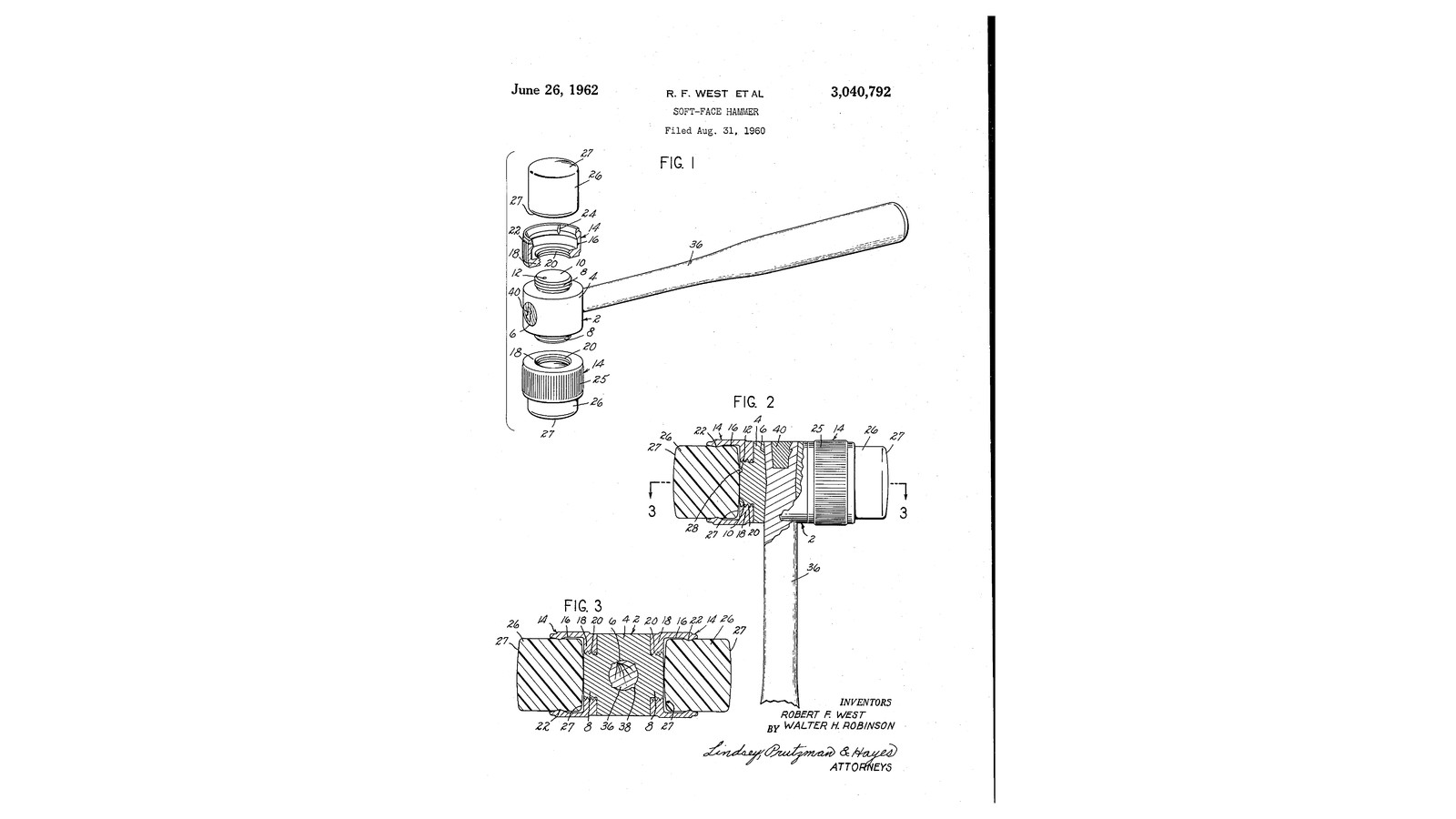


Reversible-Tip Soft-Face Hammer: Domed Rubber Tips Locked in Screw-On Sockets by an Internal Rib (West & Robinson, 1962)
Robert F. West and Walter H. Robinson of Connecticut received US 3,040,792, dated 26 June 1962, for The Stanley Works. A tubular socket screws onto a threaded boss at each end of the hammer's head. A rubber tip, domed at both ends, is pushed into the socket past an internal rib, which bites into it, and its rubber fills short grooves so it cannot turn. The tip can be pulled out and turned round to use its other end. On its first blows the tip's inner face squeezes into an off-centre hole in the boss and forms its own dowel, which stops the socket unscrewing.
The patent gives no sizes; every size here is ours.
Avanzado
About 2 days
Instrucciones
1
1
The tip's proportions
The tip's proportions
Cargando el cuaderno de Jupyter…
2
2
Read US 3,040,792
Read US 3,040,792
"Upon being subjected to the percussive forces during initial use, some of the plastic material of the inner face 27 of the striking tip 26 will be extruded or forced into the eccentrically located recess 12 in the boss surface 10 to provide a self-forming dowel pin 28 which effectively prevents inadvertent loosening of the threaded connection between boss and mounting socket during use."
3
3
Turn the head 2
Turn the head 2
From 35 mm steel bar turn a body 4 80 mm long with a boss 8 20 mm across and 15 mm long at each end; cut M20 threads on the bosses with the die. In each boss's end face drill a recess 12 4 mm across and 4 mm deep, 6 mm off centre. Drill a 20 mm handle eye 6 through the middle in a V-block.
Materiales para este paso:
 Barra redonda de acero dulce1 pieza
 Aceite de corte1 pieza
Herramientas necesarias:
 Torno de metal
 Plato de torno de 3 mordazas
 Herramienta de corte para torno
 Gubia de tronzar
 Juego de machos y terrajas
 Portaterrajas
 Tornillo de banco
 Taladro de columna
 Bloque en V
 Juego de brocas
 Granete
 Calibre digital de 6 pulgadas
 Gafas de seguridad
4
4
Turn the sockets 14
Turn the sockets 14
From 48 mm bar turn two sockets 30 mm long. Knurl the outside 25. Drill and tap the collar end 18 M20, 8 mm deep. From the other end, before boring, drill four 4 mm holes 20 mm deep centred on a 38 mm circle, for the grooves 24. Bore the aperture 16 38 mm across and 20 mm deep, leaving a rib 22 4 mm wide 10 mm in, turned to 35 mm with 30 degree ramps either side.
Materiales para este paso:
Barra redonda de acero dulce2 piezasAceite de corte1 piezaHerramientas necesarias:
Torno de metalPlato de torno de 3 mordazasHerramienta de corte para torno Barra de mandrinarGubia de tronzar
 MoleteadorTaladro de columnaJuego de brocasJuego de machos y terrajas
 Volvedor de machosCalibre digital de 6 pulgadas
5
5
Make the tips 26
Make the tips 26
For each tip, cut nine discs of 4 mm natural rubber sheet 40 mm across and bond them into a stack with contact cement; clamp it overnight. Grind it round to 38.5 mm on the belt sander, then dome both ends: a large curve over most of the face and a small round where it meets the side, the same at both ends, 36 mm long overall.
Materiales para este paso:
 Plancha de caucho natural1 pieza
 Cemento de contacto1 pieza
Herramientas necesarias:
 Brújula
 Cúter de precisión
 Sargento
 Lijadora de bandaCalibre digital de 6 pulgadas
6
6
Assemble
Assemble
Turn an ash handle to drive into the eye and wedge it. Screw a socket onto each boss hand-tight. Push a tip into each socket, squeezing it past the rib in the vice between soft packing, until its inner dome bears on the boss. Give the first few blows on a wood block: the rubber pushes into the boss's recess and locks the socket. To turn a tip round, pull it out, reverse it and push it back.
Materiales para este paso:
 Tabla de madera dura1 pieza
 Cola de carpintero1 pieza
Herramientas necesarias:
 Torno de madera
 Juego de herramientas de torno (HSS)
 Sierra para metales
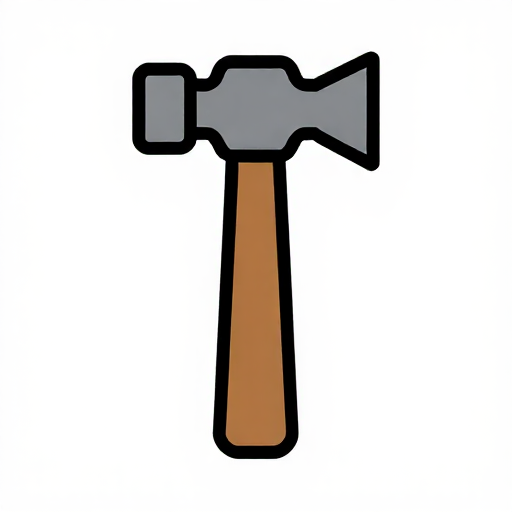 Martillo de bolaTornillo de banco
7
7
Troubleshooting
Troubleshooting
Reversible-tip hammer troubleshooting.
Flow
Loading...
8
8
History and honest limits
History and honest limits
**Robert F. West** of Simsbury and **Walter H. Robinson** of West Hartford, Connecticut, assignors to The Stanley Works, US 3,040,792, dated 26 June 1962, filed 31 August 1960. They claimed sockets with an internal portion of reduced cross-section whose surfaces are "inclined to provide ramp surfaces", and symmetrical tips "having end surfaces of convexly curvilinear configuration", removable and "reversible in said sleeves". They list natural rubber, synthetic rubbers, nylon and cellulose esters for the tips; ours are laminated natural rubber. They give proportions but no sizes; every size here is ours.
Materiales
6- 2 piezasMarcador de posición
- 2 piezasMarcador de posición
- 1 piezaMarcador de posición
- 1 piezaMarcador de posición
- 1 piezaMarcador de posición
- 1 piezaMarcador de posición
Herramientas requeridas
24- Marcador de posición
- Marcador de posición
- Marcador de posición
- Marcador de posición
- Marcador de posición
- Marcador de posición
- Marcador de posición
- Marcador de posición
- Marcador de posición
- Marcador de posición
- Marcador de posición
- Marcador de posición
- Marcador de posición
- Marcador de posición
- Marcador de posición
- Marcador de posición
- Marcador de posición
- Marcador de posición
- Marcador de posición
- 1 vendor sell this, none ship to you yetMarcador de posición
- Marcador de posición
- Marcador de posición
- Marcador de posición
- Marcador de posición
Este plano hace

Blueprints relacionados
Estos blueprints comparten conocimiento — técnicas, materiales o principios
CC0 Dominio público
Este Blueprint se publica bajo CC0. Eres libre de copiar, modificar, distribuir y usar este trabajo para cualquier propósito, sin pedir permiso.
Apoya al Maker comprando productos a través de su Blueprint, donde gana una Comisión del Maker establecida por los vendedores, o crea una nueva iteración de este Blueprint e inclúyela como conexión en tu propio Blueprint para compartir ingresos.