Collaboration
ART
BEAUTÉ ET BIEN-ÊTRE
ARTISANAT
CULTURE ET HISTOIRE
DIVERTISSEMENT
ENVIRONNEMENT
NOURRITURE ET BOISSONS
INGÉNIERIE INVERSE
SCIENCES
SPORTS
TECHNOLOGIE
TECHNOLOGIE PORTABLE
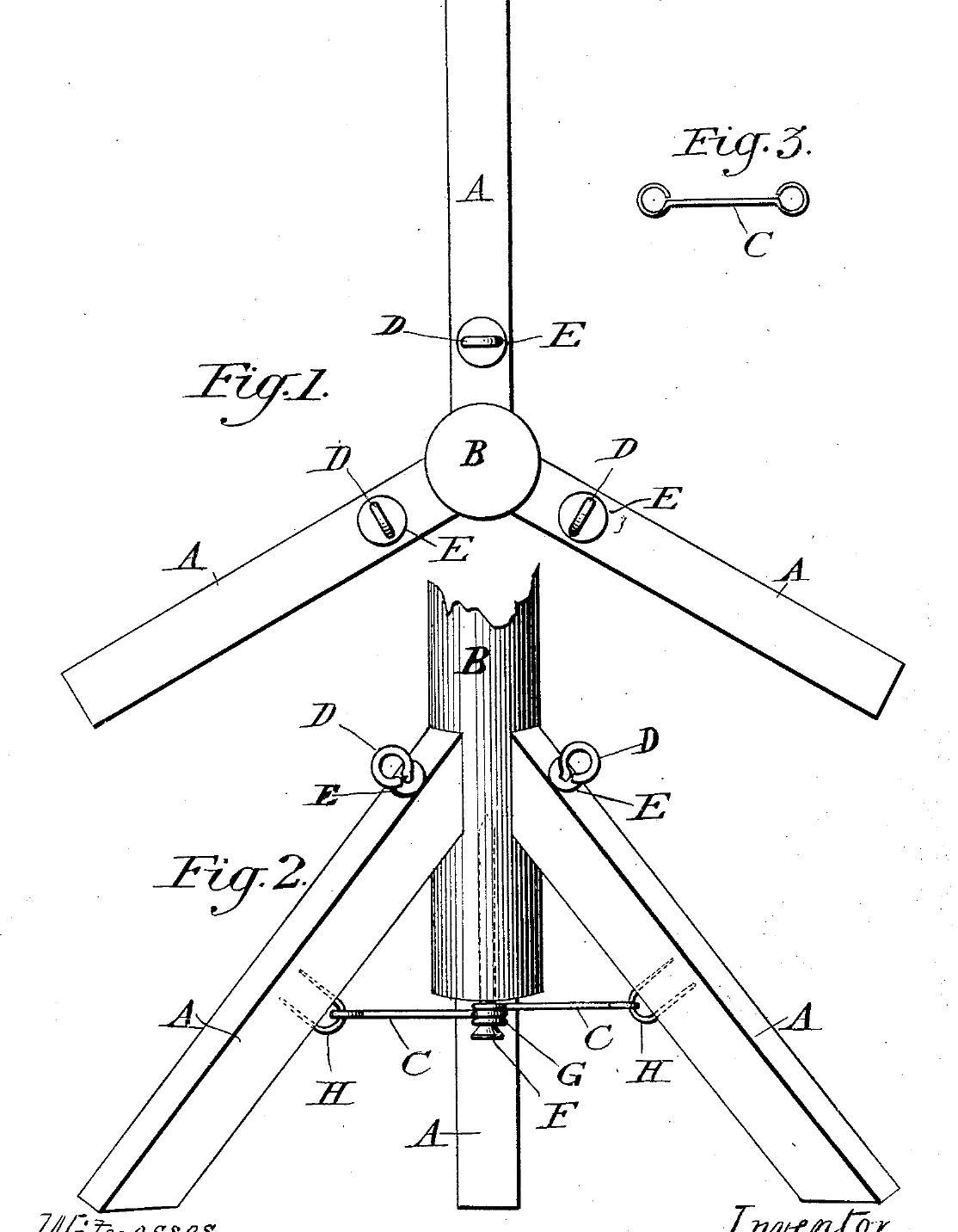


Christmas Tree Stand: Three Legs Tied by Wire Links to a Nail in the Butt (Cook, 1902)
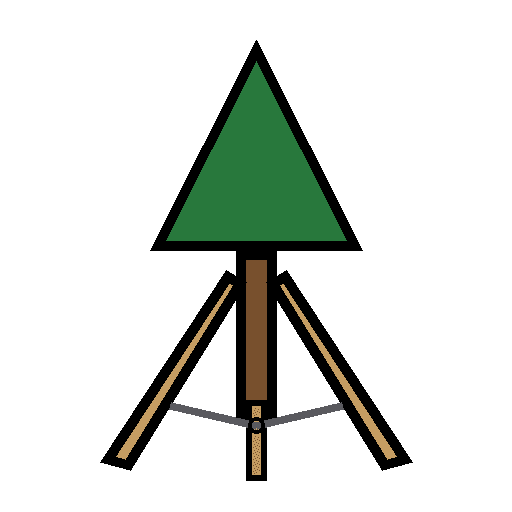
William Cook of New York received US 710,762, dated 7 October 1902, for a Christmas tree stand of three leaning legs and three wire links. The links meet under the tree on a nail driven up into the butt, and their other ends are fixed part way up the legs. The tops of the legs are screwed to the trunk. The tree's weight pushes the feet out, the links pull back, and the tops of the legs squeeze the trunk.
We make it from pine and steel wire. All sizes are ours.
Débutant
About 3 hours
Consignes
1
1
Where the links go
Where the links go
Chargement du notebook Jupyter…
2
2
Read US 710,762
Read US 710,762
"The tendency of legs A to spread by weight of tree causes an outward tension at wire nail F through the several links C and inward pressure on stem of tree by upper part of legs A. Thus the tree is held very secure and perfectly upright by two opposite forces acting a short space apart and derived from weight of tree."
3
3
Cut the legs
Cut the legs
Saw three legs 700 mm long from 70 x 22 mm pine (ours). Set a bevel gauge to 30 degrees and cut both ends of each leg at that angle, parallel to each other, so the foot sits flat on the floor and the top lies along the trunk, as in his Fig. 2. Sand off the splinters.
Matériaux pour cette étape :
 Planche de pin1 pièce
Outils nécessaires :
 Scie égoïne
 Fausse équerre
 Mètre ruban
 Crayon
 Papier abrasif
4
4
Bend the links
Bend the links
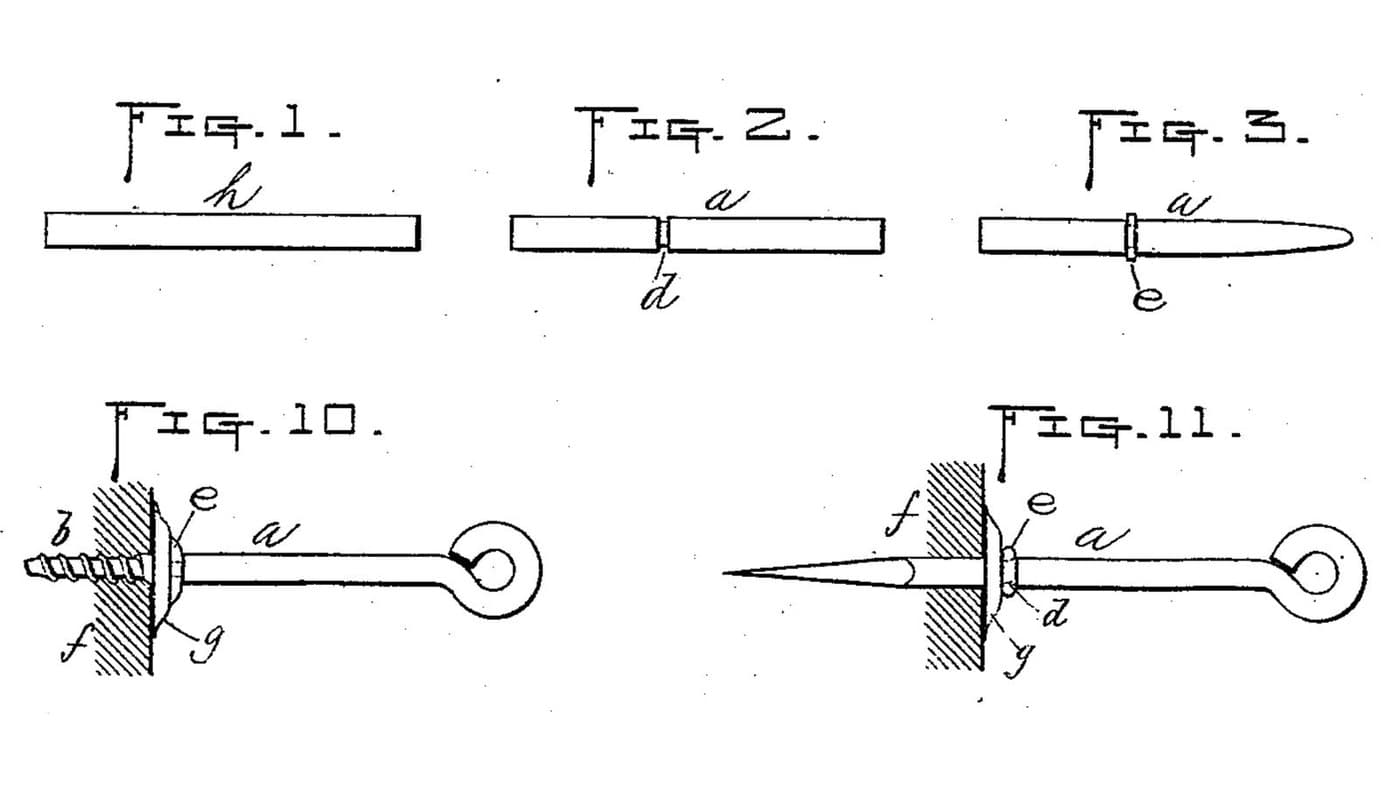
Cut three pieces of 2.5 mm steel wire, each the link length from the notebook plus about 60 mm for the eyes. Bend a round eye at each end with round-nose pliers, as his Fig. 3, so the eyes' centres are the link length apart. Make all three the same.
Matériaux pour cette étape :
 Fil d'acier3 pièces
Outils nécessaires :
 Pince coupante
 Pince à becs rondsMètre ruban
5
5
Staple the links to the legs
Staple the links to the legs
Mark each leg where the notebook says, on its inner face. Bend three U staples from the same wire (ours). Lay a link's outer eye on the mark and drive a staple over it into the leg, his staple H, leaving the eye free to turn.
Matériaux pour cette étape :
Fil d'acier1 pièceOutils nécessaires :
Pince coupantePince à becs ronds Marteau à panne fendue
6
6
Drill the tops of the legs
Drill the tops of the legs
Drill a hole through the top of each leg, about 40 mm from its end, just big enough for the screw eye's shank to pass.
Outils nécessaires :
 Chignole à main
7
7
Nail the links to the butt
Nail the links to the butt
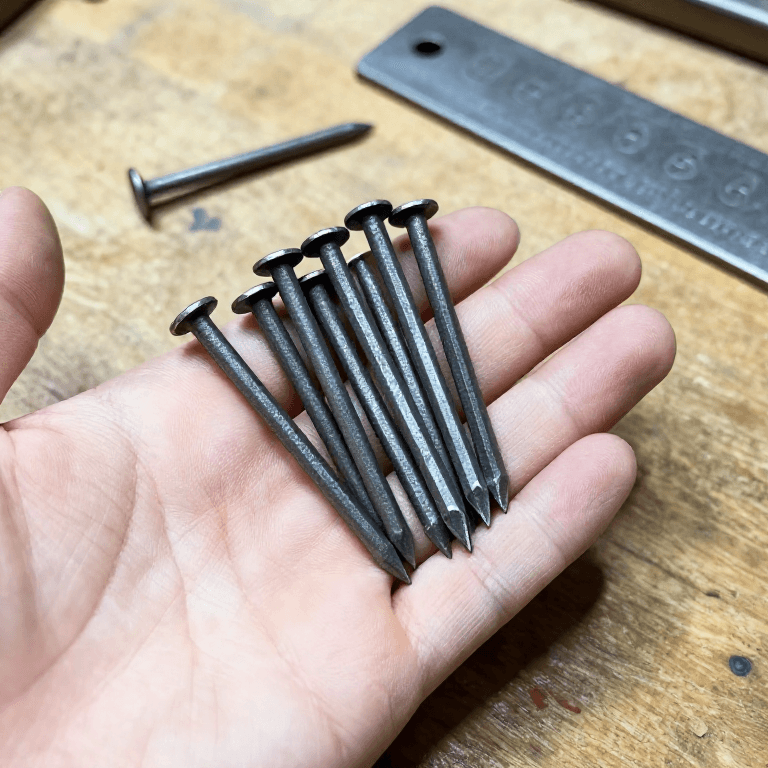
Saw the butt of the tree off square. Lay the tree on its side. Thread a long wire nail through the three free eyes of the links, his nail F, and drive it up into the middle of the bottom end of the tree.
Matériaux pour cette étape :
 Clous1 pièce
Outils nécessaires :
Scie égoïneMarteau à panne fendue8
8
Fix the tops of the legs
Fix the tops of the legs
Bring the top of each leg in against the trunk. Make a start hole in the trunk with an awl through the leg's hole, and turn a screw eye through the leg into the trunk until the leg is held tight, his screw-eye D. Do all three, then stand the tree up.
Matériaux pour cette étape :
 Piton à vis3 pièces
Outils nécessaires :
 Alêne
9
9
Check it stands upright
Check it stands upright
All three feet should touch the floor and the links should be straight and tight. Look at the tree from two sides. To take it down, turn out the screw eyes and pull the nail; the links fold about the nail for storing.
10
10
Troubleshooting
Troubleshooting
Christmas tree stand troubleshooting.
Flow
Loading...
11
11
History and honest limits
History and honest limits
**William Cook** of New York, US 710,762, dated 7 October 1902, filed 29 July 1901. He claimed "a Christmas-tree stand composed of legs, and links, one end of each link being connected with one leg at a point intermediate between the ends of the leg, and the opposite ends of the links being connected with each other to form a seat". He says the stand is "more economical of construction and more easily applied" and that "size of tree offers no obstacle". He names no materials and gives no sizes: the pine, the wire, the 700 mm legs, the 30 degree angle, the butt height and how the screw eyes pass through the legs are ours. His drawing also marks parts E and G, which his text does not describe.
Matériaux
4- 1 pièceEspace réservé
- 4 piècesEspace réservé
- 1 pièceEspace réservé
- 3 piècesEspace réservé
Outils requis
10- Espace réservé
- Espace réservé
- 1 vendor sell this, none ship to you yetEspace réservé
- 1 vendor sell this, none ship to you yetEspace réservé
- Espace réservé
- Espace réservé
- Espace réservé
- Espace réservé
- Espace réservé
- Espace réservé
Ce plan fabrique
Blueprints liés
Ces blueprints partagent des connaissances — techniques, matériaux ou principes
CC0 Domaine public
Ce blueprint est publié sous CC0. Vous êtes libre de copier, modifier, distribuer et utiliser ce travail pour tout usage, sans demander la permission.
Soutenez le Maker en achetant des produits via son Blueprint où il perçoit une Commission Maker définie par les Vendeurs, ou créez une nouvelle itération de ce Blueprint et incluez-le comme connexion dans votre propre Blueprint pour partager les revenus.