
Collaboration
ART
BEAUTÉ ET BIEN-ÊTRE
ARTISANAT
CULTURE ET HISTOIRE
DIVERTISSEMENT
ENVIRONNEMENT
NOURRITURE ET BOISSONS
INGÉNIERIE INVERSE
SCIENCES
SPORTS
TECHNOLOGIE
TECHNOLOGIE PORTABLE
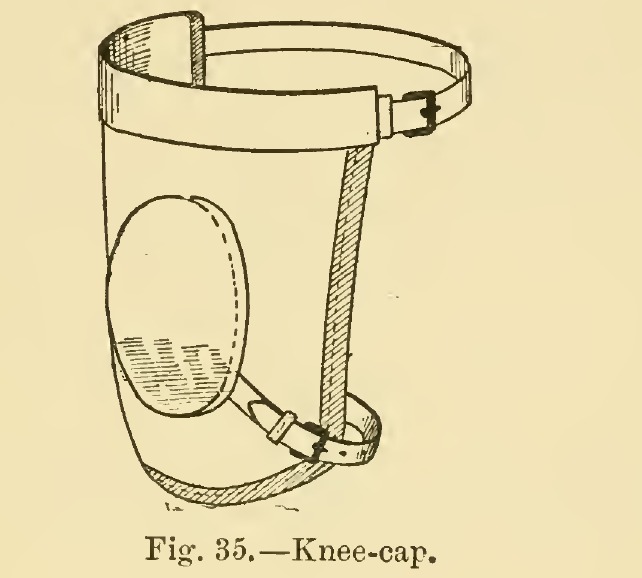
Horse Knee-Cap: Cupped Leather Block, Cloth Shield and Flock-Stuffed Chamois Roll (Hasluck, Saddlery, 1904)
Tex

Créé par

Tex

13. novembre 2026FO
7
0
0
0
0

Horse Knee-Cap: Cupped Leather Block, Cloth Shield and Flock-Stuffed Chamois Roll (Hasluck, Saddlery, 1904)

A knee-cap protects a horse's knee from knocks and falls. This one is from Paul N. Hasluck's Saddlery (1904): a leather block beaten into a cup, set on a cloth or leather shield, a flock-stuffed chamois roll along the top strap, and a strap below the knee. Every size is his. He notes it is often better to buy the pads, but shows how to make them.
Intermédiaire
About 1 day

Consignes

1

Cutting list

Chargement du notebook Jupyter…
2

Read Saddlery, ch. X

"Knee-caps are of felt, fawn rugging, kersey cloth, union, buff leather, black rubber, etc."
3

Beat the knee block

With no press, damp some half-curried leather and beat it, as a shoemaker beats boot soles, until it takes a hollow cup shape. Let it dry, then cut it to a wide oval about 5 in by 4 in.

Matériaux pour cette étape :

Cuir tanné végétalCuir tanné végétal1 pièce
Eau douceEau douce1 pièce

Outils nécessaires :

MarteauMarteau
Fer à genouxFer à genoux
Couteau à cuirCouteau à cuir
4

Cut and bind the shield

Make the cloth, kersey or leather about 8 in at the top and 9 in deep, and round the bottom. Bind all of it except the straight top with patent binding or cloth; buff leather need not be bound.

Matériaux pour cette étape :

Feuille de feutre de laineFeuille de feutre de laine1 pièce
Bande de bordureBande de bordure1 pièce
Fil de linFil de lin1 pièce
Cire d'abeilleCire d'abeille1 pièce

Outils nécessaires :

CiseauxCiseaux
Mètre rubanMètre ruban
AlêneAlêne
Deux aiguilles de sellierDeux aiguilles de sellier
5

Fit the block

Put the leather block on the centre with a piece of shaped cardboard under it, paste the two together and press the cloth down into the hollow. Stitch the block to the cloth about 1-1/4 in from the top and 1-1/2 in from the bottom.

Matériaux pour cette étape :

Carton contrecolléCarton contrecollé1 pièce
Colle de pâte de bléColle de pâte de blé1 pièce
Fil de linFil de lin1 pièce
Cire d'abeilleCire d'abeille1 pièce

Outils nécessaires :

Couteau à cuirCouteau à cuir

AlêneAlêne
Deux aiguilles de sellierDeux aiguilles de sellier
6

Make the top strap

Cut a piece of leather 1-1/8 in wide and 1 in longer at each end than the cloth at the top. Make a hole at each end 1 in from the point for a 5/8 in strap. Put a chape, buckle and loop in the hole at one end and a 5/8 in strap 9 in long in the other, and stitch both firmly.

Matériaux pour cette étape :

Cuir de harnaisCuir de harnais1 pièce
Boucle en laiton à ardillonBoucle en laiton à ardillon1 pièce
Fil de linFil de lin1 pièce
Cire d'abeilleCire d'abeille1 pièce

Outils nécessaires :

Couteau à cuirCouteau à cuir
Emporte-pièce pour cuirEmporte-pièce pour cuir
AlêneAlêne
Deux aiguilles de sellierDeux aiguilles de sellier
7

Make the padded roll

Cut chamois the same length and width as the strap. With it hanging down in front of the knee-cap and the three edges together, stitch it all along through the top leather and the cloth. Turn the chamois over the top towards the bottom and stitch it along the bottom side of the top strap, rather slack. Make two rows of stitches across the centre, leaving an opening of about 1-1/2 in exactly in the centre. Stuff both parts of the roll from each end with flock, then close the ends by stitching chamois and top leather together.

Matériaux pour cette étape :

Peau de chamoisPeau de chamois1 pièce
Bourre de laineBourre de laine1 pièce
Fil de linFil de lin1 pièce
Cire d'abeilleCire d'abeille1 pièce

Outils nécessaires :

CiseauxCiseaux
AlêneAlêne
Deux aiguilles de sellierDeux aiguilles de sellier
8

Fit the bottom strap

Put a 5/8 in chape buckle and loop at the bottom of the block pad, slanting slightly downwards, with a strap 10 in long on the opposite side. For a pair, reverse the buckles so each is on the outside.

Matériaux pour cette étape :

Cuir de harnaisCuir de harnais1 pièce
Boucle en laiton à ardillonBoucle en laiton à ardillon1 pièce
Fil de linFil de lin1 pièce
Cire d'abeilleCire d'abeille1 pièce

Outils nécessaires :

Couteau à cuirCouteau à cuir
AlêneAlêne
Deux aiguilles de sellierDeux aiguilles de sellier
9

Troubleshooting

Knee-cap troubleshooting.

Flow

Loading...
10

History and honest limits

From **Saddlery**, edited by Paul N. Hasluck, David McKay, 1904 (archive.org saddlery00hasl), chapter X, "Knee-caps and Miscellaneous Articles", pp. 81-84, Figs. 33-35; every fraction was read on the scan. He also suggests a better block cut with a tongue up under the top strap, and a fastening with two squares and a 5/8 in rubber ring; those are not shown here. The thread, the tools and the metric figures are ours.

Matériaux

12

Outils requis

8

CC0 Domaine public

Ce blueprint est publié sous CC0. Vous êtes libre de copier, modifier, distribuer et utiliser ce travail pour tout usage, sans demander la permission.

Soutenez le Maker en achetant des produits via son Blueprint où il perçoit une Commission Maker définie par les Vendeurs, ou créez une nouvelle itération de ce Blueprint et incluez-le comme connexion dans votre propre Blueprint pour partager les revenus.

Commentaires

(0)

Se connecter pour participer à la discussion

Chargement des commentaires...