ART
BEAUTÉ ET BIEN-ÊTRE
ARTISANAT
CULTURE ET HISTOIRE
DIVERTISSEMENT
ENVIRONNEMENT
NOURRITURE ET BOISSONS
INGÉNIERIE INVERSE
SCIENCES
SPORTS
TECHNOLOGIE
TECHNOLOGIE PORTABLE


The Tesla Turbine: Discs, Not Blades, Driven by the Boundary Layer
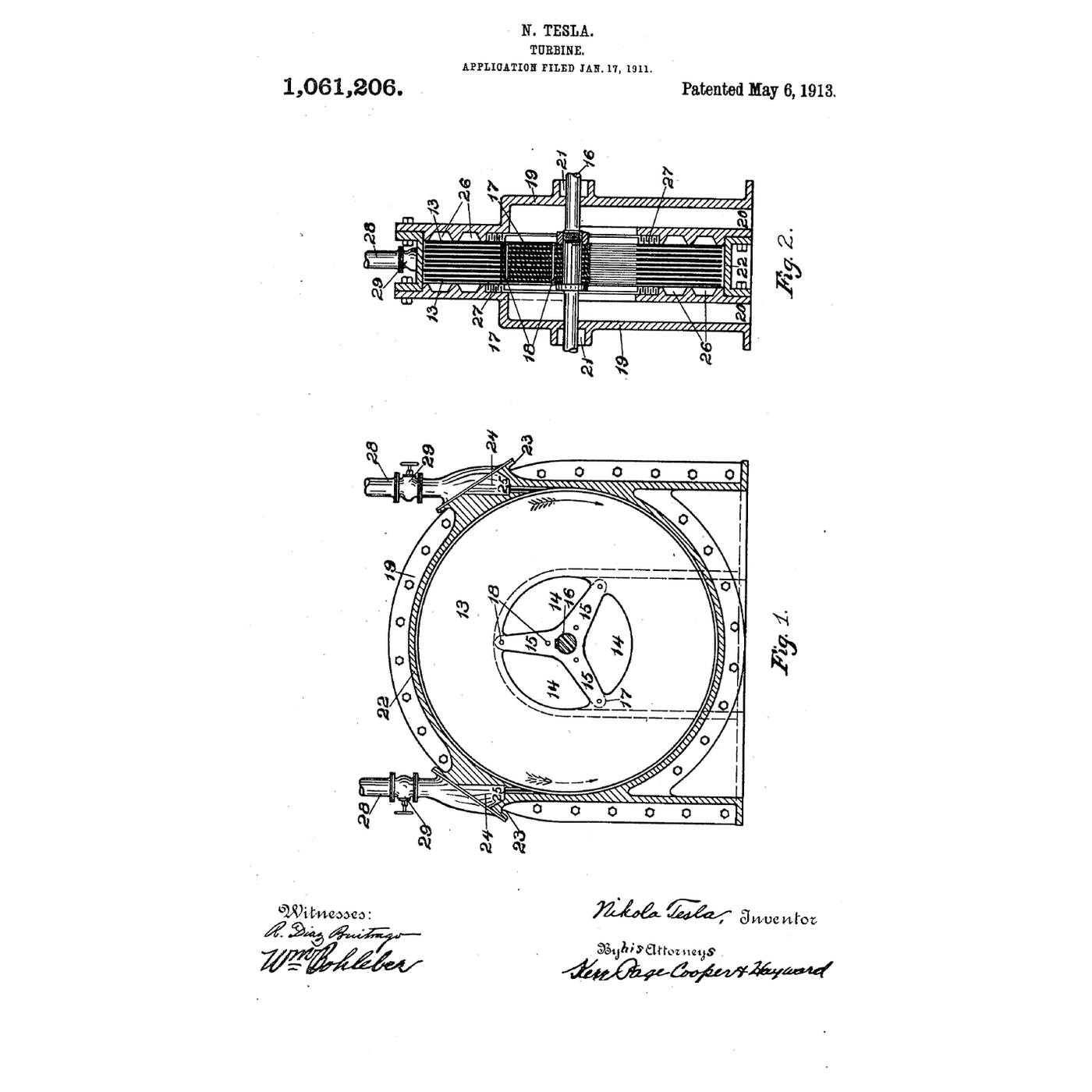
Nikola Tesla's turbine has no blades at all. A stack of flat discs with narrow gaps between them turns on a shaft; gas or steam enters tangentially at the rim, spirals inward through the gaps, and drags the discs round by viscosity before leaving near the centre. He patented it in 1913 and claimed it could be run as a turbine or, reversed, as a pump.
It never displaced bladed turbines: its practical efficiency was too low. But it is the clearest demonstration there is of the boundary layer — the thin film of fluid that sticks to every surface — and it is a classic maker build from old CDs.
This rung works out the gap the discs need and builds a CD Tesla turbine run on compressed air.
Intermédiaire
About 5 hours
Consignes
1
1
Read the patent's rule for the gap
Read the patent's rule for the gap
US 1,061,206, 'Turbine', Nikola Tesla. The runner is *"a plurality of flat rigid disks"* keyed to a shaft and spaced by washers, with *"openings"* near the centre for the exhaust. The fluid acts on them through *"adhesion and viscosity"*.
The design rule is in plain words: the spacing *"should be the greater, the larger the diameter of the disks, the longer the spiral path of the fluid and the greater its viscosity"*. Tesla drew only a few widely spaced discs *"for the sake of clearness"* — a real runner has many, close together.
2
2
The boundary layer sets the gap
The boundary layer sets the gap
Chargement du notebook Jupyter…
3
3
Build a CD turbine
Build a CD turbine
Drill out the centres of eight CDs to fit a length of threaded rod as the shaft. Drill six 10 mm exhaust holes round each disc near the centre, all in line. Stack the discs with two thin flat washers between each pair, clamped between nuts.
Print a housing that fits round the stack with 1–2 mm clearance, with one tangential inlet at the rim and exhaust ports in the side plates over the disc holes. Run the shaft in two skateboard bearings in the side plates.
Balance matters: spin the stack slowly by hand and check it does not wobble before any air goes near it.
Matériaux pour cette étape :
 Disque compact8 pièces
 Rondelle plate20 pièces
 Tige filetée1 pièce
 Roulements de planche à roulettes2 pièces
 Filament PETG150 g
Outils nécessaires :
 Perceuse sans fil
 Jeu de forets
 Imprimante 3D à filament (FDM)
 Clé à molette
 Pied à coulisse numérique 6 pouces
4
4
Run it on compressed air, behind a guard
Run it on compressed air, behind a guard
Stand the turbine behind a clear guard and wear goggles and ear protection. Connect the air compressor through the regulator to the inlet, starting at 0.5 bar.
Read the speed with the tachometer (a strip of reflective tape on the stack) at each pressure, raising it in small steps. **Stop well below 10,000 rpm** — the notebook's rim speeds show why.
Then change the gap: rebuild with one washer between discs instead of two and repeat. Compare free-running speed at the same pressure. The gap that works best is close to the notebook's boundary-layer estimate for air.
Outils nécessaires :
 Compresseur d'air (type pancake)
 Détendeur régulateur de pression
 Tachymètre numérique
 Lunettes de sécurité transparentes
 Protection auditive
5
5
History and context
History and context
**US 1,061,206, 'Turbine', Nikola Tesla; original application filed 21 October 1909, divided and this application filed 17 January 1911 (Serial 603,049); patented 6 May 1913.** A companion patent of the same family covered the machine run as a pump.
Tesla expected high efficiency and a cheap, rugged machine. In practice the discs flexed at speed, the gaps had to be very fine, and efficiency with steam fell well short of bladed turbines; the bladed Parsons turbine in this catalogue won. Disc pumps survive for abrasive and delicate fluids, where their bladeless shear is gentle.
**Honest limits.** Low efficiency at useful power; discs that flex; very close tolerances; and on a CD build, the hazard of a disc bursting.
Matériaux
5- 8 piècesEspace réservé
- 20 piècesEspace réservé
- 1 pièceEspace réservé
- Roulements de planche à roulettes10 % de commission2 piècesEspace réservé
- 150 gEspace réservé
Outils requis
10- 1 vendor sell this, none ship to you yetEspace réservé
- Espace réservé
- Espace réservé
- Espace réservé
- Espace réservé
- Espace réservé
- Espace réservé
- Espace réservé
- Espace réservé
- Protection auditive10 % de commissionEspace réservé
Blueprints liés
Ces blueprints partagent des connaissances — techniques, matériaux ou principes


CC0 Domaine public
Ce blueprint est publié sous CC0. Vous êtes libre de copier, modifier, distribuer et utiliser ce travail pour tout usage, sans demander la permission.
Soutenez le Maker en achetant des produits via son Blueprint où il perçoit une Commission Maker définie par les Vendeurs, ou créez une nouvelle itération de ce Blueprint et incluez-le comme connexion dans votre propre Blueprint pour partager les revenus.