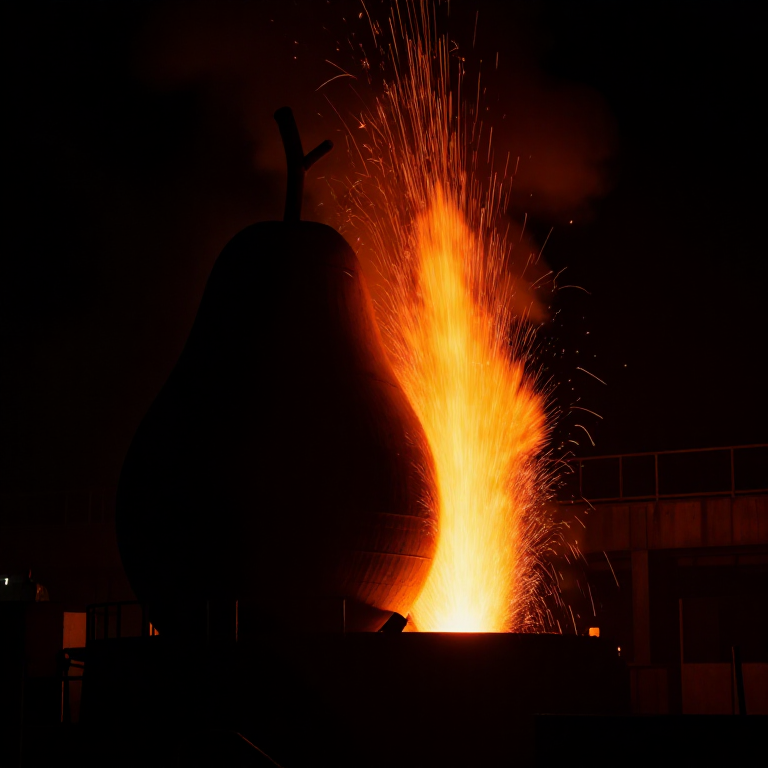


Making Steel in a Bessemer Converter — Mass Steel by Blowing Air Through Iron
Crucible steel was superb but slow, made a few kilograms at a time. In 1856 Henry Bessemer found a way to make steel by the tonne in about twenty minutes, and the price of steel collapsed from a luxury to a commodity. Rails, ships, bridges, and the first steel-framed buildings all became possible almost overnight.
His method sounds reckless: blow cold air straight up through a vessel of molten pig iron. The oxygen in the blast burns out the silicon, manganese, and carbon that make pig iron brittle — and because those reactions give off enormous heat, the metal does not cool but actually gets hotter, staying liquid with no added fuel. A volcano of flame and sparks roars from the converter's mouth while the carbon burns away.
The trick is knowing when to stop. The operator reads the flame, and the instant the carbon is gone, halts the blow and adds back a precise dose of carbon-rich spiegeleisen to hit the exact steel he wants. Tilt, pour, and there is a ladle of molten steel where minutes before there was crude pig iron.
Leiðbeiningar
Understand the converter
Understand the converter
Build and line the converter
Build and line the converter
Efni fyrir þetta skref:
 Eldfastur steinn120 stykki
Nauðsynleg verkfæri:
 Handskófla
Charge molten pig iron
Charge molten pig iron
Efni fyrir þetta skref:
 Hrájárnsstykki100 kg
Start the blast
Start the blast
Nauðsynleg verkfæri:
 Loftblásari
Burn out the impurities
Burn out the impurities
Read the flame
Read the flame
Nauðsynleg verkfæri:
 Lokuð öryggisgleraugu
Stop at the drop
Stop at the drop
Recarburise with spiegeleisen
Recarburise with spiegeleisen
Efni fyrir þetta skref:
 Spiegeleisen8 kg
Handle phosphoric iron
Handle phosphoric iron
Efni fyrir þetta skref:
 Óslökkt kalk10 kg
Pour into the ladle
Pour into the ladle
Nauðsynleg verkfæri:
 Stangamót
Strip and roll
Strip and roll
Nauðsynleg verkfæri:
 Valsavél
Appreciate the impact
Appreciate the impact
Efni
4- 120 stykkiStaðgengill
- 100 kgStaðgengill
- 8 kgStaðgengill
- 10 kgStaðgengill
Nauðsynleg verkfæri
5- Staðgengill
- Staðgengill
- Staðgengill
- Staðgengill
- Staðgengill
Efni úr tengdum teikningum

Þessi teikning býr til
Tengd Blueprint
Þessi blueprint deila þekkingu — tækni, efni eða meginreglur


CC0 opinbert ríki
Þessi teikning er gefin út undir CC0. Þér er frjálst að afrita, breyta, dreifa og nota þetta verk í hvaða tilgangi sem er, án þess að biðja um leyfi.
Studdu smiðinn með því að kaupa vörur í gegnum teikningu hans þar sem hann fær þóknun smiða sem seljendur ákvarða, eða búðu til nýja endurskoðun á þessari teikningu og tengdu hana sem tengingu í þinni eigin teikningu til að deila tekjum.