


Hammering Bronze Sheet from a Cast Ingot — Raising and Planishing
Sheet bronze was the material behind Bronze Age armour, vessels, mirrors, and decorative work. Unlike casting which produces a fixed shape, sheet-working starts with a flat ingot and transforms it through repeated cycles of hammering and annealing into sheets as thin as 0.5 mm — thinner than modern cardboard.
The process exploits a fundamental property of bronze: cold-hammering compresses the crystal grains, making the metal harder and thinner with each blow. But this work-hardening also makes the bronze brittle. Before it cracks, the smith heats it to dull red (annealing), which recrystallises the grain structure and restores ductility. A single ingot may go through 10-15 anneal-hammer cycles to reach usable sheet thickness.
The finished sheet can then be cut, bent, raised into vessels, riveted, engraved, or embossed — opening the full range of Bronze Age metalcraft.
Leiðbeiningar
Cast a flat ingot
Cast a flat ingot
Efni fyrir þetta skref:
 Koparplata500 g
Set up the anvil stone
Set up the anvil stone
Nauðsynleg verkfæri:
 Flöt steinhella
First hammering pass — rough thinning
First hammering pass — rough thinning
Nauðsynleg verkfæri:
 Barsteinn
First anneal
First anneal
Efni fyrir þetta skref:
 Viðarkol2 kg
Nauðsynleg verkfæri:
 Langskefta töng
Continue hammer-anneal cycles
Continue hammer-anneal cycles
Detect and prevent edge cracking
Detect and prevent edge cracking
Final thinning to usable sheet
Final thinning to usable sheet
Planish the surface
Planish the surface
Nauðsynleg verkfæri:
 Sléttur steinn
Polish (optional)
Polish (optional)
Efni fyrir þetta skref:
 Fínn sandur100 g
Efni
3- 500 gStaðgengill
- 2 kgStaðgengill
- 100 gStaðgengill
Nauðsynleg verkfæri
4- Staðgengill
- Staðgengill
- Staðgengill
- Staðgengill
Efni úr tengdum teikningum
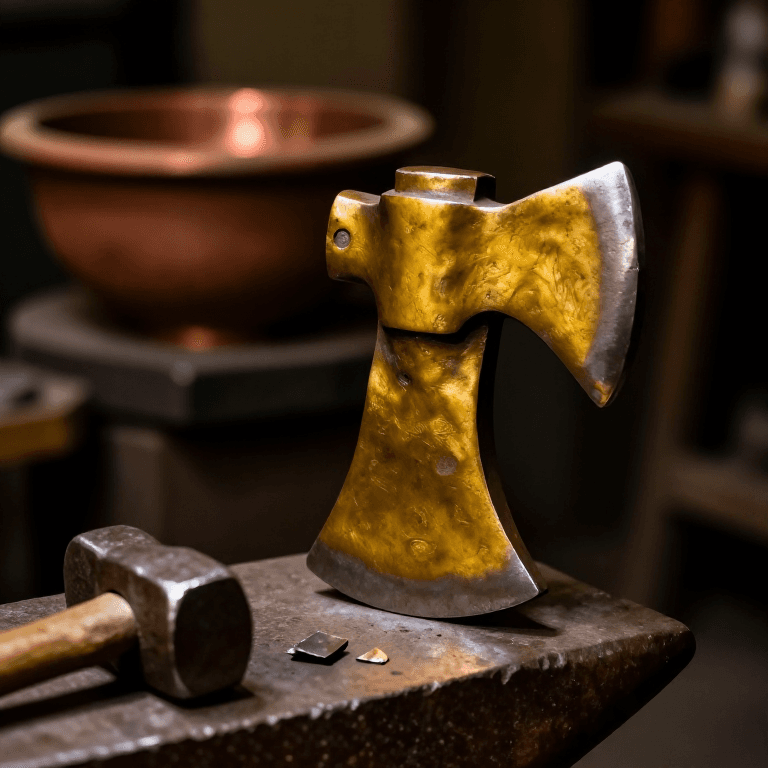
Þessi teikning býr til

Tengd Blueprint
Þessi blueprint deila þekkingu — tækni, efni eða meginreglur
CC0 opinbert ríki
Þessi teikning er gefin út undir CC0. Þér er frjálst að afrita, breyta, dreifa og nota þetta verk í hvaða tilgangi sem er, án þess að biðja um leyfi.
Studdu smiðinn með því að kaupa vörur í gegnum teikningu hans þar sem hann fær þóknun smiða sem seljendur ákvarða, eða búðu til nýja endurskoðun á þessari teikningu og tengdu hana sem tengingu í þinni eigin teikningu til að deila tekjum.