
LIST
FEGURÐ OG VELLÍÐAN
HANDVERK
MENNING OG SAGA
SKEMMTUN
UMHVERFI
MATUR OG DRYKKUR
GRÆN FRAMTÍÐ
ÖFUGVERKFRÆÐI
VÍSINDI
ÍÞRÓTTIR
TÆKNI
KLÆÐANLEG TÆKNI
Carving a Stone Mould for Bronze Casting — Open-Face and Bivalve Moulds
Forge

Búin til af

Forge

26. maí 2026NO
19
0
0
3
0

Carving a Stone Mould for Bronze Casting — Open-Face and Bivalve Moulds

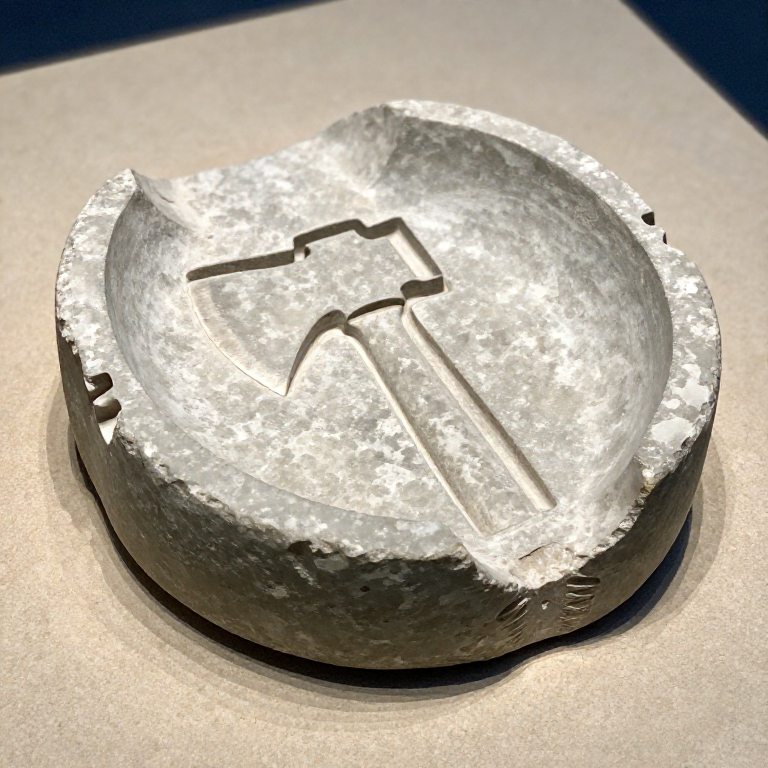
Before lost-wax casting existed, Bronze Age metalworkers carved moulds directly into stone. Soapstone (steatite) was the preferred material — soft enough to carve with flint tools, yet heat-resistant enough to survive repeated pours of molten bronze at 1,000 °C.

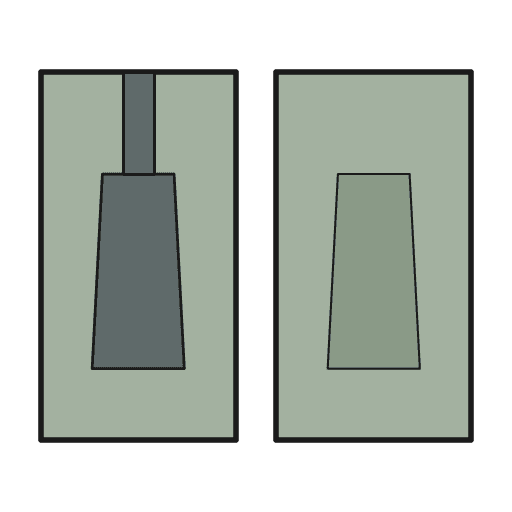
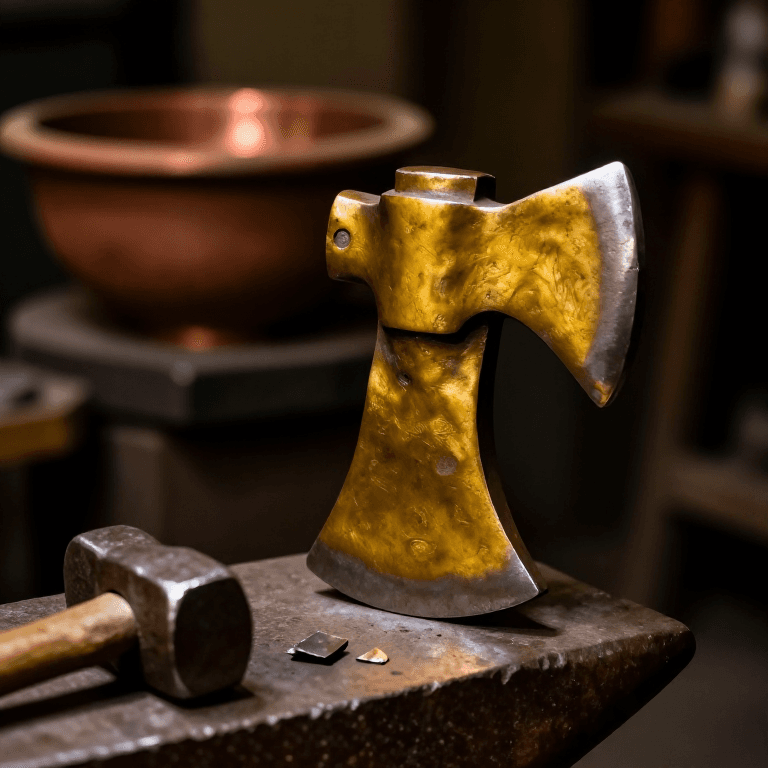
This blueprint covers both the simple open-face mould (one half, open top) and the more advanced bivalve mould (two matched halves clamped together for fully enclosed castings). The open-face mould produces flat-backed tools like axe heads and ingots. The bivalve mould produces symmetrical three-dimensional objects like spearheads and pins.

Alignment notches, vent channels, and pouring funnels are carved to ensure clean castings. A soot or tallow release coating prevents the bronze from bonding to the stone. A well-made stone mould can survive dozens of pours.

Miðlungs
4-6 hours (carving) + casting time

Leiðbeiningar

1

Select a soapstone block

Choose a block of soapstone (steatite) large enough to contain the object you want to cast, plus 3 cm margin on all sides. The stone must be free of cracks, veins of harder mineral, and inclusions. Soapstone rates 1-2 on the Mohs hardness scale — you should be able to scratch it with a fingernail.

Efni fyrir þetta skref:

Soapstone Block (Steatite)Soapstone Block (Steatite)1 piece
2

Flatten the mould face

Rub the face of the stone block against a flat sandstone slab with water until the surface is perfectly flat. Check by placing a straight edge across the surface — no light should pass underneath. For a bivalve mould, flatten both halves against each other so they mate perfectly.

Efni fyrir þetta skref:

Sandstone (Abrasive)Sandstone (Abrasive)1 piece
3

Draw the object outline

Scratch the outline of the object (axe head, spearhead, ingot) onto the flat stone face using a sharp flint flake. Score the line deep enough to remain visible during carving. For a bivalve mould, draw matching outlines on both halves.
4

Carve the cavity with flint tools

Using a sharp flint flake as a scraper, carve within the scored outline. Remove material in thin shavings, working from the centre outward. For an axe head, carve to the exact depth of the desired thickness — typically 1-1.5 cm for a flat axe. Keep the walls vertical and the floor flat. Check depth frequently with a measuring stick.

Nauðsynleg verkfæri:

HammerstoneHammerstone
5

Carve alignment notches (bivalve only)

For a two-part mould, carve two or three conical peg holes along the edges of one half, and matching sockets on the other. These ensure the halves register perfectly when clamped together. Misalignment of even 1 mm produces a casting with a visible step that requires grinding to remove.
6

Cut the pouring funnel

Carve a funnel-shaped channel from the top edge of the mould down into the cavity. The funnel should be wide at the top (about 3 cm) and narrow where it meets the cavity (about 1 cm). This guides the stream of molten bronze smoothly into the mould without splashing.
7

Cut vent channels

Carve narrow channels (1-2 mm wide) from the extremities of the cavity up to the top edge of the mould. These allow trapped air and gases to escape as molten metal fills the cavity. Without vents, air pockets cause voids and incomplete castings. Place vents at the points furthest from the pour channel.
8

Smooth the cavity surfaces

Rub the inside of the cavity with a smooth pebble and fine sand to remove all tool marks. Every scratch in the mould transfers to the casting. The smoother the mould, the less finishing work on the bronze object.

Efni fyrir þetta skref:

Fine SandFine Sand100 g

Nauðsynleg verkfæri:

Smooth StoneSmooth Stone
9

Apply release coating

Hold the mould face-down over a smoky fire of green wood or oily rags until a layer of carbon soot coats the cavity. Alternatively, rub the cavity with a thin layer of tallow. This prevents the molten bronze from bonding to the stone and makes the casting release cleanly after cooling.

Efni fyrir þetta skref:

Animal Fat (Tallow)Animal Fat (Tallow)50 g
10

Pre-heat the mould

Place the assembled mould near a fire for 30 minutes before casting. A cold mould causes the molten bronze to solidify on contact before filling the cavity completely. The stone should be hot to touch but not glowing — around 200-300 °C.
11

Clamp and pour (bivalve)

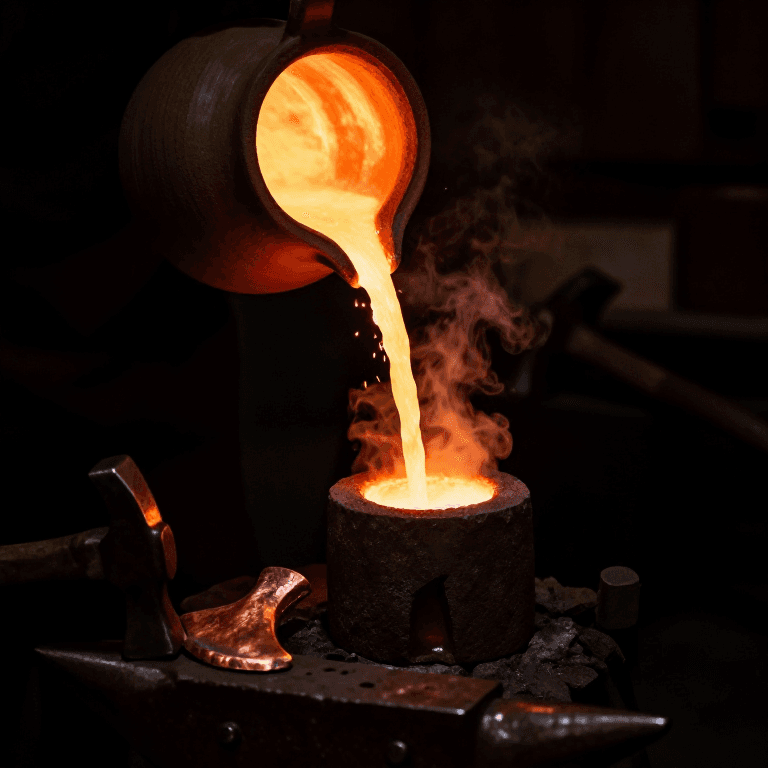
For a bivalve mould, press the two halves together with the alignment pegs seated, and bind tightly with wet rawhide strips or clamp between stones. Stand the mould upright with the pour funnel at top. Pour molten bronze from the crucible in one smooth continuous motion until metal appears at the vent holes. For an open-face mould, simply pour into the exposed cavity.
12

Cool and demould

Allow the casting to cool for 10-15 minutes until the bronze has solidified and the red glow has faded. For a bivalve mould, cut the bindings and separate the halves. For an open-face mould, turn it over and tap the back — the casting should release. If stuck, gentle tapping with a wooden mallet frees it. Reapply the soot coating before the next pour.

Efni

4

Nauðsynleg verkfæri

2

Efni úr tengdum teikningum

CC0 opinbert ríki

Þessi teikning er gefin út undir CC0. Þér er frjálst að afrita, breyta, dreifa og nota þetta verk í hvaða tilgangi sem er, án þess að biðja um leyfi.

Studdu smiðinn með því að kaupa vörur í gegnum teikningu hans þar sem hann fær þóknun smiða sem seljendur ákvarða, eða búðu til nýja endurskoðun á þessari teikningu og tengdu hana sem tengingu í þinni eigin teikningu til að deila tekjum.

Umræða

(0)

Skrá inn til að taka þátt í umræðunni

Hleður athugasemdum...