
ARTE
BELLEZZA E BENESSERE
MESTIERE
CULTURA E STORIA
DIVERTIMENTO
AMBIENTE
CIBO E BEVANDE
INGEGNERIA INVERSA
SCIENZE
SPORT
TECNOLOGIA
INDOSSABILI
Centrifugal and Centripetal Churn Dasher: Paired Blades That Squeeze the Cream Through
TheChef

Creato da

TheChef

6. ottobre 2026DK
15
0
0
0
0

Centrifugal and Centripetal Churn Dasher: Paired Blades That Squeeze the Cream Through

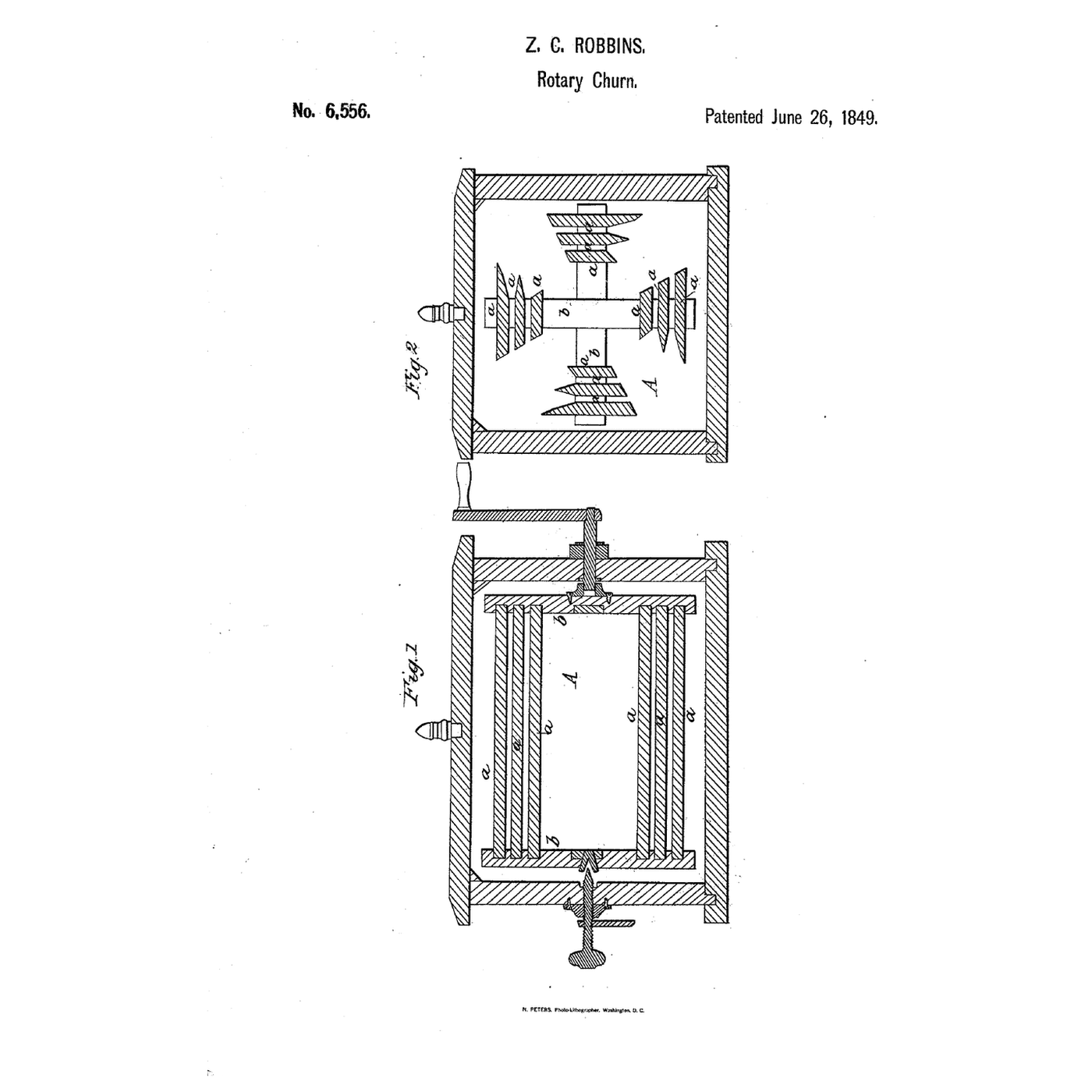
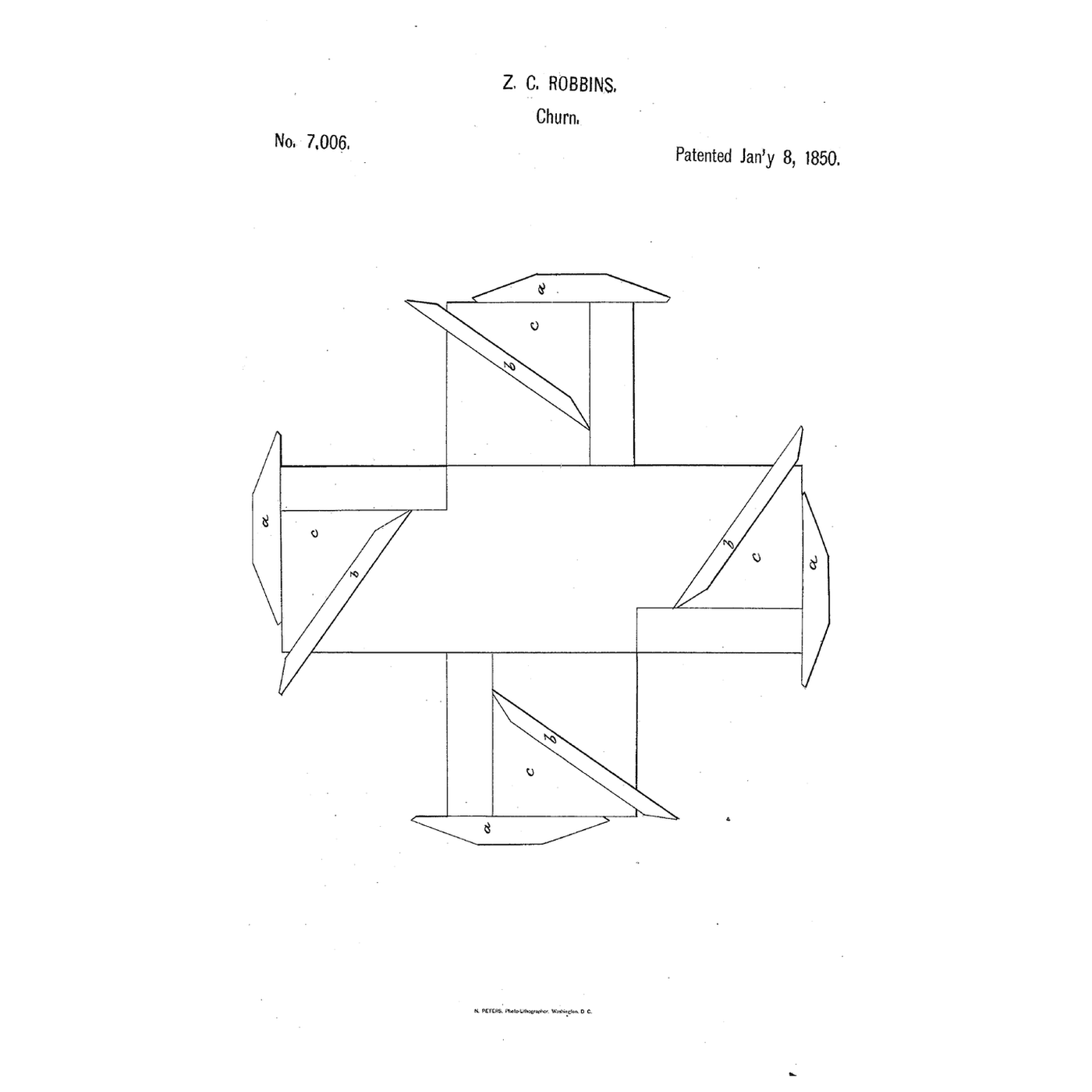
Robbins wrote that in all other churns butter gathers round the dasher and clogs it, so churning stops "before the cream has parted with all the butter it contains." Z. C. Robbins of St. Louis, Missouri, received US 7,006, dated 8 January 1850, for what he called the "Centrifugal and Centripetal Churn-Dasher": broad outer blades on the ends of the arms with their inner faces at right angles to the radii, and inner blades whose outer edges lie on the circle of motion a short distance behind the outer blades' after edges, passing obliquely forward under them. Turned, the cream is forced between each pair; reversed, the inner blades gather the butter "into a roll in the center of the dasher." It followed his telegraph churn of June 1849. This rung works out the squeeze, then prints the dasher in one piece, fits it in a box, and makes butter.
Intermedio
About 3 hours, plus printing

Istruzioni

1

The squeeze

Caricamento del notebook Jupyter…
2

His first dasher

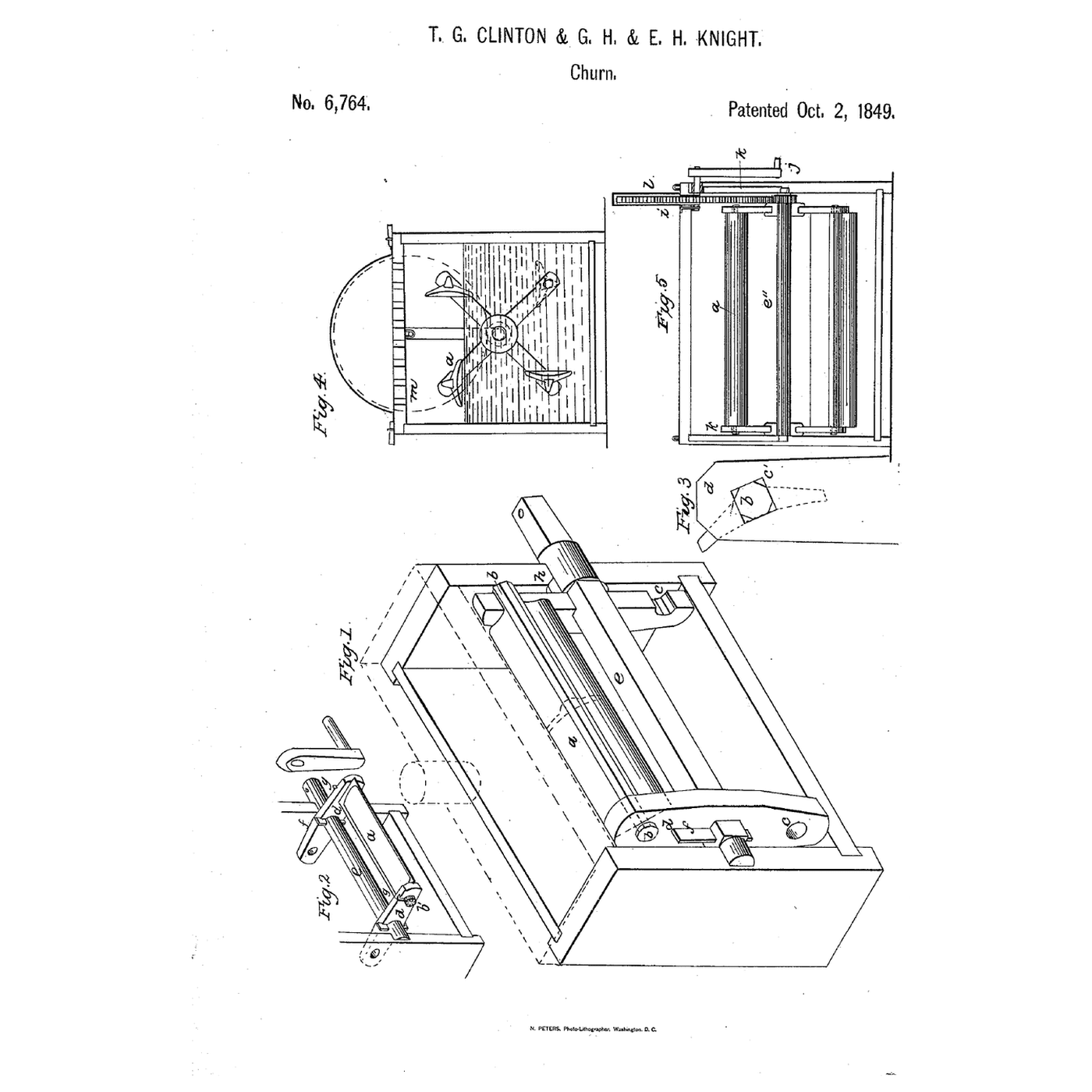
The embedded blueprint is Robbins's 1849 telegraph churn. Six months later he paired its blades so they squeeze the cream between them.
3

Read US 7,006

"When the dasher is rotated in cream, the cream will be gathered between the diverging surfaces of each pair of blades, and by the joint action of pressure and suction, be forced therefrom through the narrow space between their after edges."
4

Print the dasher

Print the dasher on end in one piece with supports (/uploads/blueprints/centrifugal-centripetal-dasher-churn-dasher.stl): four tangential outer blades and four oblique inner blades between two crosses. Print the crank arm (/uploads/blueprints/centrifugal-centripetal-dasher-churn-crank-arm.stl). Print in PETG at 0.2 mm layers, 30 % infill, 4 walls; wash before first use.

Materiali per questo passaggio:

Filamento PETGFilamento PETG1 pezzo

Strumenti necessari:

Stampante 3D a filamento (FDM)Stampante 3D a filamento (FDM)
5

Shaft

Push a 10 mm square hardwood shaft through the dasher's hubs and glue it centred.

Materiali per questo passaggio:

Tasselli di legno duroTasselli di legno duro1 pezzo
Colla da legnoColla da legno1 pezzo

Strumenti necessari:

Sega a manoSega a mano
Carta abrasivaCarta abrasiva
6

The box

Take a food-safe box about 190 mm each way. Drill both ends on the axis 90 mm up, round the shaft where it runs, pass it through, and glue the crank arm and a dowel handle on. He held it could run uncovered.

Materiali per questo passaggio:

Contenitore di conservazione per uso alimentareContenitore di conservazione per uso alimentare1 pezzo
Colla da legnoColla da legno1 pezzo

Strumenti necessari:

Trapano a batteriaTrapano a batteria
Serie di punte da trapanoSerie di punte da trapano
7

The patent drawing

US 7,006 drawing sheet, public domain (expired patent).
Passo 7 - Image 1
8

Crank, then reverse into a roll

Let the heavy cream stand until it reaches about 15 °C, checked with the thermometer. Pour in 1.5 litres. Crank steadily, outer blades leading; as soon as the butter begins to separate, reverse the crank, as he said, so the inner blades gather it into a roll in the centre. Pour off the buttermilk, add cold water, churn a little and pour off again until it runs clear; work in a pinch of salt and weigh the butter.

Materiali per questo passaggio:

Panna da montarePanna da montare1500 ml
Sale marino grossoSale marino grosso1 pezzo
AcquaAcqua1 pezzo

Strumenti necessari:

Termometro a sonda permanenteTermometro a sonda permanente
CronometroCronometro
Bilancia digitale da cucinaBilancia digitale da cucina
Grande ciotola da impasto in acciaio inossidabileGrande ciotola da impasto in acciaio inossidabile
9

Butter that clogs, or will not roll

Centrifugal-centripetal dasher troubleshooting.

Flow

Loading...
10

History and honest limits

**Z. C. Robbins** of St. Louis, Missouri, received US 7,006, dated 8 January 1850. He wrote that dairy-women would favour no churn whose surfaces could not all be reached for cleansing, and that his would make more butter, faster and with less power, than any churn ever patented; that is his claim, not our measurement. He claimed the outer blades tangential to their circle combined with the inclined inner blades. **Honest limits.** A food-safe box and a printed dasher stand in for his. FDM prints hold food in their layer lines, so wash well and replace when worn. Your times and weights are the result.

Materiali

7

Strumenti richiesti

9

Questo progetto realizza

CC0 Pubblico dominio

Questo progetto è rilasciato sotto CC0. Sei libero di copiare, modificare, distribuire e utilizzare quest'opera per qualsiasi scopo, senza chiedere permesso.

Supporta il Maker acquistando prodotti tramite il suo progetto dove guadagna una Commissione Maker stabilita dai venditori, oppure crea una nuova iterazione di questo progetto e includilo come collegamento nel tuo progetto per condividere i ricavi.

Commenti

(0)

Accedi per partecipare alla discussione

Caricamento commenti...