
ARTE
BELLEZZA E BENESSERE
MESTIERE
CULTURA E STORIA
DIVERTIMENTO
AMBIENTE
CIBO E BEVANDE
INGEGNERIA INVERSA
SCIENZE
SPORT
TECNOLOGIA
INDOSSABILI
Hydrothermal Reservoir Dasher Churn: Warm Water in the Dasher to Churn, Cold to Firm the Butter
Karen

Creato da

Karen

6. ottobre 2026SE
34
0
0
0
0

Hydrothermal Reservoir Dasher Churn: Warm Water in the Dasher to Churn, Cold to Firm the Butter

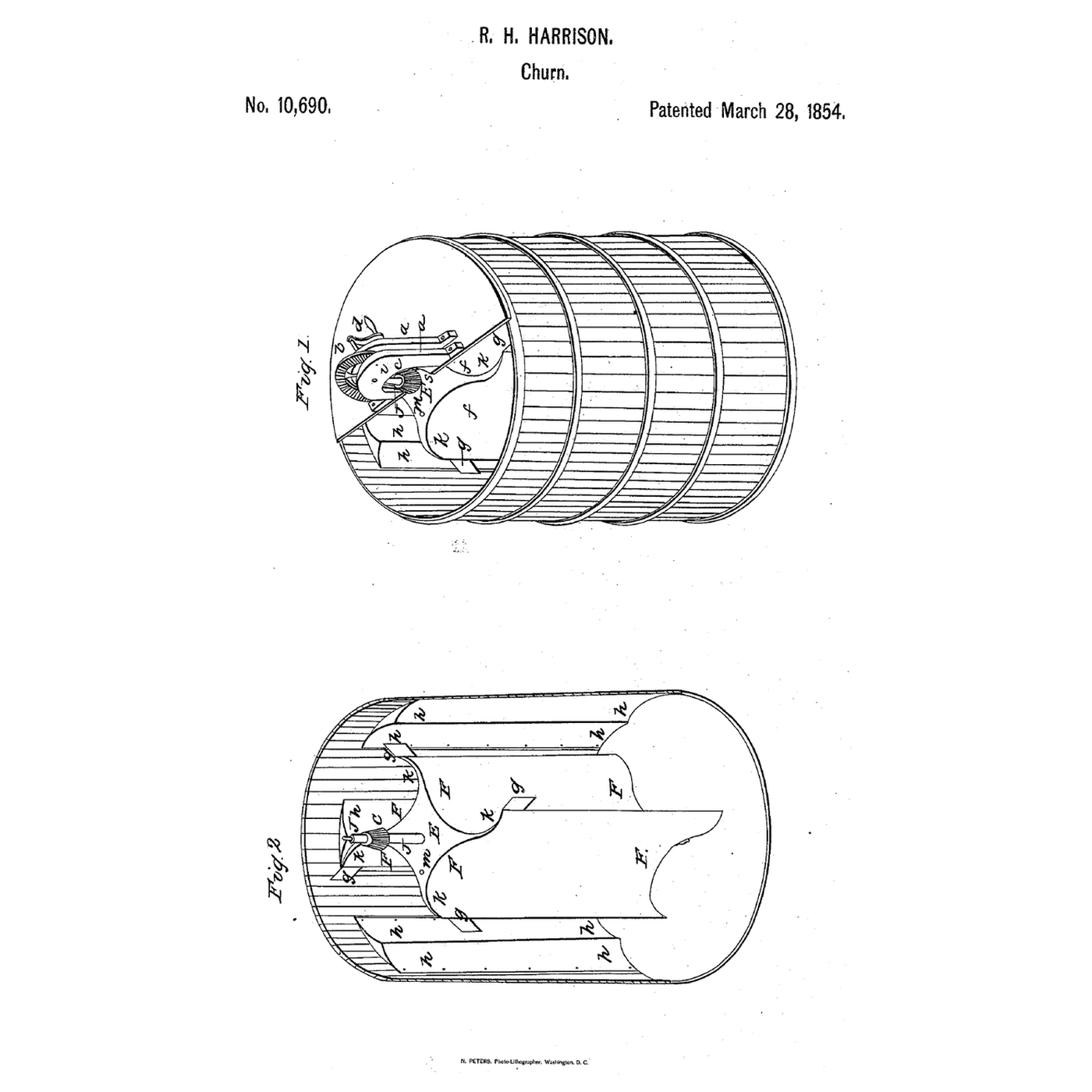
Harrison carried the water to temper the cream inside the dasher itself. Robert H. Harrison of Washington, District of Columbia, assignor to R. H. Harrison and Jno. S. Gallaher, Jr., received US 10,690, dated 28 March 1854, for what he termed "the hydrothermal churn": a vertical "concavo-convex rotary reservoir dasher having hollow, deflective, or curved radial chambers" and straight radial wings, turned by a winch through a driving wheel and bevel gear, with "double concave vertically arranged cleats or butter gatherers" of tin round the vessel's inside, which can hold water too. Hot water poured in through a hole in the dasher tempers the cream; once the butter appears, cold water substituted for it firms the butter, and in hot weather cold water or pounded ice goes in. This rung works out how far the dasher's water can move the cream's temperature, then prints the reservoir dasher, gatherers and gears, builds the churn, and makes butter.
Intermedio
About 4 hours, plus printing

Istruzioni

1

Water in the dasher

Caricamento del notebook Jupyter…
2

Tempering the cream with water before it

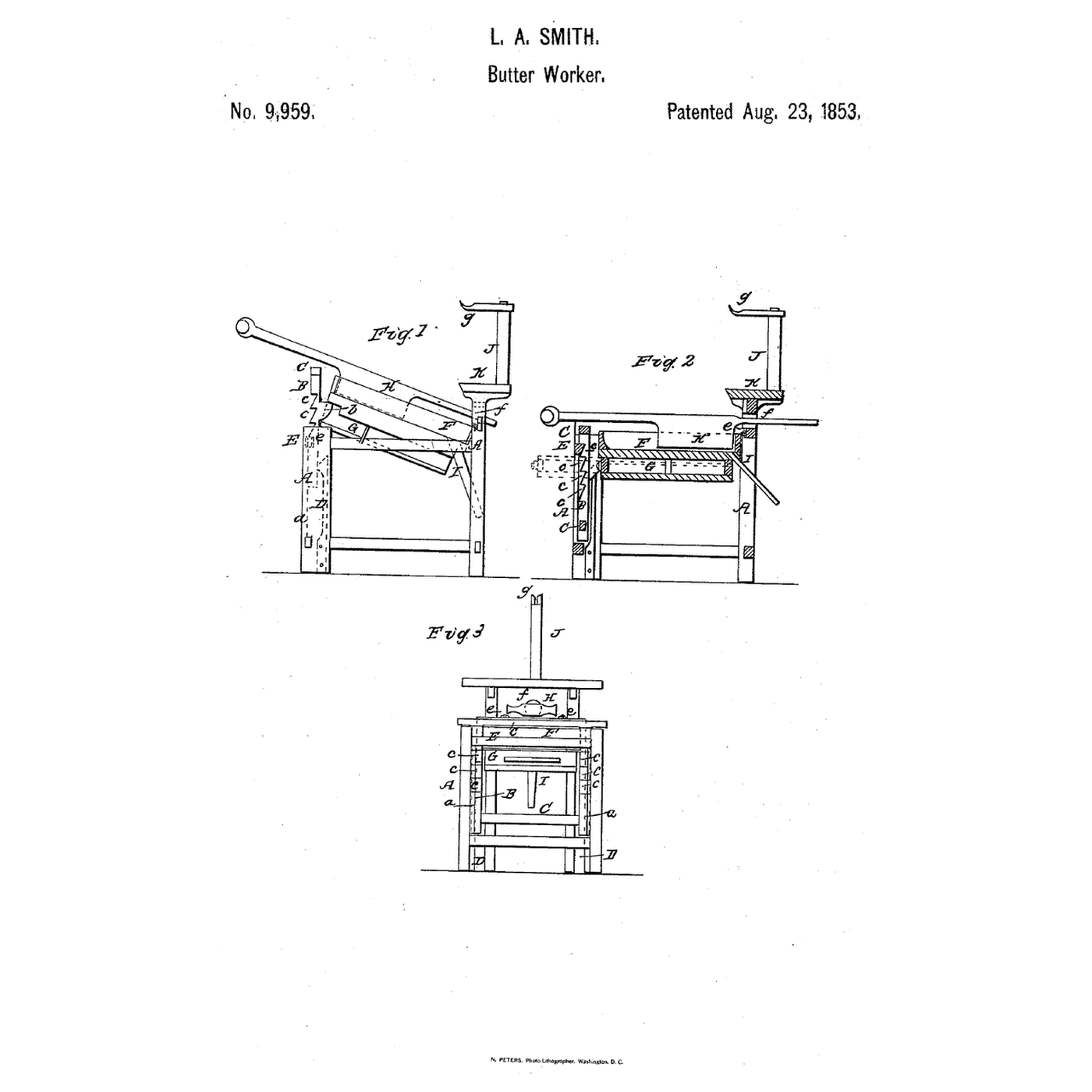
The embedded blueprint puts hot or cold water in a chamber under the churn. Harrison puts it inside the dasher and the side gatherers, where it turns through the cream.
3

Read US 10,690

"These particles are not spontaneously accumulated in concrete mass, but by the aid of cold water substituted in lieu of the warm water, which is withdrawn from the dasher by detaching the dasher from the churn vessel, the concave gatherers F, F, F, F, and h, h, h, h augmenting the concretion and forming the mass of butter without requiring much, if any, additional agency."
4

Print the parts

Print the hollow reservoir dasher with its four curved chambers, wings and filling hole (/uploads/blueprints/hydrothermal-reservoir-dasher-churn-reservoir-dasher.stl) standing up with 4 walls so it holds water, three or four hollow gatherers (/uploads/blueprints/hydrothermal-reservoir-dasher-churn-gatherer.stl), the 36-tooth crown wheel (/uploads/blueprints/hydrothermal-reservoir-dasher-churn-crown-wheel.stl), the 12-tooth pinion (/uploads/blueprints/hydrothermal-reservoir-dasher-churn-pinion.stl) and the standard (/uploads/blueprints/hydrothermal-reservoir-dasher-churn-standard.stl). Fill the dasher and gatherers with water and check for leaks before use. Print in PETG at 0.2 mm layers, 30 % infill, 4 walls; wash before first use.

Materiali per questo passaggio:

Filamento PETGFilamento PETG1 pezzo

Strumenti necessari:

Stampante 3D a filamento (FDM)Stampante 3D a filamento (FDM)
5

Vessel and gatherers

Use a straight-sided round food-grade container about 190 mm across inside and 200 mm deep. Hook the gatherers over its rim, spaced round the side, their double-concave faces inward.

Materiali per questo passaggio:

Contenitore di conservazione per uso alimentareContenitore di conservazione per uso alimentare1 pezzo

Strumenti necessari:

Carta abrasivaCarta abrasiva
6

Dasher, gears and winch

Slide the reservoir dasher onto a 10 mm stainless rod and tighten its set screw, its foot standing in a shallow hole in a scrap of the lid laid in the bottom. Fix half the lid over the vessel with a hole for the rod, the pinion on the rod's top, and the standard with the crown wheel meshing it; screw a dowel handle into the wheel's boss. Fit a cork to the filling hole.

Materiali per questo passaggio:

Tondo di acciaio dolceTondo di acciaio dolce1 pezzo
Tappi di sugheroTappi di sughero1 pezzo
Tasselli di legno duroTasselli di legno duro1 pezzo
Vite da legno #8 x 1"Vite da legno #8 x 1"1 pezzo
Viti da metalloViti da metallo1 pezzo

Strumenti necessari:

Seghetto per metalliSeghetto per metalli
Trapano a batteriaTrapano a batteria
Serie di punte da trapanoSerie di punte da trapano
Set di cacciavitiSet di cacciaviti
7

The build in 3D

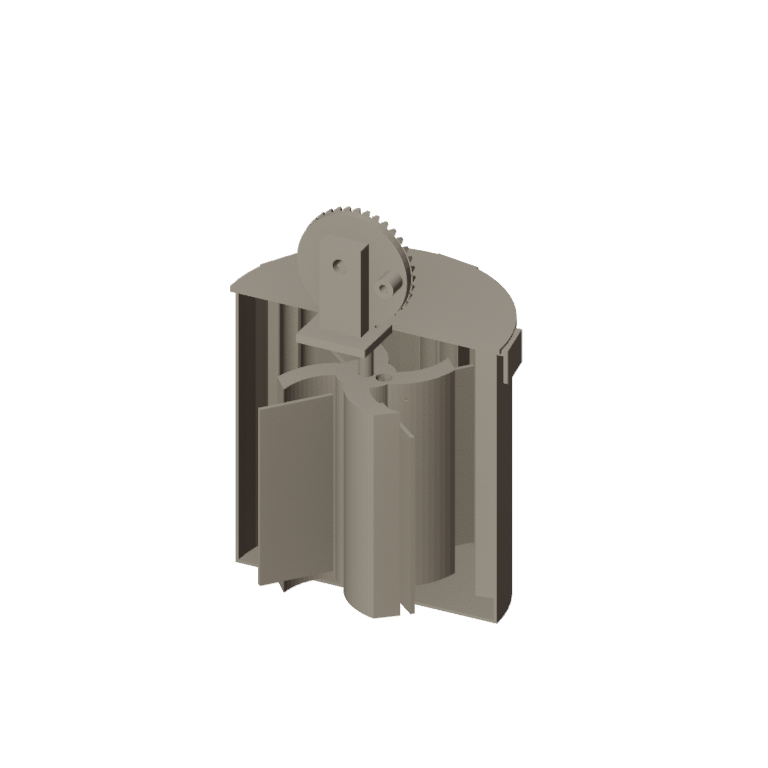
FreeCAD model of this build, not of the patent: the vessel cut away to show the hollow reservoir dasher with its four curved chambers and wings, the hollow gatherers hooked over the rim, and the crown wheel and pinion on the half lid.
File di designBLENDCC0 - Free
8

Temper, churn, then firm

Check the cream's temperature. If it is below about 15 °C, fill the dasher with lukewarm water, cork it and stir slowly until the cream reaches about 15 °C; if it is above, use cold water. Pour in 1.5 litres and turn the winch at a moderately rapid rate; time until the butter comes. Lift out the dasher, empty it, refill it with cold water or ice and water, and turn slowly to gather the butter. Pour off the buttermilk, add cold water, churn a little and pour off again until it runs clear; work in a pinch of salt and weigh the butter.
Passo 8 - Image 1

Materiali per questo passaggio:

Panna da montarePanna da montare1500 ml
Cubetti di ghiaccioCubetti di ghiaccio1 pezzo
Sale marino grossoSale marino grosso1 pezzo
AcquaAcqua1 pezzo

Strumenti necessari:

Termometro a sonda permanenteTermometro a sonda permanente
CronometroCronometro
Bilancia digitale da cucinaBilancia digitale da cucina
Grande ciotola da impasto in acciaio inossidabileGrande ciotola da impasto in acciaio inossidabile
9

A dasher that leaks, cream that will not warm

Hydrothermal churn troubleshooting.

Flow

Loading...
10

History and honest limits

**Robert H. Harrison** of Washington, District of Columbia, assignor to R. H. Harrison and Jno. S. Gallaher, Jr., received US 10,690, dated 28 March 1854. He wrote that turning for "3 to 5 minutes" is all that is required for the separation, that fresh milk can be used, and that the wings act "as coolers or fans" drawing cool air in through a vent round the spindle; these are his claims, not tested here. He claimed the vessel with double concave gatherers or water reservoirs, the reservoir dasher with curved chambers and radial wings combined with them, and the double application of warm and cold water or ice with both; he did not claim the use of hot or cold water alone in butter making, "as the same have been employed separately, or distinctly heretofore." **Honest limits.** A container, printed parts and a crown wheel with a spur pinion stand in for his tin and bevel gearing. PETG softens at about 55–60 °C, so we use lukewarm water rather than hot. The notebook's temperatures are upper bounds with an estimated specific heat. FDM prints hold food in their layer lines, so wash well and replace when worn. Your times and weights are the result.

Materiali

11

Strumenti richiesti

10

File di progetto

1

Questo progetto realizza

CC0 Pubblico dominio

Questo progetto è rilasciato sotto CC0. Sei libero di copiare, modificare, distribuire e utilizzare quest'opera per qualsiasi scopo, senza chiedere permesso.

Supporta il Maker acquistando prodotti tramite il suo progetto dove guadagna una Commissione Maker stabilita dai venditori, oppure crea una nuova iterazione di questo progetto e includilo come collegamento nel tuo progetto per condividere i ricavi.

Commenti

(0)

Accedi per partecipare alla discussione

Caricamento commenti...