ARTE
BELLEZZA E BENESSERE
MESTIERE
CULTURA E STORIA
DIVERTIMENTO
AMBIENTE
CIBO E BEVANDE
INGEGNERIA INVERSA
SCIENZE
SPORT
TECNOLOGIA
INDOSSABILI


Oscillating Paddle Churn: Oblique Paddles Swung to and Fro by a Strap
A rotary dasher carries the cream round the churn; Thomson wanted it thrown in and out as well.
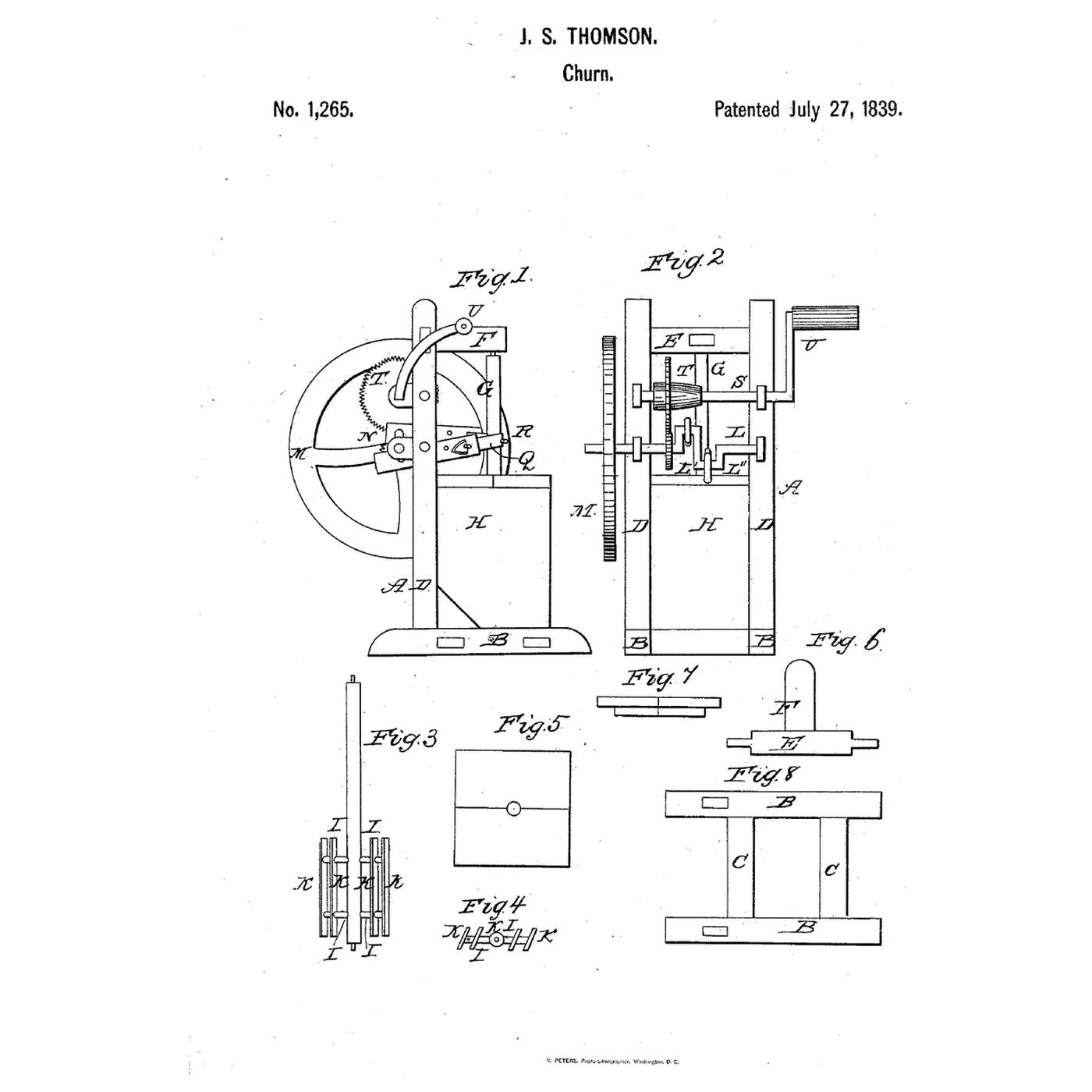
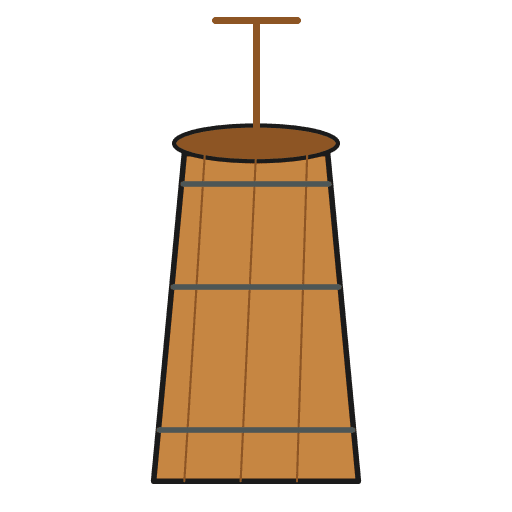
John S. Thomson of Luzerne County, Pennsylvania, received US 1,265, dated 27 July 1839, for a churn whose upright dasher carries four vertical paddles set obliquely on horizontal parallel arms, "so that they shall force the cream when moving in one direction from the center to the circumference of the churn and when turned in an opposite direction or returning throw it back toward the center." A double crank works two pitmen joined by a leather strap round the dasher shaft, and a nail through the strap gives "the vibratory motion of the dasher."
This rung sizes the crank for a half turn, then prints the dasher, strap drum and double crank, builds the frame, and makes butter.
Avanzato
About 6 hours, plus printing
Istruzioni
1
1
Crank throw and paddle push
Crank throw and paddle push
Caricamento del notebook Jupyter…
2
2
Oblique paddles before them
Oblique paddles before them
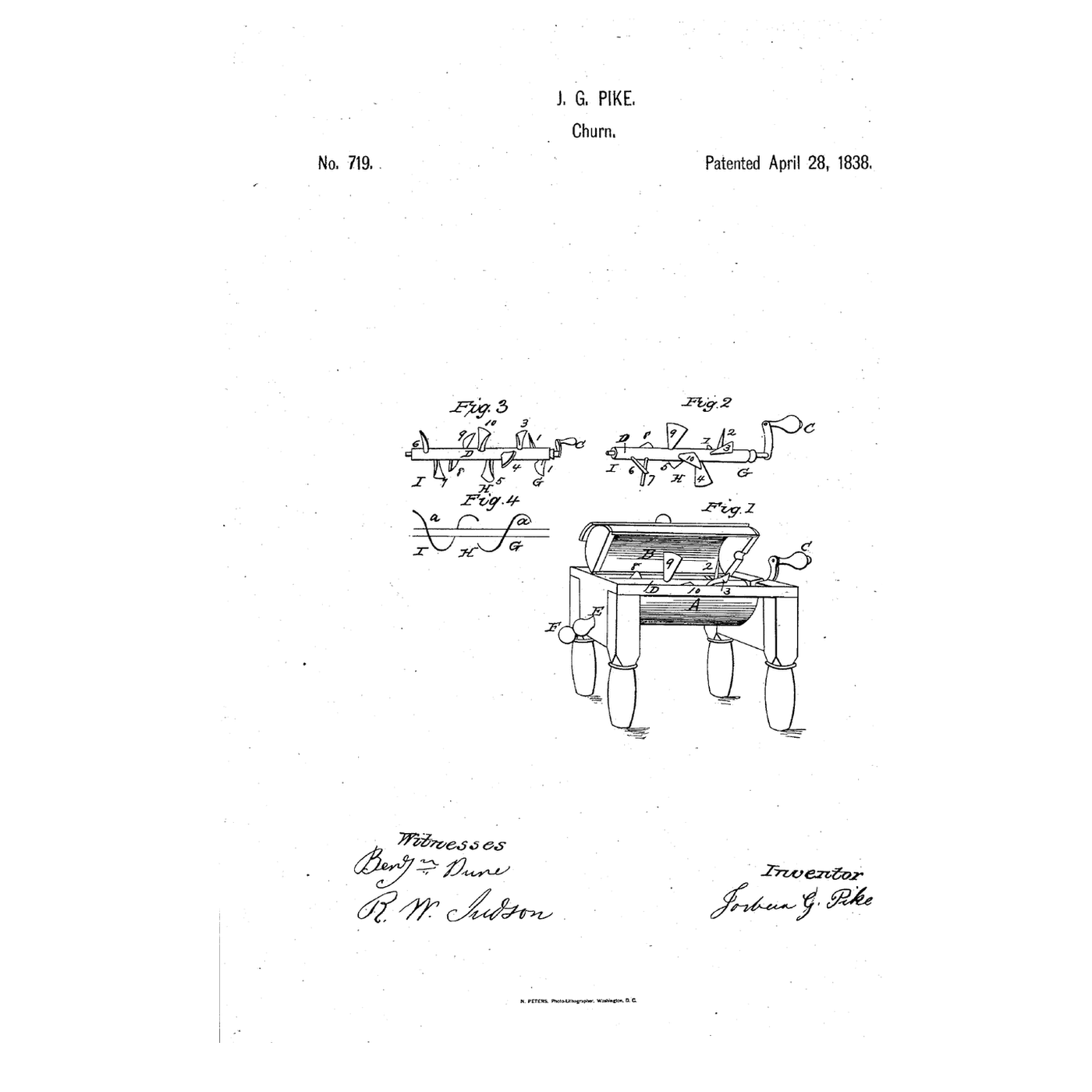
The embedded blueprint sets paddles obliquely on a turning shaft to move the cream along a cylinder. Thomson sets them obliquely on arms of an upright dasher and swings it back and forth.
3
3
Read US 1,265
Read US 1,265
"The dasher consists of an upright shaft with two or three arms I placed above each other as the size of the churn may require, passing horizontally through it in the same direction and low enough to be within the churn, to which horizontal parallel arms I I are fastened four vertical parallel boards or paddles K, two on one side of the shaft G and two on the opposite side. They are fastened to the arms obliquely at any required angle suitable for producing the intended effect."
4
4
Print the parts
Print the parts
Print the dasher standing on its lower arm (/uploads/blueprints/oscillating-paddle-churn-dasher.stl): four paddles at 45° to the arms. Print the strap drum (/uploads/blueprints/oscillating-paddle-churn-drum.stl), the double crank with its two opposite pins (/uploads/blueprints/oscillating-paddle-churn-double-crank.stl), the pivot cup (/uploads/blueprints/oscillating-paddle-churn-pivot-cup.stl) and the crank arm (/uploads/blueprints/oscillating-paddle-churn-crank-arm.stl). Print in PETG at 0.2 mm layers, 30 % infill, 4 walls; wash before first use.
Materiali per questo passaggio:
 Filamento PETG1 pezzo
Strumenti necessari:
 Stampante 3D a filamento (FDM)
5
5
Build the frame
Build the frame
Join two pine sills with two cross pieces and stand two posts 330 mm tall at one end, joined at the top by a rail. Fix an arm from the middle of the rail reaching over the churn's centre. Drill both posts for a 12 mm dowel crankshaft 70 mm above the churn's top.
Materiali per questo passaggio:
 Tavola di pino1 pezzo
 Vite da legno #8 x 1"1 pezzo
 Colla da legno1 pezzo
Strumenti necessari:
 Sega a mano
 Trapano a batteria
 Serie di punte da trapano
 Set di cacciaviti
 Morsetti
 Metro a nastro
6
6
Dasher, strap and pitmen
Dasher, strap and pitmen
Set a food-safe box about 150 mm square under the arm and screw the pivot cup to its floor. Slide the dasher and the drum onto a 10 mm square hardwood shaft, drive a nail into each end as pivots, and stand it in the cup and the arm's hole through the lid. Glue the double crank and the crank arm on the dowel crankshaft. Cut two pine pitmen to reach from the crank pins to the drum. Pass a leather strip once round the drum, nail it through to the drum, and fasten one end to each pitman.
Materiali per questo passaggio:
 Contenitore di conservazione per uso alimentare1 pezzo
 Tasselli di legno duro1 pezzoTavola di pino1 pezzo
 Striscia di pelle1 pezzo
 Chiodi1 pezzoColla da legno1 pezzoVite da legno #8 x 1"1 pezzo
Strumenti necessari:
Sega a manoTrapano a batteriaSerie di punte da trapano Martello
 Kit di seghe a tazza
7
7
The patent drawing
The patent drawing
US 1,265 drawing sheet, public domain (expired patent).
8
8
Crank and make butter
Crank and make butter
Let the heavy cream stand until it reaches about 15 °C, checked with the thermometer. Pour in 500 ml and fit the lid. Turn the handle steadily: the dasher swings half a turn each way. Time until the butter comes. Pour off the buttermilk, add cold water, churn a little and pour off again until it runs clear; work in a pinch of salt and weigh the butter.
Materiali per questo passaggio:
 Panna da montare500 ml
 Sale marino grosso1 pezzo
 Acqua1 pezzo
Strumenti necessari:
 Termometro a sonda permanente
 Cronometro
 Bilancia digitale da cucina
 Grande ciotola da impasto in acciaio inossidabile
9
9
A dasher that turns too far, a strap that slips
A dasher that turns too far, a strap that slips
Oscillating paddle churn troubleshooting.
Flow
Loading...
10
10
History and honest limits
History and honest limits
**John S. Thomson** of Luzerne County, Pennsylvania, received US 1,265, dated 27 July 1839. His frame was of timber about two inches square, with sills about eighteen inches long and posts about three feet high. A balance wheel about 2 feet across and about 16 pounds steadied the crankshaft. A 9-inch cog wheel with a crank and handle, on a shaft above, drove a 3-inch wheel on the crankshaft. "The size of this machine in all its parts may be varied and made larger or smaller as required, preserving, however, all the proportions."
**Honest limits.** A food-safe box and printed parts stand in for his churn and dasher. Our handle turns the double crank directly, without his cog wheels or balance wheel. FDM prints hold food in their layer lines, so wash well and replace when worn. Your times and weights are the result.
Materiali
11- 1 pezzoSegnaposto
- 1 pezzoSegnaposto
- 2 pezziSegnaposto
- 2 pezziSegnaposto
- Segnaposto
- 1 pezzoSegnaposto
- 1 pezzoSegnaposto
- 1 pezzoSegnaposto
- 500 mlSegnaposto
- 1 pezzoSegnaposto
- 1 pezzoSegnaposto
Strumenti richiesti
13- Segnaposto
- Segnaposto
- 1 vendor sell this, none ship to you yetSegnaposto
- Segnaposto
- Segnaposto
- Segnaposto
- 1 vendor sell this, none ship to you yetSegnaposto
- Segnaposto
- Segnaposto
- Segnaposto
- Segnaposto
- Segnaposto
Questo progetto realizza
Blueprint correlati
Questi blueprint condividono conoscenze — tecniche, materiali o principi


CC0 Pubblico dominio
Questo progetto è rilasciato sotto CC0. Sei libero di copiare, modificare, distribuire e utilizzare quest'opera per qualsiasi scopo, senza chiedere permesso.
Supporta il Maker acquistando prodotti tramite il suo progetto dove guadagna una Commissione Maker stabilita dai venditori, oppure crea una nuova iterazione di questo progetto e includilo come collegamento nel tuo progetto per condividere i ricavi.