
Carbon Arc Welding
An electric arc is the hottest thing a nineteenth-century workshop could produce — far hotter than any furnace, hot enough to melt iron on contact. The arc lamp had been lighting streets since the 1870s, so the heat was well known. What was not obvious was that you could point it at a seam and use it as a tool.
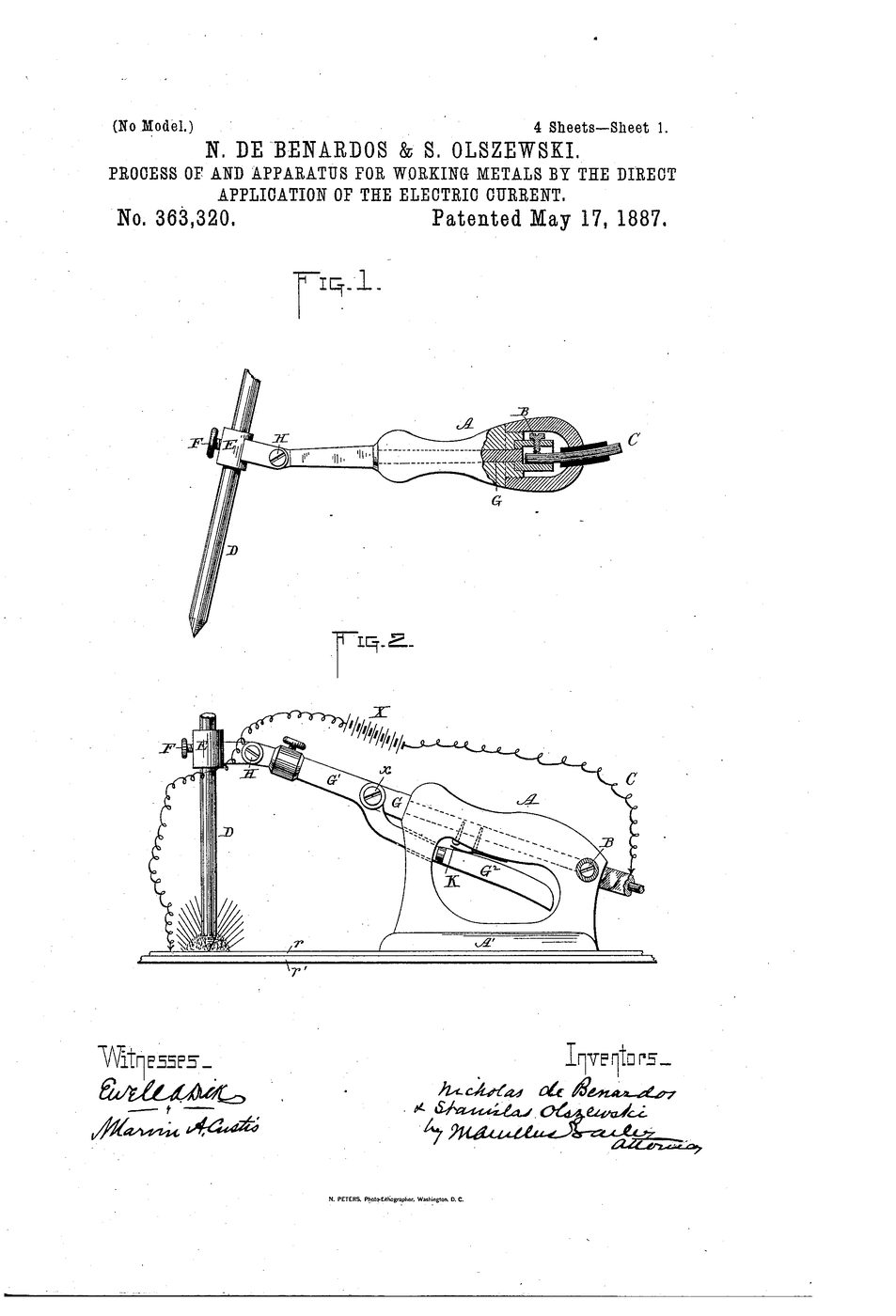
Nikolai Bernardos and Stanisław Olszewski patented the idea as US 363,320, “Process of and Apparatus for Working Metals by the Direct Application of the Electric Current”, granted 17 May 1887. They called the process Elektrogefest — electric Hephaestus, after the smith of the gods. The electrode is a carbon rod; the arc runs between that rod and the work, and any filler metal is fed in separately by the other hand, exactly as a gas welder does.
Two names, and the second one usually disappears. The signature block on the patent drawing reads “Nicholas de Benardos & Stanislas Olszewski”. Olszewski was a Polish engineer who worked with Bernardos and helped finance the patents; almost every retelling credits Bernardos alone. This blueprint names both.
What follows measures the arc rather than welding with it: its voltage, its length, and the relationship between the two that every later welding machine is built to exploit.
手順
Read the safety step before anything else
Read the safety step before anything else
Go to step 12 and read it now. An arc will damage your eyes before you decide it is bright. Nothing in this blueprint is worth an injury.
Set the work up on firebrick
Set the work up on firebrick
Lay two firebricks on a clear bench. Put the steel plate on them. Nothing flammable within two metres, and no bystanders without a helmet.
このステップの材料:
 軟鋼板1 個
 耐火れんが2 個
Clamp the return lead to the work
Clamp the return lead to the work
Clamp the return lead directly to the steel plate. A poor return connection makes its own arc where you are not looking.
このステップの材料:
軟鋼板1 個必要な工具:
 C 型クランプ
Fit the carbon electrode and dress its tip
Fit the carbon electrode and dress its tip
Fit the graphite electrode in the holder. Grind the tip to a blunt cone about 30 mm long. A sharp point burns back immediately.
このステップの材料:
 黒鉛電極1 個
必要な工具:
 卓上グラインダー
Put the helmet on and check it darkens
Put the helmet on and check it darkens
Put on the auto-darkening helmet, gloves and covered clothing. Test the lens on a bright lamp before striking anything.
必要な工具:
 自動遮光溶接面
 革手袋
革手袋Strike the arc by scratching, not tapping
Strike the arc by scratching, not tapping
Draw the electrode across the plate like a match and lift 3 mm. Tapping straight down sticks the electrode and stalls the supply.
このステップの材料:
軟鋼板1 個黒鉛電極1 個必要な工具:
自動遮光溶接面Measure the arc voltage at a short arc
Measure the arc voltage at a short arc
Hold roughly 2 mm and have a second person read the voltage across the leads. Record it. Expect a low reading, in the region of twenty volts.
必要な工具:
 アナログマルチメータ自動遮光溶接面
Measure it again at a long arc
Measure it again at a long arc
Hold roughly 6 mm and read again. The voltage rises with length. This is the arc's volt-ampere characteristic, measured directly.
必要な工具:
アナログマルチメータ自動遮光溶接面Plot voltage against arc length
Plot voltage against arc length
Plot the readings. The near-straight rise is why welders are told to hold a short arc: length is the one variable the hand controls, and it sets the voltage.
このステップの材料:
 方眼紙1 枚
Look at what the carbon left behind
Look at what the carbon left behind
Let the plate cool. Examine the bead under magnification. A carbon electrode adds carbon to the weld, leaving it harder and more brittle than the parent steel.
必要な工具:
 虫眼鏡
虫眼鏡Record the defect that ended the process
Record the defect that ended the process
Write down what you saw: carbon pick-up, and a pool open to the air. Both are why the carbon electrode was replaced within a decade.
Safety awareness — arc eye and fume
Safety awareness — arc eye and fume
An electric arc emits ultraviolet light strong enough to burn the cornea in seconds. The injury is called photokeratitis, or “arc eye”. It is not felt at the time — the pain arrives six to twelve hours later, typically in the middle of the night, and feels like sand under the eyelids. It normally heals in a day or two, but repeated exposure is cumulative.
Nobody in the room may look at an arc unshielded, including bystanders. Ordinary safety glasses do not protect against it and neither does a quick glance. Use an auto-darkening helmet, screen the work so passers-by cannot see it, and warn anyone nearby before striking. The same ultraviolet burns exposed skin like strong sunburn, so cover arms and neck.
Fume is the second hazard. Any arc over steel produces a fine metal-oxide smoke that should not be breathed. Work outdoors or with forced ventilation drawing the plume away from your face, never in a closed room. Galvanised (zinc-coated) steel is specifically excluded from this blueprint: heated zinc causes metal fume fever. Use plain mild steel.
And the obvious ones. The plate stays hot enough to burn for many minutes after it stops glowing, spatter travels, and a dropped electrode holder can short the supply. Gloves on, sleeves down, bare skin covered.
必要な工具:
自動遮光溶接面革手袋History & Context
History & Context
US 363,320, granted 17 May 1887, four sheets, application filed 1886. The granted title is “Process of and Apparatus for Working Metals by the Direct Application of the Electric Current” — note that it never uses the word welding. The claims cover cutting and piercing as well as joining, because the same arc does all three.
Nikolai Nikolaevich Bernardos (1842-1905) was a Russian inventor of Greek descent who filed the process in Russia, France, Britain, Germany, Italy and the United States between 1885 and 1887. Stanisław Olszewski is named with him on the American sheet and is missing from most accounts. The two are also credited with the first practical electrode holder — a detail that sounds trivial and is not, because without it there is no way to hold the arc steady.
Why the carbon electrode lost. Carbon does not melt into the joint, so filler has to be fed by the free hand, which halves the operator's control. Worse, the electrode transfers carbon into the weld metal, raising its hardness and cracking risk. Nikolay Slavyanov demonstrated the alternative — a metal electrode that melts and becomes the filler — in Perm in 1888, and Charles Coffin patented it in America in 1890. The next blueprint is that step.
What survived. Carbon arc welding is essentially extinct as a joining process, but the carbon arc itself did not disappear: it lit cinema projectors into the 1970s, and carbon-arc gouging — blowing molten metal out of a joint with a carbon rod and compressed air — is still standard practice for removing bad welds. The tool outlived the technique.
接続ブループリントの材料

関連ブループリント
これらのブループリントは知識を共有しています — 技術、材料、原理

CC0 パブリックドメイン
このブループリントはCC0で公開されています。許可を求めずに、自由にコピー、修正、配布、あらゆる目的で使用できます。
メイカーを応援するには、ブループリント経由で製品を購入してください。メイカーには メイカーコミッション がベンダーにより設定されています。または、このブループリントの新しいイテレーションを作成し、自分のブループリントにコネクションとして含めて収益を共有できます。